Physics 2 Final Exam Review
TL;DR
This video provides a review of physics topics covered in the second semester and includes practice problems for a comprehensive understanding.
Transcript
so this video is for those of you who are taking your second semester of physics and you need to study for your final exam now some of the problems in this video might be easy it might just be a simple review some of them will be harder than others so i'm trying to give you a good overview of what you may need to know on your exam so let's start wi... Read More
Key Insights
- 🈂️ Net charge of a particle can be calculated by subtracting the number of electrons from protons and multiplying by the charge of each particle.
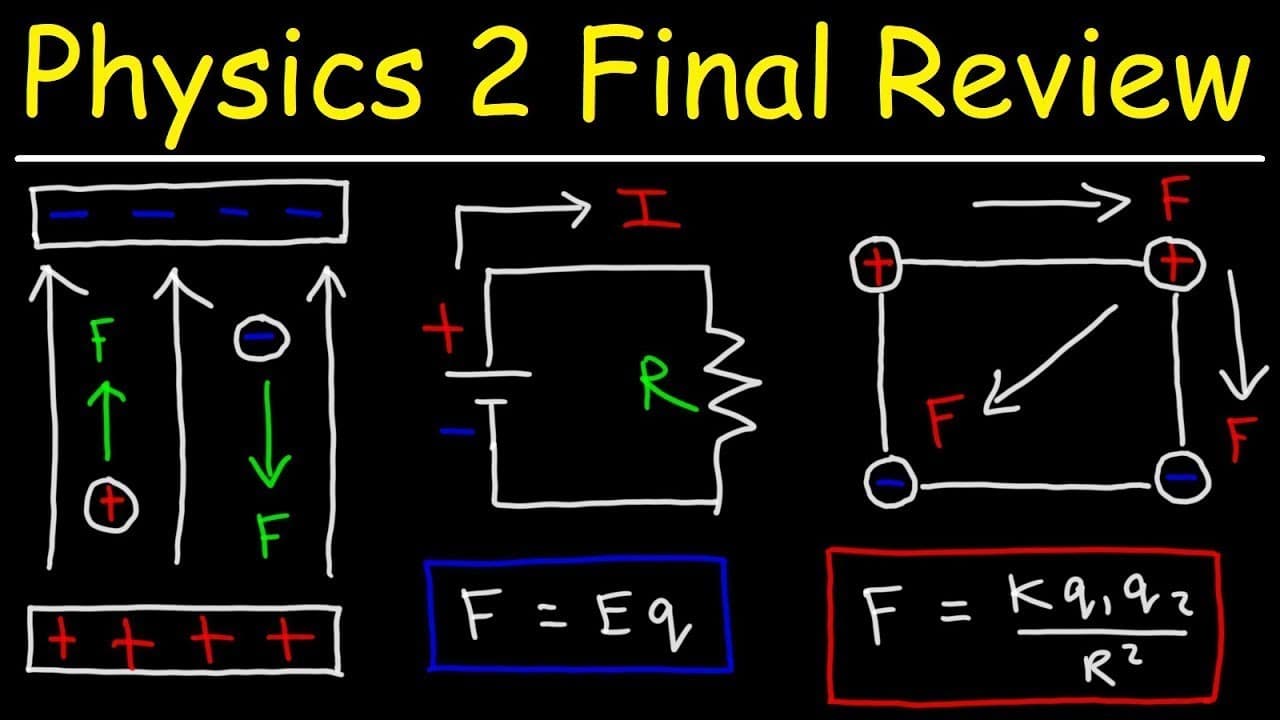
- 🇧🇫 Electric force formula: F = kq1q2/r^2, where F is the force, k is the electrostatic constant, q1 and q2 are the charges, and r is the distance between them.
- 🏑 The electric field strength is inversely related to the square of the distance between two charges.
- 🈂️ Capacitance is a measure of how much charge a capacitor can store when charged by one volt.
- 🏑 The direction of the force exerted on a charge by an electric field depends on the sign of the charge and the direction of the field.
- 🍽️ Doubling the area of the plates in a parallel-plate capacitor doubles its capacitance.
- 🈂️ The magnitude of the electric field created by a point charge depends on the charge and the distance from the charge.
- 🔌 The electric potential energy of an object can be calculated by multiplying the charge by the potential difference.
Install to Summarize YouTube Videos and Get Transcripts
Explore YouTube Video Summarizer or Get YouTube Transcript Extractor
Questions & Answers
Q: How can you calculate the net charge of a dust particle given the number of protons and electrons?
The net charge of a dust particle can be calculated by subtracting the number of electrons from the number of protons, then multiplying the difference by the charge of each particle.
Q: What is the formula for calculating the electric force between two point charges?
The formula for electric force is F = kq1q2/r^2, where F is the force, k is the electrostatic constant, q1 and q2 are the charges of the two objects, and r is the distance between them.
Q: How do you calculate the magnitude of the electric field created by a point charge at a given distance?
The magnitude of the electric field created by a point charge can be calculated using the formula E = k*q/r^2, where E is the electric field, k is the electrostatic constant, q is the charge, and r is the distance from the point charge.
Q: How do you calculate the change in potential energy of an electron accelerated through a potential difference?
The change in potential energy can be calculated by multiplying the charge of the electron by the potential difference. The formula is ΔPE = q*ΔV, where ΔPE is the change in potential energy, q is the charge of the electron, and ΔV is the potential difference.
Q: How does capacitance relate to the charge and voltage of a capacitor?
Capacitance is a measure of how much charge a capacitor can store when it is charged by one volt. It is calculated by dividing the charge by the voltage, C = Q/V, where C is the capacitance, Q is the charge, and V is the voltage.
Q: What happens to the electric force between two charges if the magnitude of the charges is tripled and the distance is halved?
The electric force between two charges is proportional to the product of their magnitudes and inversely proportional to the square of the distance between them. If the magnitude of the charges is tripled, the force will be nine times greater. If the distance is halved, the force will be four times greater. Thus, the net effect is a 9 * 4 = 36 times increase in the electric force.
Q: How does the separation distance between two point charges affect the electric field between them?
The strength of the electric field is inversely proportional to the square of the distance between two point charges. As the separation distance increases, the electric field decreases. If the distance is doubled, the electric field is reduced to one-fourth of its original value.
Q: How does the area of the plates in a parallel plate capacitor affect its capacitance?
The capacitance of a parallel plate capacitor is directly proportional to the area of the plates. If the area is doubled, the capacitance will also double. If the area is tripled, the capacitance will triple. The relationship between capacitance and area is linear.
Summary & Key Takeaways
-
The video covers various physics problems, including calculating net charge, electric force, electric field, and electric potential.
-
The video emphasizes the use of formulas and provides step-by-step solutions for each problem.
-
The problems involve manipulating charges, distances, and voltages to determine the magnitude and direction of various physics quantities.
Read in Other Languages (beta)
Share This Summary 📚
Summarize YouTube Videos and Get Video Transcripts with 1-Click
Try YouTube Summary with ChatGPT & Claude or YouTube Transcript Generator
Explore More Summaries from The Organic Chemistry Tutor 📚



Summarize YouTube Videos and Get Video Transcripts with 1-Click
Try YouTube Summary with ChatGPT & Claude or YouTube Transcript Generator