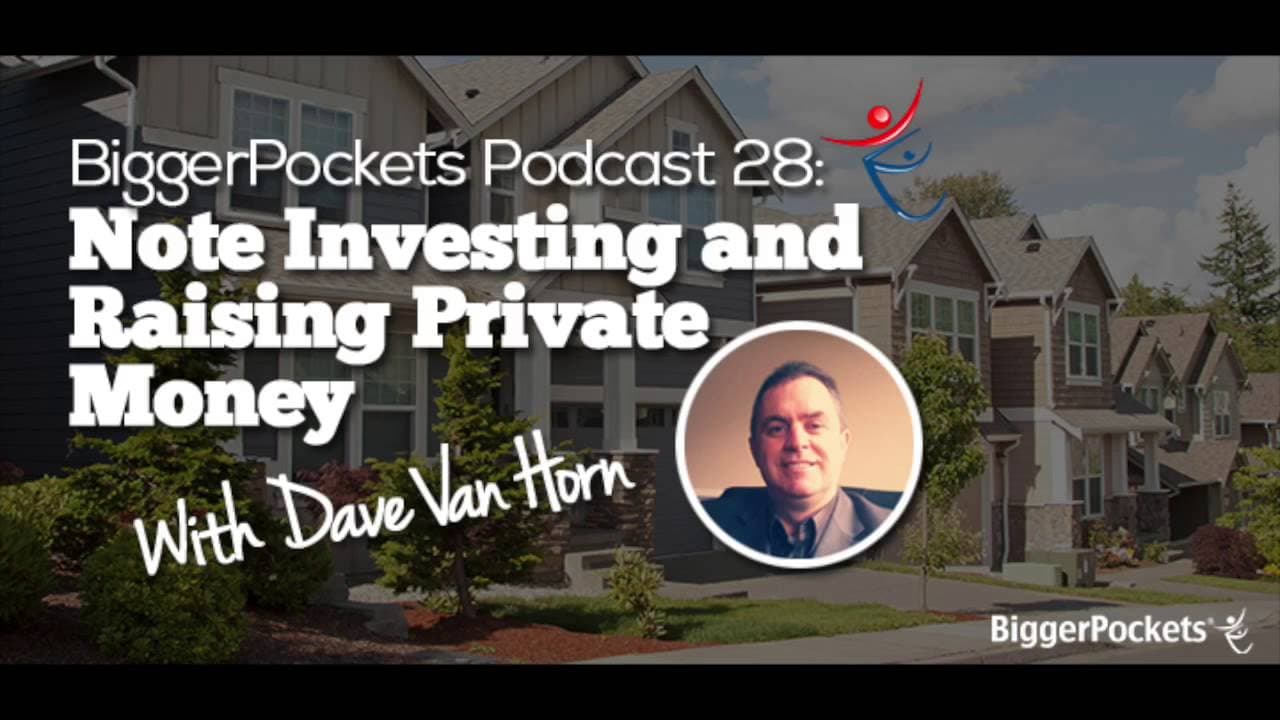
Note Investing and Raising Private Money with Dave Van Horn | BP Podcast 028
TL;DR
Dave Van Horn discusses note investing and raising private money.
Transcript
are you looking to become a better real estate investor then hang on because you're about to experience another episode of the world's most popular real estate podcast the BiggerPockets podcast but before we get to this week's show I wanted to invite you to become part of our community biggerpockets.com the real estate investing social network the ... Read More
Key Insights
- Dave Van Horn shares his journey from construction to real estate, emphasizing the importance of networking and private money in expanding investment opportunities.
- Note investing offers a passive income stream by buying delinquent mortgages at a discount and working out payment plans with borrowers.
- Van Horn highlights the benefits of second mortgages, which are cheaper and can yield significant returns despite being riskier than first mortgages.
- Raising private money is crucial for scaling real estate investments, and Van Horn suggests networking and building a good reputation to attract investors.
- Accredited investors are key targets for raising capital, as they are considered financially savvy and capable of handling investment risks.
- The recent changes in regulations allow general solicitation for investments, but they require strict verification of investors' accredited status.
- Van Horn emphasizes the importance of goal setting and taking action as critical components of successful investing.
- He also discusses the role of property management experience in understanding the real estate market and making informed investment decisions.
Install to Summarize YouTube Videos and Get Transcripts
Explore YouTube Video Summarizer or Get YouTube Transcript Extractor
Questions & Answers
Q: What is note investing?
Note investing involves buying existing loans, often at a discount, and collecting payments from borrowers. It can be a passive income stream, as investors can purchase delinquent mortgages and work out payment plans with borrowers, potentially yielding significant returns.
Q: How did Dave Van Horn start in real estate?
Dave Van Horn began his real estate journey after his mother suggested it when he struggled to find a job post-college. He initially bought properties using credit cards and gradually expanded his portfolio, eventually transitioning to note investing, which he found to be less demanding than property management.
Q: Why are second mortgages considered riskier?
Second mortgages are riskier because they are subordinate to first mortgages, meaning they get paid only after the first mortgage is settled. However, they can be purchased at a significant discount, offering higher potential returns if managed properly.
Q: How can investors raise private money?
Investors can raise private money by networking, building a strong reputation, and targeting accredited investors. Teaching about investing and participating in charitable activities can also attract potential investors, as these avenues demonstrate expertise and commitment.
Q: What are the recent changes in investment solicitation regulations?
Recent changes allow general solicitation for investments, meaning companies can advertise to the public. However, they must verify that investors are accredited, ensuring they meet income or net worth requirements to handle the risks associated with such investments.
Q: What is an accredited investor?
An accredited investor is an individual with a net worth of over $1 million, excluding their primary residence, or an income of $200,000 ($300,000 for joint income) for the last two years. They are deemed financially sophisticated and capable of handling investment risks.
Q: Why is goal setting important in real estate investing?
Goal setting is crucial in real estate investing as it provides direction, helps measure progress, and motivates investors to take action. It enables investors to focus on specific objectives, such as expanding their portfolio or improving their investment strategies.
Q: What role does property management experience play in real estate investing?
Property management experience provides insights into tenant behavior, property maintenance, and market trends, which are essential for making informed investment decisions. It helps investors understand the operational aspects of real estate, leading to more effective management and investment strategies.
Summary & Key Takeaways
-
Dave Van Horn discusses his transition from construction to real estate investing, highlighting the role of networking and private money in his success. He emphasizes the potential of note investing as a passive income stream, offering insights into buying delinquent mortgages at a discount.
-
Van Horn explains the advantages of second mortgages, which, despite their higher risk, can be bought cheaply and yield significant returns. He also provides strategies for raising private money, focusing on networking and building a solid reputation to attract accredited investors.
-
The podcast delves into the recent changes in regulations allowing general solicitation for investments, requiring strict verification of investors' accredited status. Van Horn stresses the importance of goal setting, taking action, and property management experience in successful real estate investing.
Read in Other Languages (beta)
Share This Summary 📚
Summarize YouTube Videos and Get Video Transcripts with 1-Click
Try YouTube Summary with ChatGPT & Claude or YouTube Transcript Generator
Explore More Summaries from BiggerPockets 📚





Summarize YouTube Videos and Get Video Transcripts with 1-Click
Try YouTube Summary with ChatGPT & Claude or YouTube Transcript Generator