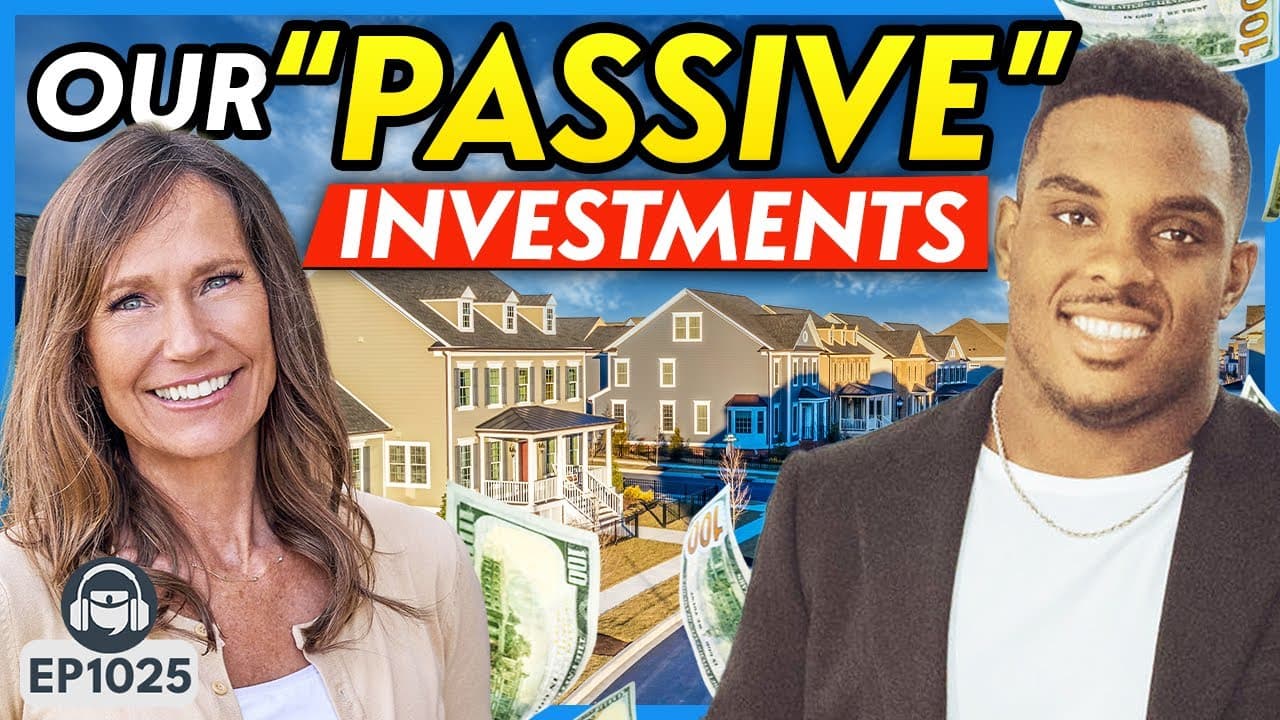
Our Favorite Real Estate Investments for “Passive” Income
TL;DR
Explores active vs passive real estate investing and their benefits.
Transcript
real estate investing is a grind we love it sure but it's definitely a grind finding deals negotiating with sellers fetting tenants repairing properties it all adds up to a lot of time and effort to generate the cash flow that you want and need but there's another way to invest in real estate passive investing that can be as simple as putting your ... Read More
Key Insights
- Active real estate investing involves hands-on management and effort, such as flipping houses or managing rentals, requiring time and skill.
- Passive investing is less hands-on, often involving investing in funds or syndications, offering potentially lower returns but requiring minimal effort.
- Busy professionals or those with limited time may benefit from passive investing to grow wealth without sacrificing their primary career.
- Active investing might provide higher returns but requires significant time, effort, and expertise, suitable for those seeking a career in real estate.
- Many investors start actively to learn the market and then transition to passive investing as they accumulate capital and experience.
- Passive investing allows investors to maintain other careers while still participating in real estate markets, leveraging capital without direct management.
- The spectrum of investing ranges from highly active (e.g., flipping) to extremely passive (e.g., REITs), and individuals can choose based on their time, capital, and interest.
- Strategies like 'delayed cosmetic Burr' allow for gradual property improvement and refinancing, offering a balance between active management and passive returns.
Install to Summarize YouTube Videos and Get Transcripts
Explore YouTube Video Summarizer or Get YouTube Transcript Extractor
Questions & Answers
Q: What is the main difference between active and passive real estate investing?
Active real estate investing involves direct management and effort, such as flipping houses or managing rental properties. It requires significant time, skill, and involvement. In contrast, passive investing involves placing money in funds or syndications, requiring minimal effort and offering potentially lower returns but with less hands-on management.
Q: Who should consider passive real estate investing?
Passive real estate investing is ideal for busy professionals or individuals with limited time who wish to grow their wealth without sacrificing their primary career. It allows them to participate in real estate markets by leveraging capital without the need for direct management or involvement in day-to-day operations.
Q: What are the potential downsides of passive investing?
The primary downside of passive investing is that it may yield lower returns compared to active investing, as investors often give up some percentage of returns for the convenience of not managing the investment directly. Additionally, passive investing requires access to capital, as investors cannot trade time for money like in active investing.
Q: Why might someone choose active real estate investing?
Active real estate investing might be chosen by individuals who have more time, enjoy hands-on management, and are passionate about real estate. It is suitable for those who want to make real estate a career or who seek higher returns by being directly involved in the management and improvement of properties.
Q: How can one transition from active to passive investing?
Many investors start with active investing to learn the market and accumulate capital. Over time, as they gain experience and financial resources, they can transition to passive investing by placing their capital into funds or syndications, allowing them to enjoy returns without direct involvement, thus freeing up their time.
Q: What is a 'delayed cosmetic Burr' strategy in real estate investing?
The 'delayed cosmetic Burr' strategy involves buying a stabilized property that is cash-flowing and gradually renovating it one unit at a time as tenants move out. This allows for opportunistic improvements and refinancing without the urgency of a traditional Burr, balancing active management with passive returns.
Q: What are some examples of passive real estate investments?
Examples of passive real estate investments include investing in real estate investment trusts (REITs), participating in syndications, investing in funds, buying notes, or engaging in turnkey rental property investing where properties are managed by others, requiring minimal involvement from the investor.
Q: What active investment strategy is Devon Kennard excited about?
Devon Kennard is excited about his private lending company, which allows him to earn higher returns by being slightly more active. He focuses on building infrastructure to manage the business efficiently, aiming to balance active involvement with the benefits of passive income, achieving returns between 16% to 18%.
Summary & Key Takeaways
-
The podcast discusses the differences between active and passive real estate investing, highlighting the pros and cons of each. Active investing requires more time and effort but can yield higher returns. Passive investing suits those with less time, offering a simpler way to earn returns through funds or syndications.
-
Devon Kennard and Kathy Fettke share their experiences with both investing styles. Devon emphasizes investing passively during his NFL career, while Kathy discusses her active and passive investments. Both stress the importance of aligning investment strategies with personal goals and time availability.
-
The conversation covers who should choose active or passive investing based on their lifestyle and career goals. It also provides insights into specific investment strategies, such as note investing and build-to-rent, offering listeners practical advice on structuring their real estate portfolios.
Read in Other Languages (beta)
Share This Summary 📚
Summarize YouTube Videos and Get Video Transcripts with 1-Click
Try YouTube Summary with ChatGPT & Claude or YouTube Transcript Generator
Explore More Summaries from BiggerPockets 📚





Summarize YouTube Videos and Get Video Transcripts with 1-Click
Try YouTube Summary with ChatGPT & Claude or YouTube Transcript Generator