Lecture 07
TL;DR
Explains portfolio theory, CAPM, and asset pricing models.
Transcript
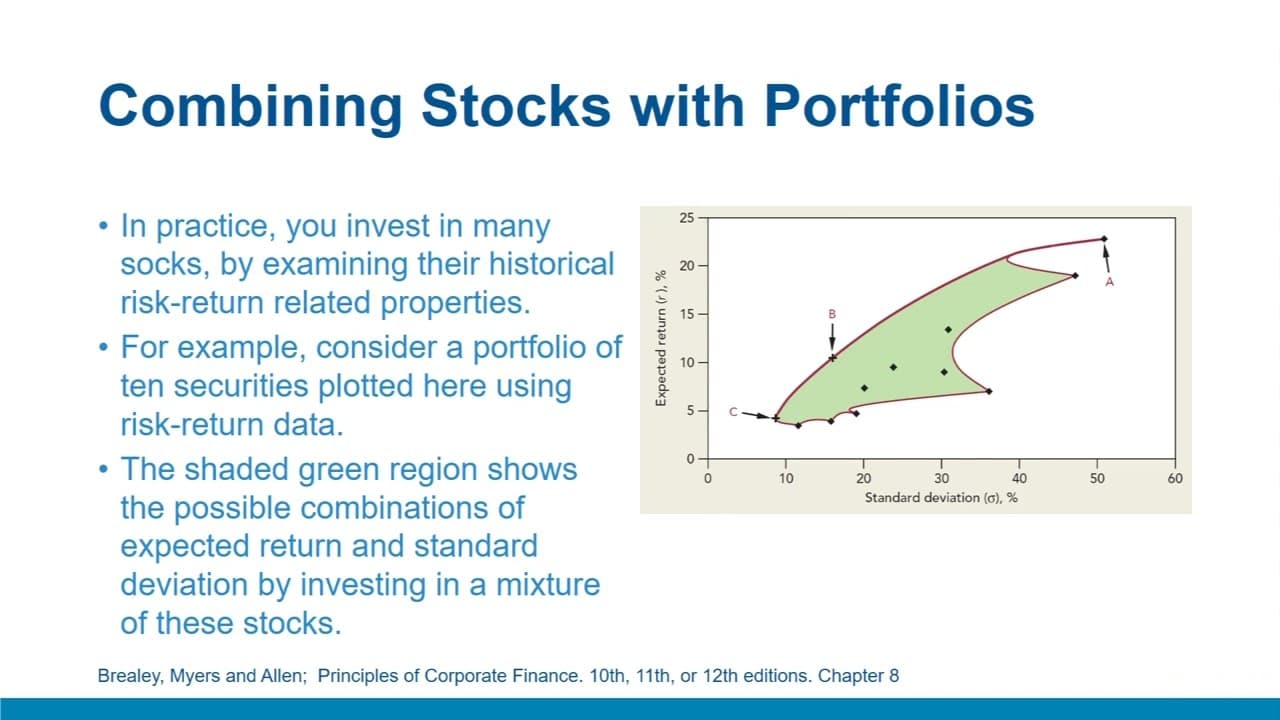
thank you portfolio Theory and capital asset pricing model stock market is considered risky because there is a possibility of multiple outcomes the spread in these multiple outcomes is measured using variance or standard deviation this variance or standard deviation spreads has two components first stock specific or diversifiable risk this risk is ... Read More
Key Insights
- The stock market is considered risky due to the variance in potential outcomes, which can be divided into diversifiable and market risks.
- Diversification helps reduce stock-specific risk but not market risk, with beta being a key measure of a stock's sensitivity to market movements.
- Normal distribution is crucial in modeling security returns, as it simplifies the assessment of expected returns and standard deviation.
- Efficient portfolios offer the best combination of risk and return, and are identified using concepts like the efficient frontier and Sharpe ratio.
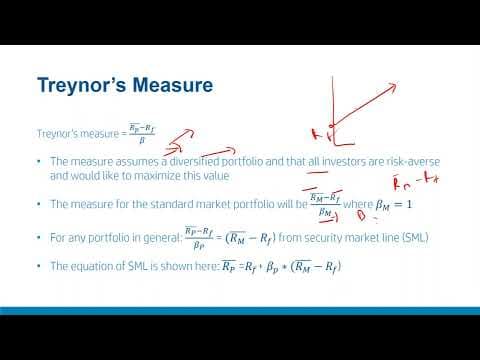
- The Capital Asset Pricing Model (CAPM) is used to determine the risk-return relationship, emphasizing the importance of beta in estimating expected returns.
- Critiques of CAPM highlight discrepancies in real-world scenarios, such as size and value premiums that CAPM doesn't fully explain.
- Alternative models like Arbitrage Pricing Theory (APT) and the Fama-French three-factor model aim to address CAPM's limitations by incorporating additional risk factors.
- Investors seek to maximize expected returns while minimizing risk, with the best portfolios often being a mix of market portfolios and risk-free instruments.
Install to Summarize YouTube Videos and Get Transcripts
Explore YouTube Video Summarizer or Get YouTube Transcript Extractor
Questions & Answers
Q: What are the two main components of risk in the stock market?
The two main components of risk in the stock market are diversifiable risk, which is specific to individual stocks, and market risk, which is related to the overall market movements. Diversifiable risk can be mitigated through diversification, while market risk affects all stocks and is measured by a stock's beta, indicating its sensitivity to market changes.
Q: How does diversification impact portfolio risk?
Diversification reduces portfolio risk by spreading investments across various assets, thereby minimizing the impact of stock-specific or diversifiable risk. However, it does not eliminate market risk, which affects all stocks. The degree of diversification's effectiveness depends on the correlation between assets; lower correlation generally leads to greater risk reduction.
Q: Why is normal distribution important in modeling security returns?
Normal distribution is important in modeling security returns because it is defined by two parameters: mean (expected return) and standard deviation (risk). This simplifies the process of assessing investment performance, as investors can rely on these two measures to evaluate securities. Normal distribution also provides a framework for predicting future returns based on historical data.
Q: What is the efficient frontier in portfolio theory?
The efficient frontier is a concept in portfolio theory that represents a set of optimal portfolios offering the highest expected return for a given level of risk or the lowest risk for a given level of return. Portfolios on the efficient frontier are considered efficient because they maximize returns while minimizing risk, and are a key focus for investors seeking optimal investment strategies.
Q: How does CAPM determine the expected return on a security?
CAPM determines the expected return on a security by relating it to the risk-free rate, the security's beta, and the market risk premium. The formula is: Expected Return = Risk-Free Rate + Beta * (Market Return - Risk-Free Rate). This model assumes that the expected return on a security is proportional to its systematic risk, as measured by beta.
Q: What are the limitations of CAPM in real-world scenarios?
CAPM's limitations in real-world scenarios include its inability to account for size and value premiums, where small-cap and value stocks often yield higher returns than predicted by CAPM. The model also assumes that investors have homogeneous expectations and can borrow and lend at the risk-free rate, which may not hold true in practice. Additionally, CAPM's reliance on beta as the sole risk measure may oversimplify complex market dynamics.
Q: What are some alternative models to CAPM?
Alternative models to CAPM include the Arbitrage Pricing Theory (APT) and the Fama-French three-factor model. APT considers multiple macroeconomic factors affecting stock returns, while the Fama-French model incorporates size and value factors in addition to the market factor. These models aim to provide a more comprehensive framework for asset pricing by addressing CAPM's limitations and capturing additional risk dimensions.
Q: How do investors use the Sharpe ratio in portfolio management?
Investors use the Sharpe ratio to evaluate the risk-adjusted performance of a portfolio by measuring the excess return per unit of risk. It is calculated as the difference between the portfolio's return and the risk-free rate, divided by the portfolio's standard deviation. A higher Sharpe ratio indicates a more favorable risk-return tradeoff, guiding investors in selecting efficient portfolios that maximize returns for a given level of risk.
Summary & Key Takeaways
-
The content discusses the fundamentals of portfolio theory and the Capital Asset Pricing Model (CAPM), focusing on risk components, diversification, and the importance of beta in assessing market risk. It explains how efficient portfolios are constructed and evaluated using the efficient frontier and Sharpe ratio.
-
CAPM's role in determining the risk-return relationship is examined, highlighting its reliance on beta as a measure of systematic risk. The content also addresses critiques of CAPM, such as the existence of size and value premiums, and introduces alternative models like Arbitrage Pricing Theory and the Fama-French three-factor model.
-
The discussion emphasizes investors' goals of maximizing returns while minimizing risk, suggesting optimal portfolio strategies that involve a combination of market portfolios and risk-free instruments. It concludes with insights into the limitations of CAPM and the potential of alternative asset pricing models to provide a more comprehensive understanding of market dynamics.
Read in Other Languages (beta)
Share This Summary 📚
Summarize YouTube Videos and Get Video Transcripts with 1-Click
Try YouTube Summary with ChatGPT & Claude or YouTube Transcript Generator
Explore More Summaries from IIT KANPUR-NPTEL 📚



Summarize YouTube Videos and Get Video Transcripts with 1-Click
Try YouTube Summary with ChatGPT & Claude or YouTube Transcript Generator