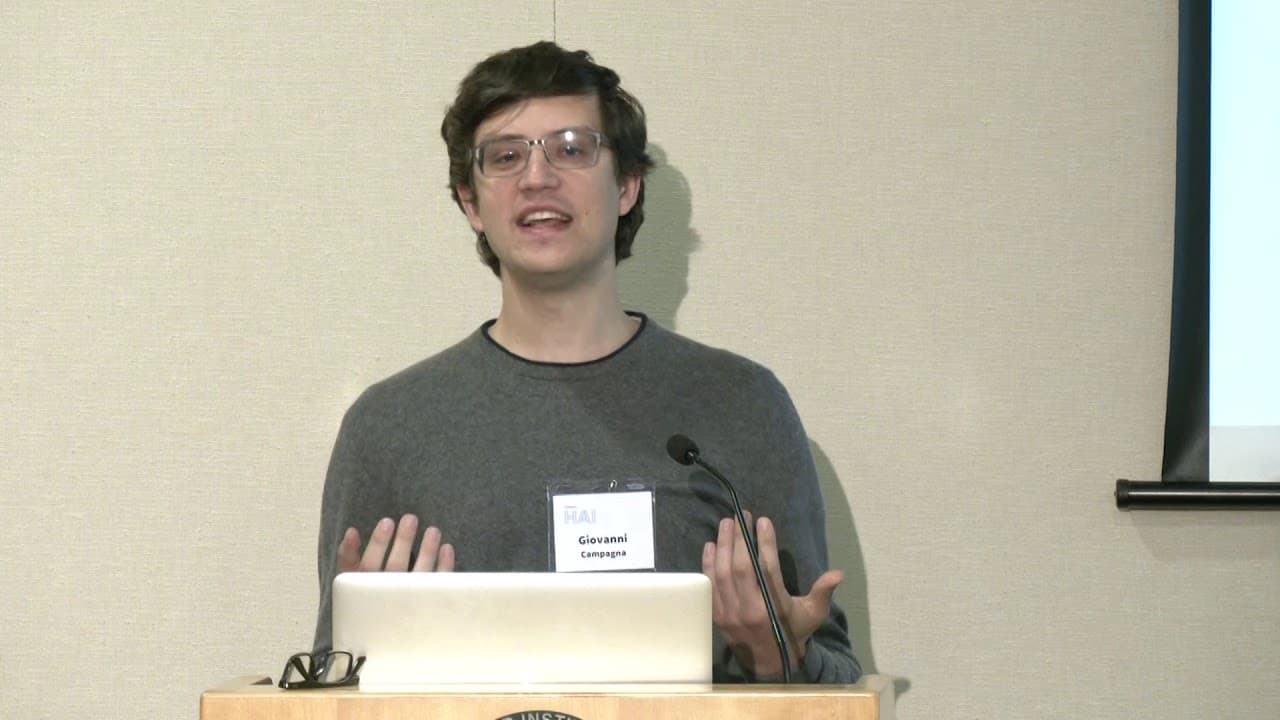
Stanford HAI OVAL: Privacy - Giovanni Campagna
TL;DR
Almond is a virtual assistant that allows users to share data securely and easily by providing fine-grained control over access.
Transcript
we have heard about the idea of a digital guardian angel that helps us with our privacy decision and maybe that digital guardian angel can be of its own assistant and it can help us share and this is joint work with my colleagues here at Stanford and adviser Monica and it was presented at the ubiquitous and computing ambiguous computing conference ... Read More
Key Insights
- 🛀 Almond's fine-grained control over data sharing improves user comfort and willingness to share sensitive assets, as shown in a survey with 200 participants.
- 👤 The ThinkTalk policy construct used by Almond is understandable and covers a wide range of user preferences, as demonstrated by 85% of collected use cases being represented accurately.
- ❓ Almond's performance in natural language understanding and paraphrasing is promising, achieving 82% accuracy on realistic crowdsourced policies.
Install to Summarize YouTube Videos and Get Transcripts
Explore YouTube Video Summarizer or Get YouTube Transcript Extractor
Questions & Answers
Q: How does Almond address the issue of sharing data from IoT devices or services like bank accounts?
Almond provides fine-grained control over data sharing, allowing users to define who, when, where, and what can be shared. This eliminates the need to share usernames and passwords, ensuring privacy and security.
Q: How does Almond ensure that only authorized access is granted?
Almond acts as a trusted agent, mediating data access requests. This means that only the allowed access is provided, and no third party can see the data being shared. It guarantees privacy and protects sensitive information.
Q: How does Almond combine natural language programming with access control?
Almond uses a high-level language called ThingTalk, which can be translated both from natural language to code and from code to natural language. This enables users to generate permission requests in a format that is easy to understand and execute.
Q: How does Almond determine if a program is allowed or not?
Almond uses satisfiability modular theories to check if two logical formulas, representing the program and the policy, are entailed. It also computes the largest intersection of the program and the policy, providing a formal guarantee of allowed execution.
Summary & Key Takeaways
-
The traditional methods of data sharing, such as through social media or email, may not be suitable for sharing sensitive data from IoT devices or services like bank accounts. Almond provides a solution by allowing users to share data with fine-grained control.
-
Almond uses a federated architecture that allows virtual assistants to communicate, ensuring privacy and avoiding indirect access to data.
-
The system is designed with natural language programming, making it user-friendly and efficient for sharing data securely.
Read in Other Languages (beta)
Share This Summary 📚
Summarize YouTube Videos and Get Video Transcripts with 1-Click
Try YouTube Summary with ChatGPT & Claude or YouTube Transcript Generator
Explore More Summaries from Stanford 📚



Summarize YouTube Videos and Get Video Transcripts with 1-Click
Try YouTube Summary with ChatGPT & Claude or YouTube Transcript Generator