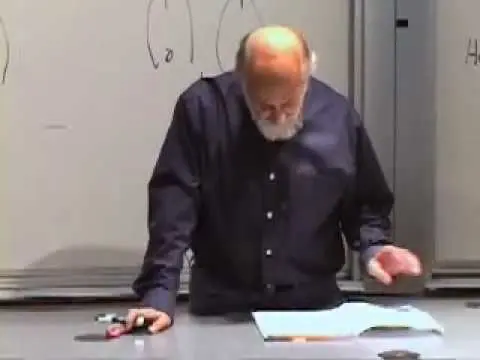
Lecture 5 | Quantum Entanglements, Part 1 (Stanford)

Transcript
this program is brought to you by Stanford University please visit us at stanford.edu first of all I want to show you what difference a sign can make and in particular the sign that occurs we've studied an entangled state of two electrons we could call it up down and then there are two possibilities well there's more than two possibilities but ther... Read More
Install to Summarize YouTube Videos and Get Transcripts
Explore YouTube Video Summarizer or Get YouTube Transcript Extractor
Summary
In this video, we learn about entangled states of two electrons and the difference between the singlet state and the triplet state. We also discuss Bell's theorem and how it relates to quantum mechanics and classical physics. The video introduces the concept of projection operators, which are used to calculate probabilities in quantum mechanics.
Questions & Answers
Q: What is the difference between the singlet state and the triplet state in quantum mechanics?
The singlet state is a state in which the spins of two electrons are perfectly correlated, such that if one spin is measured, the other spin will have the opposite value. The triplet state, on the other hand, is a state in which the spins of two electrons can take on any combination of up and down values, and there is no correlation between them.
Q: How do we calculate the probability for a certain proposition in quantum mechanics?
In quantum mechanics, the probability for a certain proposition can be calculated by constructing a projection operator for that proposition and then calculating its expectation value. The projection operator is an operator that projects onto the eigenvector corresponding to the proposition. The expectation value of the projection operator gives the probability of the proposition being true.
Q: What is Bell's theorem and how does it relate to quantum mechanics and classical physics?
Bell's theorem is a theorem in classical physics that has implications for quantum mechanics. It states that certain inequalities, known as Bell's inequalities, should hold for classical systems. However, quantum mechanics violates these inequalities, suggesting that classical physics cannot explain the behavior of entangled quantum systems. This implies that quantum mechanics is a more fundamental theory than classical physics and that there are aspects of reality that cannot be explained using classical concepts.
Q: What is the significance of the singlet state and the triplet state in quantum entanglement?
The singlet state and the triplet state represent two different types of correlation between the spins of entangled particles. In the singlet state, the spins of two particles are perfectly correlated, such that if one spin is up, the other spin is guaranteed to be down. This type of correlation is known as Einstein-Podolsky-Rosen (EPR) correlation and has important implications for quantum information processing. The triplet state, on the other hand, represents a situation where the spins are not perfectly correlated and can take on any combination of up and down values.
Q: How do we calculate the expectation value of a projection operator in quantum mechanics?
The expectation value of a projection operator can be calculated by taking the inner product of the projection operator with the state vector and then multiplying by the complex conjugate of the state vector. This gives the probability of the projection operator being true for the given state.
Q: How does the singlet state violate Bell's inequalities?
Bell's inequalities are a set of inequalities that are derived based on assumptions of classical physics. The singlet state violates these inequalities because the correlations between the spins of entangled particles in the singlet state cannot be explained using classical concepts. This violation is a key characteristic of quantum entanglement and has been experimentally observed.
Q: Can the singlet state be used to send information faster than the speed of light?
No, the singlet state cannot be used to send information faster than the speed of light. While there are correlations between the spins of entangled particles in the singlet state, these correlations cannot be used to transmit information instantaneously. Any measurement of the spin of one particle will not immediate-ly affect the spin of the other particle, so there is no violation of causality.
Q: What is the difference between an eigenvector and an expectation value in quantum mechanics?
In quantum mechanics, an eigenvector is a vector that represents a quantum state that has a definite value of a certain observable. The expectation value, on the other hand, is the average value of an observable when the system is in a certain quantum state. The expectation value is calculated by taking the inner product of the state vector with the operator corresponding to the observable and then multiplying by the complex conjugate of the state vector.
Q: How does the projection operator relate to measuring properties in quantum mechanics?
The projection operator is used to calculate the probability of a certain property being true in quantum mechanics. By acting on a state vector with a projection operator, the part of the vector that corresponds to the desired property is isolated and its squared magnitude gives the probability of the property being true. This allows us to measure properties in quantum mechanics.
Q: What is the significance of Bell's theorem for our understanding of quantum mechanics?
Bell's theorem has important implications for our understanding of quantum mechanics and its relationship to classical physics. It shows that there are fundamental differences between classical and quantum systems and suggests that quantum mechanics provides a more accurate and complete description of nature. The violation of Bell's inequalities by entangled quantum systems demonstrates the existence of non-local correlations that cannot be explained using classical concepts. This has profound implications for fields such as quantum information processing and cryptography.
Q: How do projection operators correspond to classical logic in quantum mechanics?
In classical logic, statements can be represented by subsets of a set. Similarly, in quantum mechanics, projection operators correspond to statements about properties of a system. The set in classical logic is analogous to the vector space in quantum mechanics, and the intersection and union of subsets correspond to projection operators that can be added and combined. The use of projection operators allows us to mathematically describe and calculate properties in quantum mechanics using classical logic concepts.
Takeaways
In this video, we learned about entangled states of two electrons and the difference between the singlet state and the triplet state. We also discussed Bell's theorem and how it relates to quantum mechanics and classical physics. The concept of projection operators was introduced, which are used to calculate probabilities in quantum mechanics. Bell's theorem shows that there are fundamental differences between classical and quantum systems, and the violation of Bell's inequalities by quantum systems demonstrates the existence of non-local correlations. This has important implications for our understanding of quantum mechanics and its potential applications.
Read in Other Languages (beta)
Share This Summary 📚
Summarize YouTube Videos and Get Video Transcripts with 1-Click
Try YouTube Summary with ChatGPT & Claude or YouTube Transcript Generator
Explore More Summaries from Stanford 📚

Summarize YouTube Videos and Get Video Transcripts with 1-Click
Try YouTube Summary with ChatGPT & Claude or YouTube Transcript Generator