RLC Circuits (7 of 19) Series RL; An Explanation, Voltage, Impedance, Phasor Diagrams
TL;DR
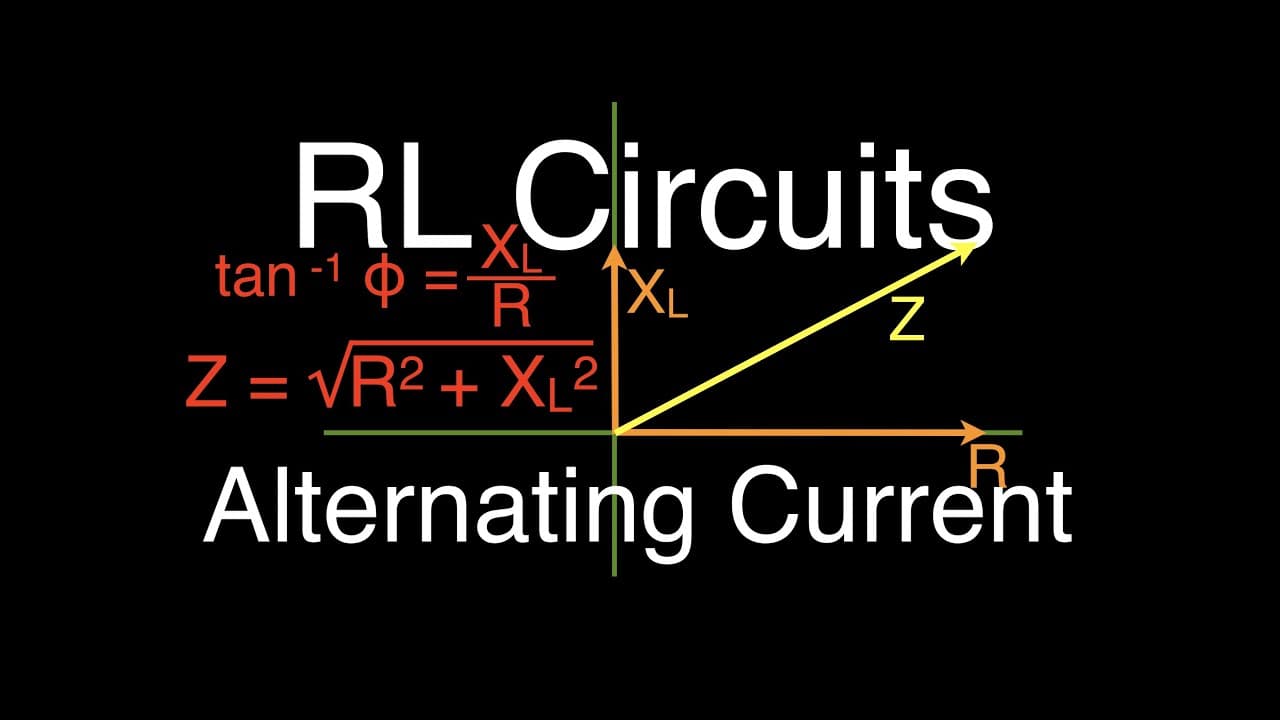
Learn how to draw phasor diagrams, calculate voltage impedance, and understand phase angles in RL circuits.
Transcript
okay today's video is entitled AC inductive reactance part 2 and we're going to go over conceptually voltage impedance and phasor diagrams for our L circuits in the next video I will go over some work examples but this is the basic circuit diagram that we're going to be using for this video we have an RL circuit we have a resistor R and inductor L ... Read More
Key Insights
- 🦻 Phasor diagrams aid in visualizing voltage relationships in RL circuits.
- ⚡ Source voltage in RL circuits is calculated using vector addition and Pythagorean theorem.
- 💐 Impedance is the total opposition to current flow, incorporating resistances and reactances.
- ⚡ Phase angles indicate the relationship between voltage and current in RL circuits.
- 🔙 Understanding phasor diagrams and impedance is crucial for analyzing complex AC circuits.
- ⚡ Pythagorean theorem is used to calculate source voltage in RL circuits.
- 💐 Impedance triangle helps determine the total opposition to current flow in an AC circuit.
Install to Summarize YouTube Videos and Get Transcripts
Explore YouTube Video Summarizer or Get YouTube Transcript Extractor
Questions & Answers
Q: What is the significance of drawing phasor diagrams in RL circuits?
Phasor diagrams help visualize the relationship between voltage and current in resistive and inductive components, aiding in calculations and analysis of RL circuits.
Q: How is source voltage calculated in an RL circuit?
Source voltage is calculated by adding voltage vectors of resistor and inductor using the Pythagorean theorem, with the resultant vector representing the source voltage.
Q: What is the phase angle, and how is it determined in RL circuits?
The phase angle is the angle by which voltage leads current in an RL circuit, calculated using trigonometry functions like arctangent based on voltage values across resistor and inductor.
Q: Why is impedance important in AC circuits?
Impedance represents total opposition to current flow in AC circuits, incorporating resistances and reactances to provide a comprehensive understanding of circuit behavior.
Summary & Key Takeaways
-
Discusses how to draw phasor diagrams for voltage across resistors and inductors in RL circuits.
-
Explains how to calculate source voltage using Pythagorean theorem.
-
Demonstrates how to calculate impedance and phase angles in RL circuits.
Read in Other Languages (beta)
Share This Summary 📚
Summarize YouTube Videos and Get Video Transcripts with 1-Click
Try YouTube Summary with ChatGPT & Claude or YouTube Transcript Generator
Explore More Summaries from Step by Step Science 📚




Summarize YouTube Videos and Get Video Transcripts with 1-Click
Try YouTube Summary with ChatGPT & Claude or YouTube Transcript Generator