Pentagons and the Golden Ratio - Numberphile
TL;DR
Ptolemy's theorem showcases the elegance of geometry with equilateral and regular pentagons, revealing the golden ratio.
Transcript
So, what is the simplest and most beautiful triangle in the world, Brady? (Brady: Ohh...) (The Bermuda Triangle?) Well... [Brady laughs]
- Is it of the, type of triangle that I'm thinking of? (Brady: I couldn't think of another famous triangle.) (You mean an equilateral triangle.) Equilateral triangle. That's what I'm thinking of. Well, there we go... Read More
Key Insights
- 🟰 Equilateral triangles inscribed in circles demonstrate equal segment relationships through Ptolemy's theorem.
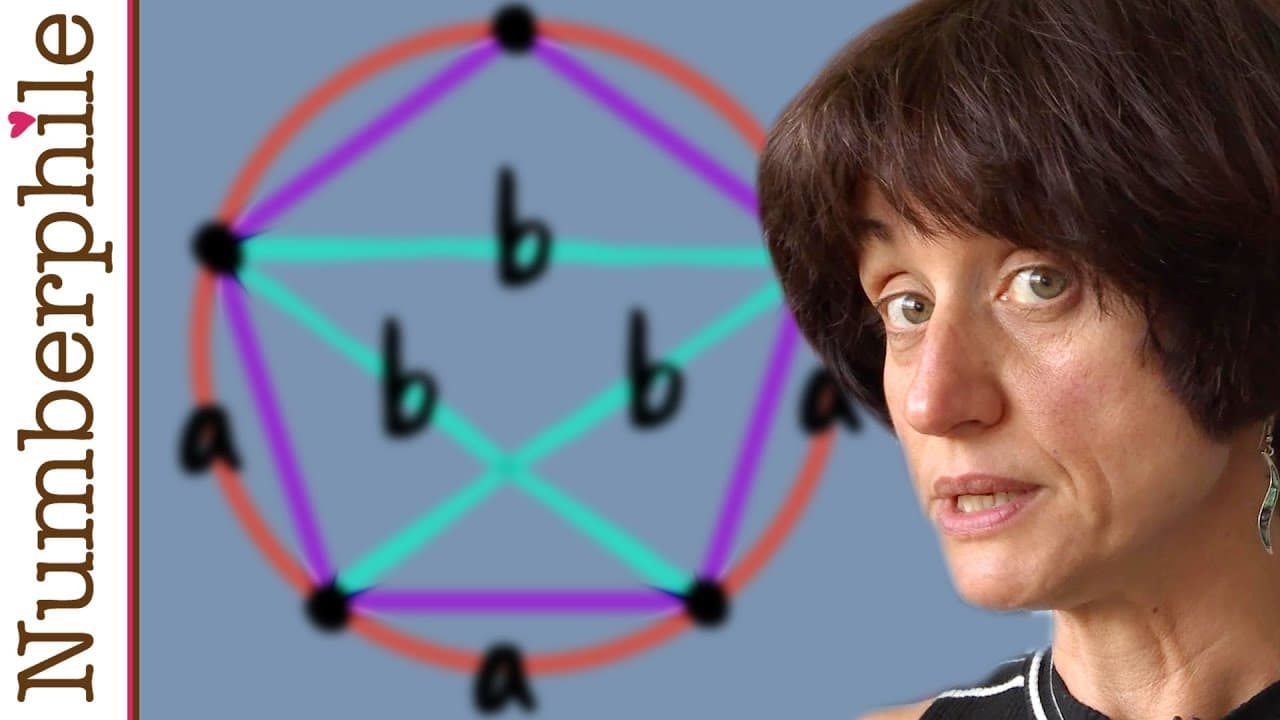
- 🙃 Regular pentagons inscribed in circles reveal the golden ratio relationship among diagonals and sides.
- 🤩 Quadrilaterals play a key role in applying Ptolemy's theorem to solve geometric problems efficiently.
- ❓ The elegance and simplicity of Ptolemy's theorem shine in explaining geometric properties of complex figures.
- 🥳 Understanding the concept of ratios and proportions leads to revealing mathematical patterns like the golden ratio.
- 💠 Ptolemy's theorem can be applied creatively to illustrate connections between sides, diagonals, and vertices in various shapes.
- ❓ Exploring geometric theorems like Ptolemy's enhances mathematical problem-solving skills and fosters a deeper appreciation for geometry.
Install to Summarize YouTube Videos and Get Transcripts
Explore YouTube Video Summarizer or Get YouTube Transcript Extractor
Questions & Answers
Q: How does Ptolemy's theorem demonstrate the relationship between segments in an equilateral triangle inscribed in a circle?
Ptolemy's theorem proves that the sum of two smaller segments in an equilateral triangle is equal to the longer segment by using a quadrilateral and opposite sides' product equality.
Q: In the context of regular pentagons, what does Ptolemy's theorem reveal about the ratio of diagonals to sides?
Ptolemy's theorem shows that the ratio of any diagonal to a side in a regular pentagon results in the golden ratio, explaining the geometric properties of pentagons.
Q: Why is the golden ratio significant in geometry, and how does Ptolemy's theorem establish this relationship?
The golden ratio is a fundamental proportion found in nature and art, and Ptolemy's theorem proves that in regular pentagons, any diagonal divided by a side yields this unique value, showcasing the beauty of mathematics.
Q: What is the importance of using Ptolemy's theorem in solving geometric problems involving triangles and pentagons?
Ptolemy's theorem offers a simple and elegant approach to solving complex geometric puzzles by utilizing the properties of quadrilaterals and opposite sides' products, providing insight into triangle and pentagon relationships.
Summary & Key Takeaways
-
Equilateral triangles inscribed in a circle show that the sum of two smaller segments is equal to the longer segment using Ptolemy's theorem.
-
Regular pentagons inscribed in a circle demonstrate that the ratio of any diagonal to a side yields the golden ratio, derived from a quadratic equation.
-
Ptolemy's theorem simplifies complex geometric problems elegantly, offering insights into triangle and pentagon properties.
Read in Other Languages (beta)
Share This Summary 📚
Summarize YouTube Videos and Get Video Transcripts with 1-Click
Try YouTube Summary with ChatGPT & Claude or YouTube Transcript Generator
Explore More Summaries from Numberphile 📚



Summarize YouTube Videos and Get Video Transcripts with 1-Click
Try YouTube Summary with ChatGPT & Claude or YouTube Transcript Generator