Bohr Model (2 of 7) Calculate the Wavelength of Light Emitted
TL;DR
Determine the wavelength of light emitted in the hydrogen atom's Lyman series transition using energy level diagrams and equations.
Transcript
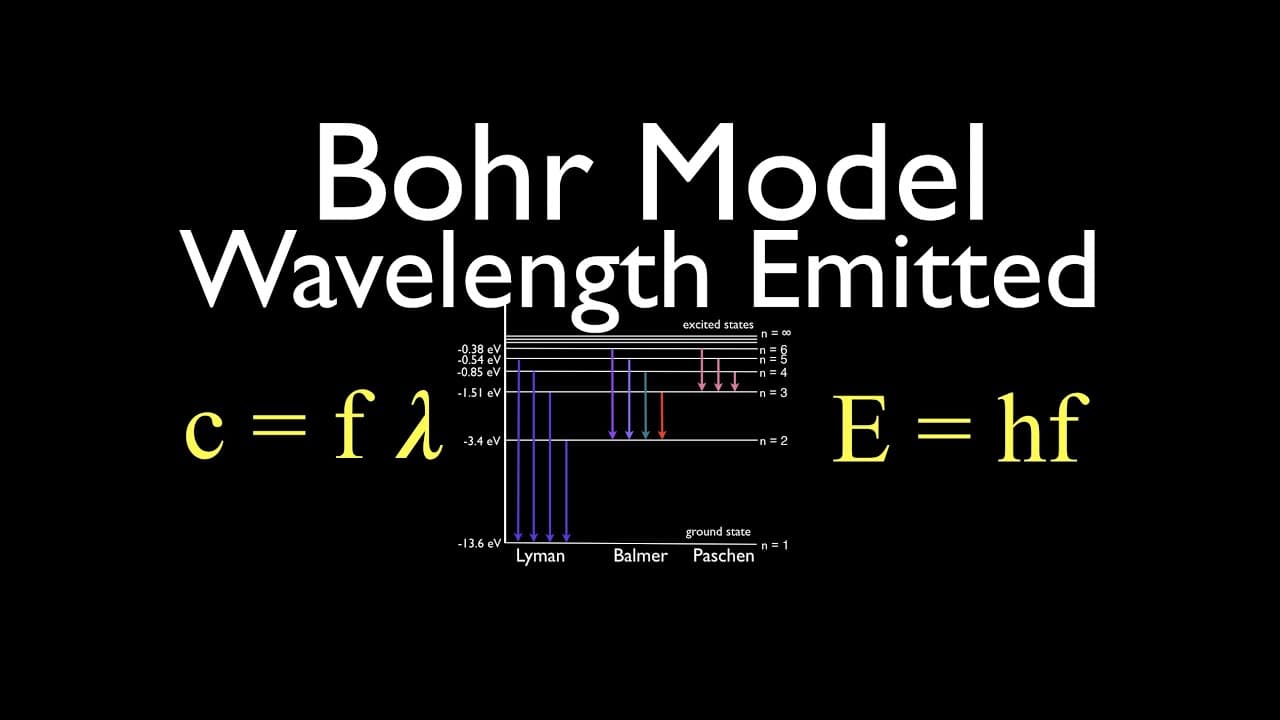
okay in today's video we're gonna go over a problem involving the Bohr model the Bohr model energy level diagram for hydrogen in the emission spectrum for the hydrogen atom when we go over my transition from n2 down to the ground state before do that actually mind you please don't forget to subscribe to my channel click on that red button down here... Read More
Key Insights
- 🙂 Energy level differences determine emitted light wavelengths.
- ❓ Conversion of energy to frequency is crucial in calculating wavelengths.
- 🦻 Rydberg constant equation aids in wavelength calculations for specific transitions.
- 🫥 Different series like Lyman, Balmer, and Paschen offer unique spectral lines.
- 🈸 Understanding energy transitions is essential for spectroscopy applications.
- 🧑🏭 Conversion factors for energy units facilitate accurate wavelength calculations.
- ❓ Utilizing multiple equations enhances the precision of wavelength determinations.
Install to Summarize YouTube Videos and Get Transcripts
Explore YouTube Video Summarizer or Get YouTube Transcript Extractor
Questions & Answers
Q: How do you determine the energy level difference for a transition in the hydrogen atom?
The energy level difference is calculated by subtracting the energy of the initial state from the energy of the final state. In this case, transitioning from n=2 to n=1 yields a difference of 10.2 electron volts.
Q: What equations are used to convert energy to frequency and wavelength?
To convert energy to frequency, you use the equation E = hf, where E is energy, h is Planck's constant, and f is frequency. To convert frequency to wavelength, you use the equation c = λν, where c is the speed of light, λ is wavelength, and ν is frequency.
Q: How is the Rydberg constant equation applied to calculate the wavelength?
The Rydberg constant equation, 1/λ = R(1/n1^2 - 1/n2^2), is used for transitions in the hydrogen atom. For the Lyman series transition from n=2 to n=1, the calculation results in a wavelength of 122 nanometers.
Q: What is the significance of different energy transitions in the hydrogen atom?
Different energy transitions such as Lyman, Balmer, and Paschen series represent electron movements to specific energy levels. Each series corresponds to specific wavelength emissions, providing insight into atomic structure.
Summary & Key Takeaways
-
Calculate energy level difference for n2 to n1 in the hydrogen atom.
-
Convert energy to frequency, then to wavelength in nanometers.
-
Use Rydberg constant equation for wavelength calculation, obtaining 122 nanometers.
Read in Other Languages (beta)
Share This Summary 📚
Summarize YouTube Videos and Get Video Transcripts with 1-Click
Try YouTube Summary with ChatGPT & Claude or YouTube Transcript Generator
Explore More Summaries from Step by Step Science 📚


Summarize YouTube Videos and Get Video Transcripts with 1-Click
Try YouTube Summary with ChatGPT & Claude or YouTube Transcript Generator