A Colorful Unsolved Problem - Numberphile
TL;DR
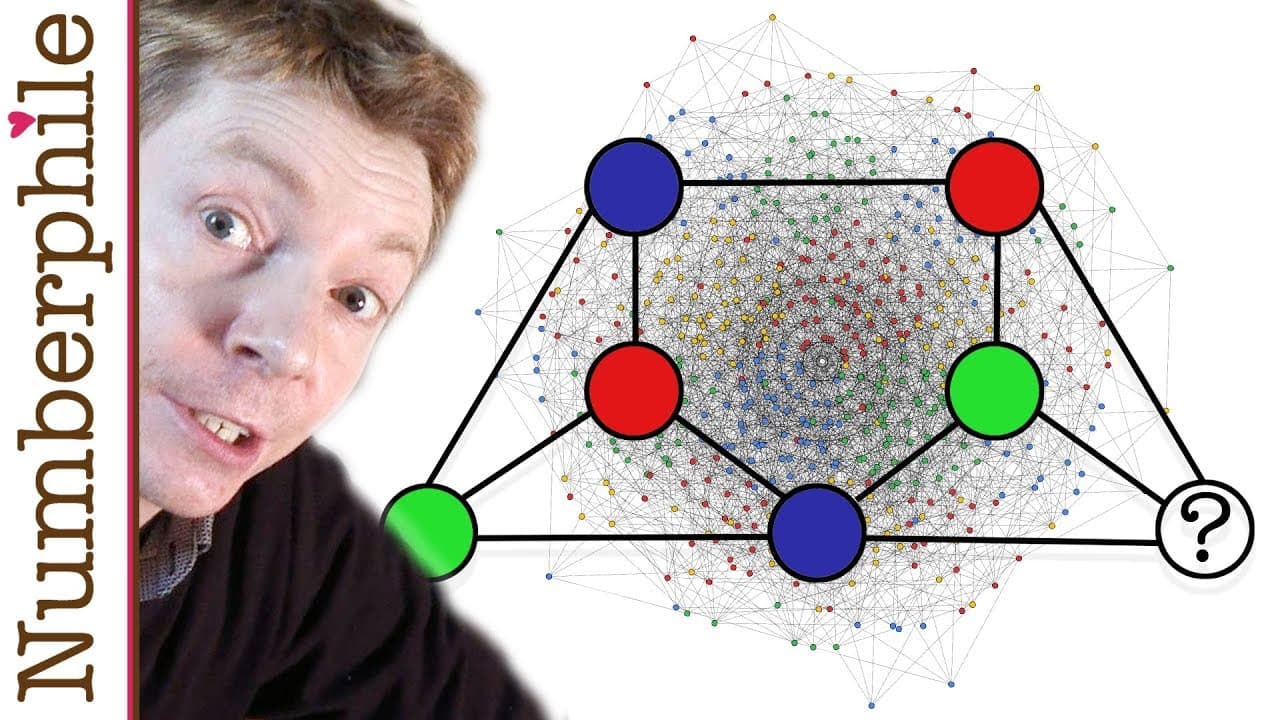
Can the plane be colored so that no two points at a unit distance are the same color?
Transcript
There's been an advance in a sixty-year-old Math's problem, a maths problem which was Related to the four color theorem Which is something I've mentioned before, perhaps I should do a quick recap of what the four color theorem was. It's a similar sort of thing really. Before color theorem said, imagine you had a map Right, and I'm just going to mak... Read More
Key Insights
- 😥 The Hadwiger-Nelson problem involves colorings on an infinite plane to prevent same-colored neighboring points at a unit distance.
- 🛀 Initial solutions required seven colors, but recent advancements have shown that five colors are needed, eliminating four as a feasible solution.
- 👨🔬 Mathematicians continue to research and find smaller examples that require five colors, aiming to determine the minimum number of colors necessary for the problem's solution.
- 🤔 The problem's complex nature challenges mathematicians to think creatively and strategically to find optimal solutions.
- ❓ Advancements in the Hadwiger-Nelson problem showcase the ongoing progress and collaborative efforts within the mathematics community.
- 🙃 Aubrey de Grey, a biologist, made significant contributions to the problem, showcasing the interdisciplinary nature of mathematical challenges.
- 👨🔬 The problem's history, advancements, and ongoing research highlight the intricacies and depth of mathematical problem-solving.
Install to Summarize YouTube Videos and Get Transcripts
Explore YouTube Video Summarizer or Get YouTube Transcript Extractor
Questions & Answers
Q: What is the Hadwiger-Nelson problem?
The problem involves coloring the infinite plane such that no two points at a unit distance share the same color, challenging mathematicians to find the minimum number of colors needed.
Q: How was the Hadwiger-Nelson problem initially solved?
Initially, it was proven that the problem could be solved with seven colors using a pattern of colored hexagons with a specific diameter to ensure a different color for each step.
Q: What recent advancements have occurred in the Hadwiger-Nelson problem?
In 2018, an amateur mathematician found a walk that could not be done with four colors, eliminating four as a solution and proving that five colors are required.
Q: How are mathematicians continuing to explore the Hadwiger-Nelson problem?
Mathematicians are striving to find the fewest colors needed to solve the problem, with recent examples showcasing walks that cannot be done with four colors, pushing the limits of previous solutions.
Summary & Key Takeaways
-
The Hadwiger-Nelson problem involves coloring the plane so that neighboring points at a unit distance are of different colors.
-
Initially proven to require seven colors, recent advancements have shown it cannot be done with four colors but can be done with five.
-
Mathematicians continue to search for the minimum number of colors needed to solve the problem.
Read in Other Languages (beta)
Share This Summary 📚
Summarize YouTube Videos and Get Video Transcripts with 1-Click
Try YouTube Summary with ChatGPT & Claude or YouTube Transcript Generator
Explore More Summaries from Numberphile 📚





Summarize YouTube Videos and Get Video Transcripts with 1-Click
Try YouTube Summary with ChatGPT & Claude or YouTube Transcript Generator