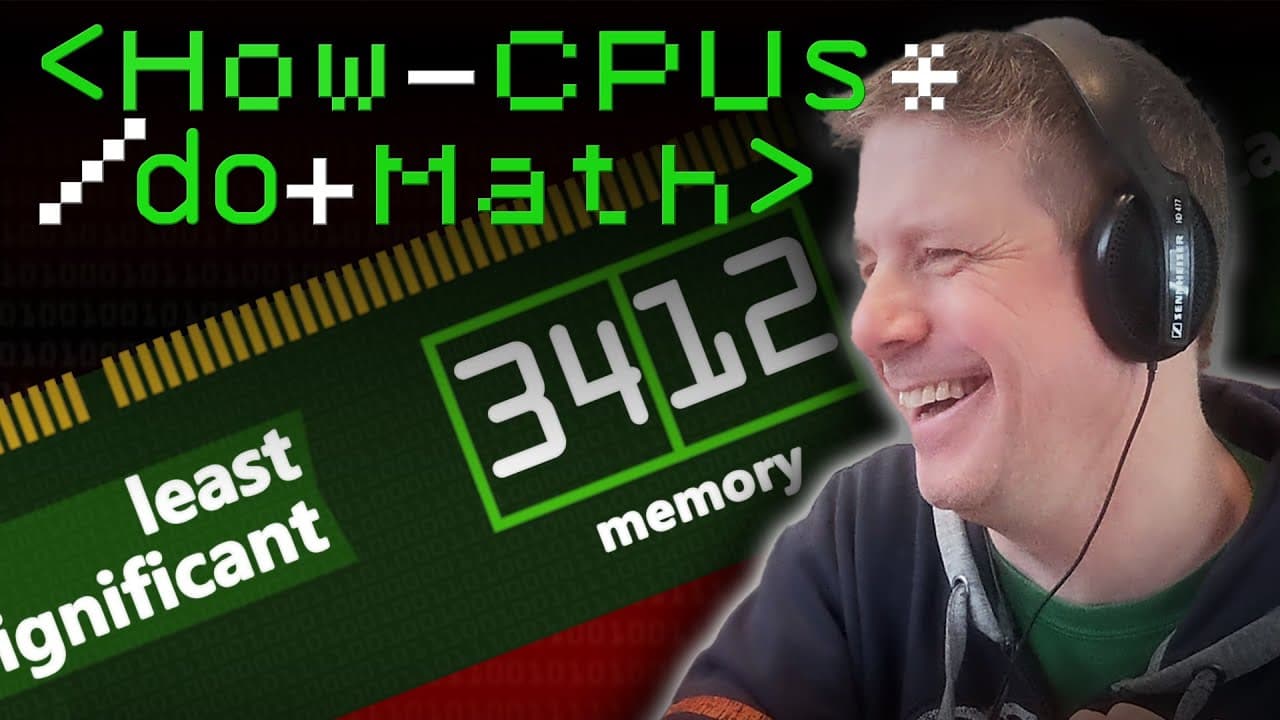
How CPUs Do Math(s) - Computerphile
TL;DR
This video explores how math operations are performed in computers, specifically focusing on adding large numbers with limited resources.
Transcript
last time we talked about the idea of um anthropomorphized is that the right word I think it is Robo prored robot proris yes um creatures creatures running around anyway doing doing jobs for us doing tasks for us and where where do we go from here then that's right so yeah um yeah last time as you say we had I made up this uh robot thing which real... Read More
Key Insights
- 💻 Early computers had limited resources for representing and manipulating numbers.
- 😒 Addition of multiple digits is achieved through carrying operations and the use of flags.
- 👻 Conditional jumps in assembly code allow for efficient control flow.
- 🎮 The concepts discussed in the video are applicable to both early and modern computers.
- 🦠 The demonstration of a BBC micro emulator showcases the practical implementation of the discussed principles.
- 💻 Understanding number representation and arithmetic operations is crucial for computer programming and optimizing efficiency.
- 🖱️ Different computer architectures may use different byte storage orders, affecting how numbers are stored and processed in memory.
Install to Summarize YouTube Videos and Get Transcripts
Explore YouTube Video Summarizer or Get YouTube Transcript Extractor
Questions & Answers
Q: How did early computers overcome resource limitations when dealing with large numbers?
Early computers used limited resources to represent numbers using two digits and employed carrying operations to handle larger values.
Q: What are flags in a computer, and how are they used in math operations?
Flags are raised or lowered indicators used to track specific conditions. In math operations, flags indicate carries, zeroes, negatives, and other important information.
Q: How can computers compare numbers using math operations?
By performing subtraction operations and checking the resulting flags, computers can compare numbers for equality, inequality, and other conditional operations.
Q: What is the significance of little endian and big endian in computer architecture?
Little endian and big endian refer to the storage order of bytes in computer memory. Little endian stores the least significant byte first, while big endian stores the most significant byte first.
Summary & Key Takeaways
-
The video discusses the limitations of resources in early computers and introduces the concept of using two-digit numbers to represent values.
-
It explains how carrying operations enable the addition of multiple digits and how flags are used to indicate carries, zeroes, and negative results.
-
The video demonstrates assembly code examples for adding four-digit numbers and highlights the use of conditional jumps.
-
It concludes by showcasing a BBC micro emulator running a Fibonacci code and displaying the results on the screen.
Read in Other Languages (beta)
Share This Summary 📚
Summarize YouTube Videos and Get Video Transcripts with 1-Click
Try YouTube Summary with ChatGPT & Claude or YouTube Transcript Generator
Explore More Summaries from Computerphile 📚




Summarize YouTube Videos and Get Video Transcripts with 1-Click
Try YouTube Summary with ChatGPT & Claude or YouTube Transcript Generator