Why Didn’t Antimatter Destroy The Universe After The Big Bang?
TL;DR
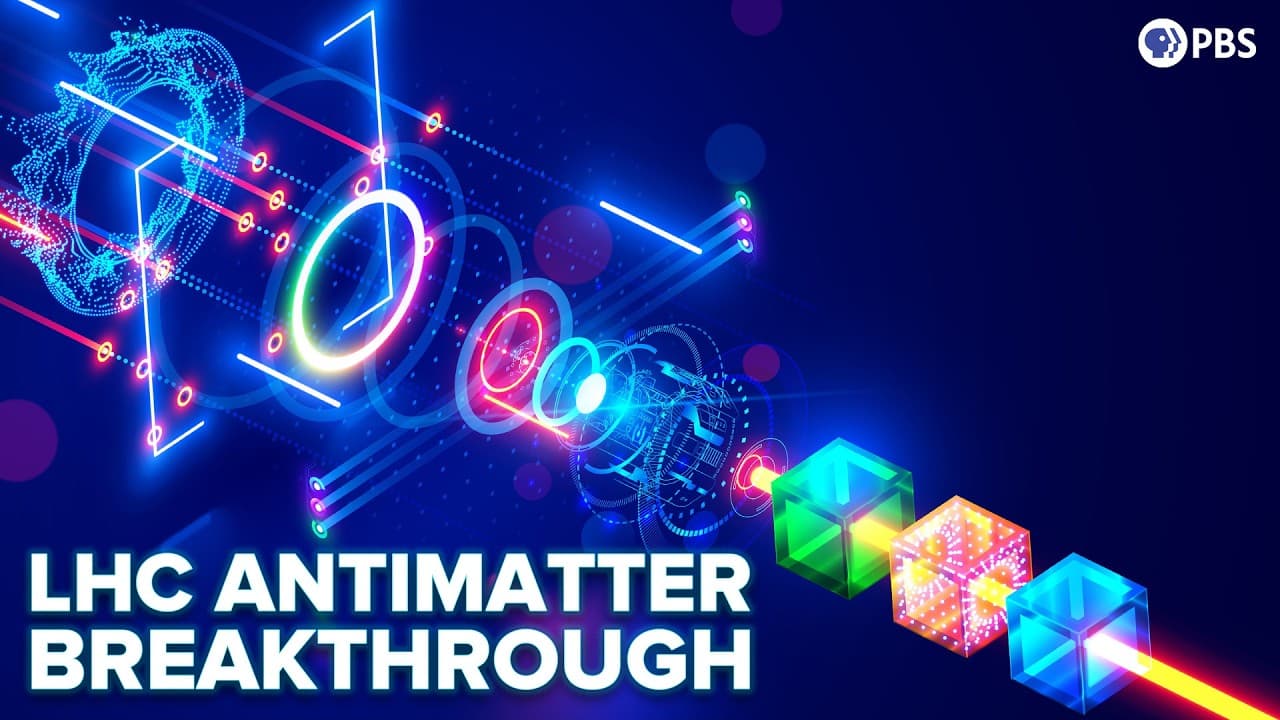
Antimatter didn't completely annihilate all matter after the Big Bang due to a slight excess of matter over antimatter, estimated at one particle per billion. Recent research from the Large Hadron Collider found CP violation in baryons, indicating subtle differences between matter and antimatter, but more investigation is needed to fully understand the matter-antimatter imbalance.
Transcript
thank you to Kiwiico for supporting PBS At 1 1,000th of a second after the Big Bang the Great Annihilation event should have wiped out all matter leaving a universe of only radiation We still don't know why any matter survived Well a new finding from the LHC brings us one step closer to understanding why there is something rather than nothing Hey e... Read More
Key Insights
- The universe's existence is questioned due to the expected annihilation of matter and antimatter post-Big Bang, yet matter survived.
- The Large Hadron Collider (LHC) has made significant progress in understanding the matter-antimatter asymmetry.
- CP symmetry suggests matter and antimatter should behave identically, but observed violations indicate subtle differences.
- LHCb experiment focuses on the bottom quark to explore matter-antimatter asymmetries, revealing CP violation in baryons.
- CP violation in baryons suggests that familiar matter may differ from antimatter, contributing to the universe's matter dominance.
- The degree of CP violation observed is insufficient to fully explain the matter-antimatter imbalance, indicating further research is needed.
- Future experiments aim to explore CP violation in leptons, which could provide additional insights into the asymmetry.
- The findings highlight the importance of continued research and experimentation to unravel the mysteries of the universe's composition.
Install to Summarize YouTube Videos and Get Transcripts
Explore YouTube Video Summarizer or Get YouTube Transcript Extractor
Questions & Answers
Q: What is the significance of the LHC's recent findings?
The LHC's recent findings are significant because they bring us closer to understanding why matter survived the expected annihilation event post-Big Bang. By revealing CP violation in baryons, the findings suggest that matter and antimatter may have subtle differences, contributing to the universe's matter dominance. This discovery is a crucial step in unraveling the mysteries of the universe's composition.
Q: How does CP symmetry relate to matter and antimatter?
CP symmetry posits that matter and antimatter should behave identically, with their quantum properties being mirror images of each other. If CP symmetry holds, replacing every particle in the universe with its antimatter counterpart would result in no observable changes. However, observed violations of CP symmetry indicate that matter and antimatter may have subtle differences, which could explain the universe's matter dominance.
Q: What role does the bottom quark play in the LHCb experiment?
The bottom quark plays a central role in the LHCb experiment because it is unusually susceptible to CP violation. The experiment focuses on exploring matter-antimatter asymmetries through the decay of particles containing bottom quarks, such as baryons. By studying these decays, researchers aim to uncover differences in behavior between matter and antimatter, contributing to our understanding of the universe's composition.
Q: Why is further research needed despite the LHC's findings?
Further research is needed because the degree of CP violation observed in the LHC's findings is insufficient to fully explain the matter-antimatter imbalance in the universe. While the discovery of CP violation in baryons is significant, it does not account for the entire asymmetry. Additional research, particularly into CP violation in leptons, is necessary to provide a more comprehensive understanding of the universe's matter dominance.
Q: What future experiments are planned to explore CP violation?
Future experiments aim to explore CP violation in leptons, which could provide additional insights into the matter-antimatter asymmetry. These experiments include Fermilab's NOvA, the upcoming DUNE, Japan's T2K, and the upcoming Hyper-Kamiokande. By observing how neutrinos oscillate between types, researchers hope to uncover further evidence of CP violation, contributing to our understanding of the universe's composition.
Q: How does CP violation contribute to the universe's matter dominance?
CP violation contributes to the universe's matter dominance by indicating that matter and antimatter may have subtle differences in behavior. These differences could have led to a slight imbalance in the early universe, resulting in more matter than antimatter surviving the expected annihilation event post-Big Bang. Understanding CP violation is crucial for explaining why the universe is composed predominantly of matter.
Q: What is the significance of the LHCb experiment's focus on baryons?
The significance of the LHCb experiment's focus on baryons lies in the fact that baryons, such as protons and neutrons, make up the visible matter in the universe. By studying CP violation in baryons, researchers aim to understand the matter-antimatter asymmetry in the context of the type of matter that constitutes the universe. This focus is crucial for unraveling the mysteries of the universe's composition.
Q: What challenges remain in understanding the matter-antimatter asymmetry?
Challenges remain in understanding the matter-antimatter asymmetry due to the insufficient degree of CP violation observed so far. While discoveries like those from the LHC are significant, they do not fully account for the universe's matter dominance. Researchers must continue exploring new sources of CP violation, potentially beyond the standard model, to provide a comprehensive explanation of the asymmetry.
Summary & Key Takeaways
-
The universe's existence is a mystery due to the expected annihilation of matter and antimatter post-Big Bang. However, recent findings from the Large Hadron Collider (LHC) bring us closer to understanding why matter survived. The LHCb experiment has revealed CP violation in baryons, suggesting subtle differences between matter and antimatter.
-
CP symmetry posits that matter and antimatter should behave identically, but observed violations indicate otherwise. The LHCb experiment focuses on the bottom quark to explore these asymmetries. The degree of CP violation observed is not enough to fully explain the matter-antimatter imbalance, prompting further research into leptons.
-
Future experiments aim to explore CP violation in leptons, which could provide additional insights into the asymmetry. The findings emphasize the importance of continued research and experimentation to unravel the mysteries of the universe's composition. The study of matter-antimatter asymmetry remains a crucial area of physics research.
Read in Other Languages (beta)
Share This Summary 📚
Summarize YouTube Videos and Get Video Transcripts with 1-Click
Try YouTube Summary with ChatGPT & Claude or YouTube Transcript Generator
Explore More Summaries from PBS Space Time 📚



Summarize YouTube Videos and Get Video Transcripts with 1-Click
Try YouTube Summary with ChatGPT & Claude or YouTube Transcript Generator