Circles, Angle Measures, Arcs, Central & Inscribed Angles, Tangents, Secants & Chords - Geometry
TL;DR
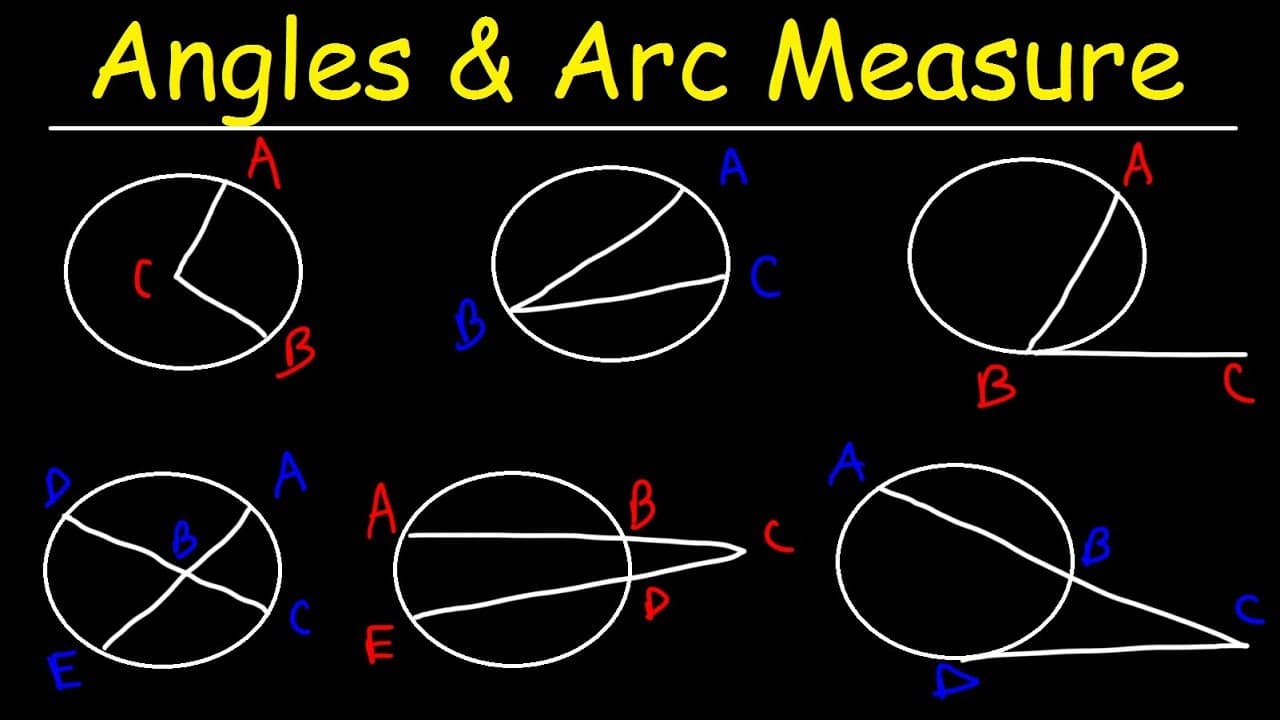
This lesson focuses on central angles, inscribed angles, tangent chord angles, chord chord angles, secant angles, and tangent tangent angles in circles.
Transcript
in this lesson we're going to focus on circles and angles the first type of angle that you need to be familiar with is known as the central angle the central angle with reference to a circle has the vertex on the center of the circle so let's talk about it so let's say this is circle c and let's call this point a b and this is point c so let's say ... Read More
Key Insights
- 🫠 Central angles have their vertex at the center of the circle and have the same measure as the intercepted arc.
- 🫠 Inscribed angles have their vertex on the circle and their measure is half the measure of the intercepted arc.
- 🔺 Tangent chord angles have a tangent segment meeting a chord, and the intercepted arc is twice the measure of the tangent chord angle.
- 🫠 Chord chord angles are formed by the intersection of two chords, and their measure is the average of the intercepted arcs.
- 🫠 Secant angles have two secant segments with a common endpoint, and their measure is half the difference of the intercepted arcs.
- 🫠 Tangent tangent angles are formed by a tangent segment and another tangent segment, and their measure is half the difference of the intercepted arcs.
- 🔺 The measure of the intercepted arc and the measure of the inscribed angle or tangent chord angle are always equal.
- 🫠 The measure of the intercepted arc and the measure of the central angle are always equal.
- 🫠 The measure of the chord chord angle is the sum of the measures of the intercepted arcs divided by 2.
- 🫠 The measure of the secant angle is half the difference of the measures of the intercepted arcs.
- 🫠 The measure of the tangent tangent angle is half the difference of the measures of the intercepted arcs.
Install to Summarize YouTube Videos and Get Transcripts
Explore YouTube Video Summarizer or Get YouTube Transcript Extractor
Questions & Answers
Q: What is the difference between a central angle and an inscribed angle?
A central angle has its vertex at the center of the circle, while an inscribed angle has its vertex on the circle. The measure of the central angle is equal to the measure of the intercepted arc, while the measure of the inscribed angle is half the measure of the intercepted arc.
Q: How is the measure of the intercepted arc related to the measure of a tangent chord angle?
The measure of the intercepted arc is twice the measure of the tangent chord angle. So, if the angle is 25 degrees, the intercepted arc would be 50 degrees.
Q: How do you calculate the measure of a chord chord angle if you are given the intercepted arc's measures?
To find the measure of a chord chord angle, you need the measures of the two intercepted arcs. Add the measures of the intercepted arcs and divide by 2 to find the measure of the chord chord angle.
Q: What is the difference between a secant angle and a tangent tangent angle?
A secant angle is formed by two secant segments with a common endpoint, while a tangent tangent angle is formed by a tangent segment and another tangent segment. The measure of a secant angle is half the difference of the intercepted arcs, and the measure of a tangent tangent angle is half the difference of the intercepted arcs.
Summary & Key Takeaways
-
Central angles have the vertex at the center of the circle, and the measure of the central angle is equal to the measure of the intercepted arc.
-
Inscribed angles have the vertex on the circle, and the measure of the inscribed angle is half the measure of the intercepted arc.
-
Tangent chord angles are formed when a tangent segment meets a chord, and the measure of the intercepted arc is twice the measure of the tangent chord angle.
-
Chord chord angles are formed by the intersection of two chords, and the measure of the chord chord angle is the average of the intercepted arcs.
-
Secant angles have two secant segments with a common endpoint, and the measure of the secant angle is half the difference of the intercepted arcs.
-
Tangent tangent angles are formed by a tangent segment and another tangent segment, and the measure of the tangent tangent angle is half the difference of the intercepted arcs.
Read in Other Languages (beta)
Share This Summary 📚
Summarize YouTube Videos and Get Video Transcripts with 1-Click
Try YouTube Summary with ChatGPT & Claude or YouTube Transcript Generator
Explore More Summaries from The Organic Chemistry Tutor 📚




Summarize YouTube Videos and Get Video Transcripts with 1-Click
Try YouTube Summary with ChatGPT & Claude or YouTube Transcript Generator