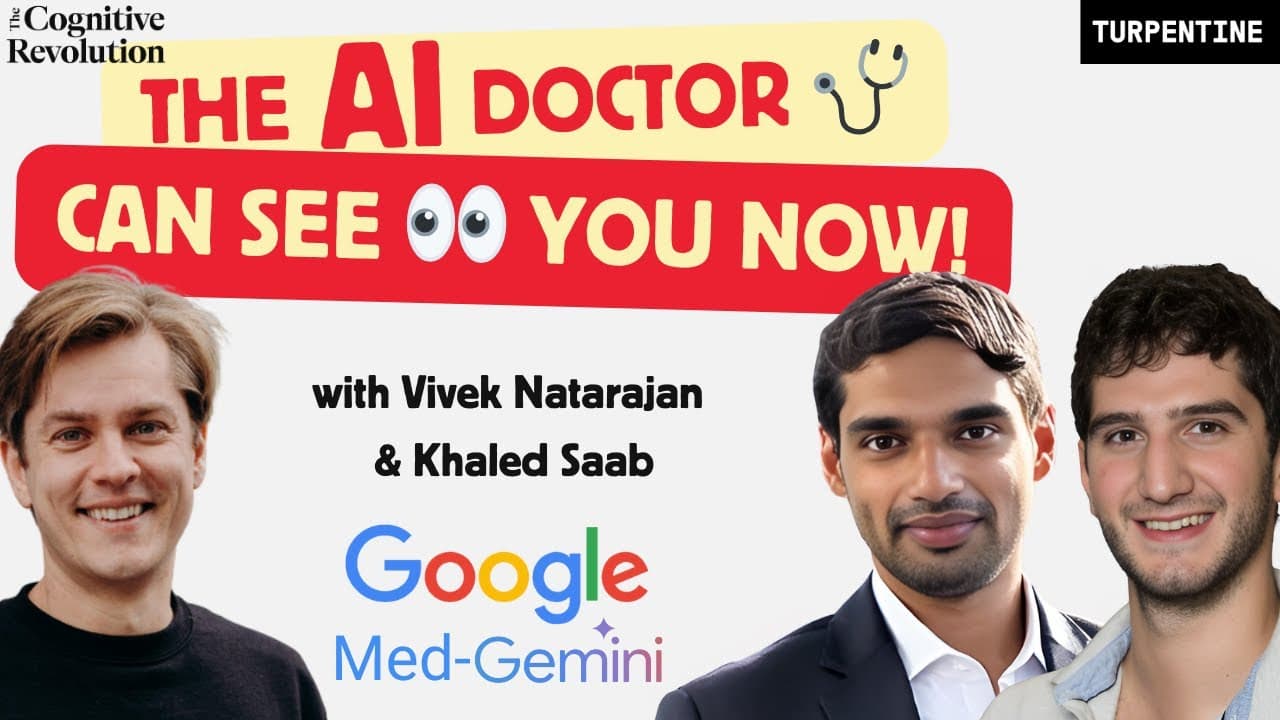
The AI Doctor Can See You Now, with Vivek Natarajan and Khaled Saab from Google
TL;DR
AI doctors may soon provide accessible, high-quality medical advice worldwide.
Transcript
hello and welcome to the cognitive Revolution where we interview Visionary researchers entrepreneurs and Builders working on the frontier of artificial intelligence each week we'll explore their revolutionary ideas and together we'll build a picture of how AI technology will transform work life and Society in the coming years I'm Nathan lens joined... Read More
Key Insights
- AI advancements in healthcare, such as AI doctors, promise to democratize access to medical advice, especially in regions with limited healthcare resources.
- Large language models like Flamingo and MedGemini show potential in surpassing human doctors in diagnostic accuracy, particularly in radiology and medical conversations.
- Simulation learning environments and synthetic data generation are crucial for training AI models to perform complex diagnostic tasks effectively.
- The integration of multimodal data, including text, images, and chemical structures, enhances AI models' capabilities in medical applications.
- The development of AI doctors requires rigorous evaluation and societal acceptance, focusing on safety, trust, and ethical deployment.
- Uncertainty-guided search techniques improve AI's reliability by identifying areas of uncertainty and seeking additional information.
- The cost of AI deployment remains a consideration, but technological advancements are driving down costs, making AI more accessible globally.
- AI's potential extends beyond diagnostics to biomedical discovery, offering insights into human biology and personalized healthcare solutions.
Install to Summarize YouTube Videos and Get Transcripts
Explore YouTube Video Summarizer or Get YouTube Transcript Extractor
Questions & Answers
Q: What are the main advancements in AI for healthcare discussed in the video?
The video highlights significant advancements in AI for healthcare, focusing on AI doctors like Amy and MedGemini. These systems leverage large language models to provide diagnostic accuracy and patient interaction, often surpassing human doctors. Key techniques include simulation learning environments, synthetic data generation, and multimodal data integration, enhancing AI's capabilities in medical applications.
Q: How do AI models like Amy and MedGemini outperform human doctors?
AI models like Amy and MedGemini outperform human doctors by utilizing advanced large language models, which allow them to accurately diagnose conditions and interact with patients. These models benefit from extensive training on synthetic data and simulation environments, enabling them to handle complex diagnostic tasks and provide empathetic patient interactions, often scoring higher than human doctors in evaluations.
Q: What role does simulation learning play in training AI doctors?
Simulation learning plays a crucial role in training AI doctors by creating synthetic environments where AI models can practice diagnostic conversations and decision-making under uncertainty. This approach allows AI to learn from a vast array of simulated patient interactions, covering diverse medical conditions and patient personalities, which enhances their diagnostic accuracy and patient interaction skills.
Q: How do AI models integrate multimodal data for medical applications?
AI models integrate multimodal data by incorporating various types of information, such as text, medical images, and chemical structures, into their training processes. This integration allows models like MedGemini to understand complex medical data and perform tasks like radiology report generation and CT scan analysis, improving diagnostic accuracy and expanding their capabilities in medical applications.
Q: What challenges remain for deploying AI doctors globally?
Challenges for deploying AI doctors globally include ensuring safety, building trust, and gaining societal acceptance. Rigorous evaluation and regulatory compliance are necessary to demonstrate AI's reliability in critical healthcare contexts. Additionally, reducing deployment costs and addressing ethical considerations are essential for making AI healthcare solutions accessible worldwide.
Q: What is the significance of uncertainty-guided search in AI healthcare applications?
Uncertainty-guided search is significant in AI healthcare applications as it improves the reliability of AI models by identifying areas of uncertainty in their responses. By generating multiple responses and analyzing inconsistencies, AI systems can determine when additional information is needed, enhancing their accuracy and ensuring safer, more dependable interactions with patients.
Q: How does AI contribute to biomedical discovery beyond diagnostics?
AI contributes to biomedical discovery beyond diagnostics by offering insights into human biology and facilitating personalized healthcare solutions. By encoding vast amounts of biomedical data, AI models can identify causative genetic factors, design better therapies, and advance scientific understanding, potentially leading to breakthroughs in disease treatment and prevention.
Q: What are the ethical considerations for AI deployment in healthcare?
Ethical considerations for AI deployment in healthcare include ensuring patient safety, maintaining privacy, and addressing biases in AI systems. It is crucial to build trust with patients and healthcare professionals by demonstrating AI's reliability and effectiveness. Additionally, equitable access to AI healthcare solutions must be prioritized to avoid exacerbating existing disparities in healthcare access.
Summary & Key Takeaways
-
AI is transforming healthcare by enabling AI doctors to provide high-quality medical advice globally, addressing the scarcity of medical professionals. Researchers at Google are pioneering this field, demonstrating AI's potential in diagnostic accuracy and patient interaction.
-
Through innovative use of large language models, AI systems like Amy and MedGemini are achieving promising results in medical applications, often surpassing human performance. These advancements are supported by simulation learning and synthetic data generation techniques.
-
The future of AI in healthcare hinges on societal acceptance and rigorous evaluation to ensure safety and trust. While AI offers significant benefits, it requires careful integration and ethical considerations to maximize its impact on global healthcare.
Read in Other Languages (beta)
Share This Summary 📚
Summarize YouTube Videos and Get Video Transcripts with 1-Click
Try YouTube Summary with ChatGPT & Claude or YouTube Transcript Generator
Explore More Summaries from Cognitive Revolution "How AI Changes Everything" 📚





Summarize YouTube Videos and Get Video Transcripts with 1-Click
Try YouTube Summary with ChatGPT & Claude or YouTube Transcript Generator