What Did the Königsberg Bridge Problem Teach Us About Graph Theory?
TL;DR
The Königsberg bridge problem, which examined whether you could cross all seven bridges of the city without retracing steps, was solved by Leonhard Euler. He discovered that to create a route visiting each bridge once, a graph representation using nodes and edges depends on the odd and even degrees of those nodes. This foundational work laid the groundwork for the development of graph theory.
Transcript
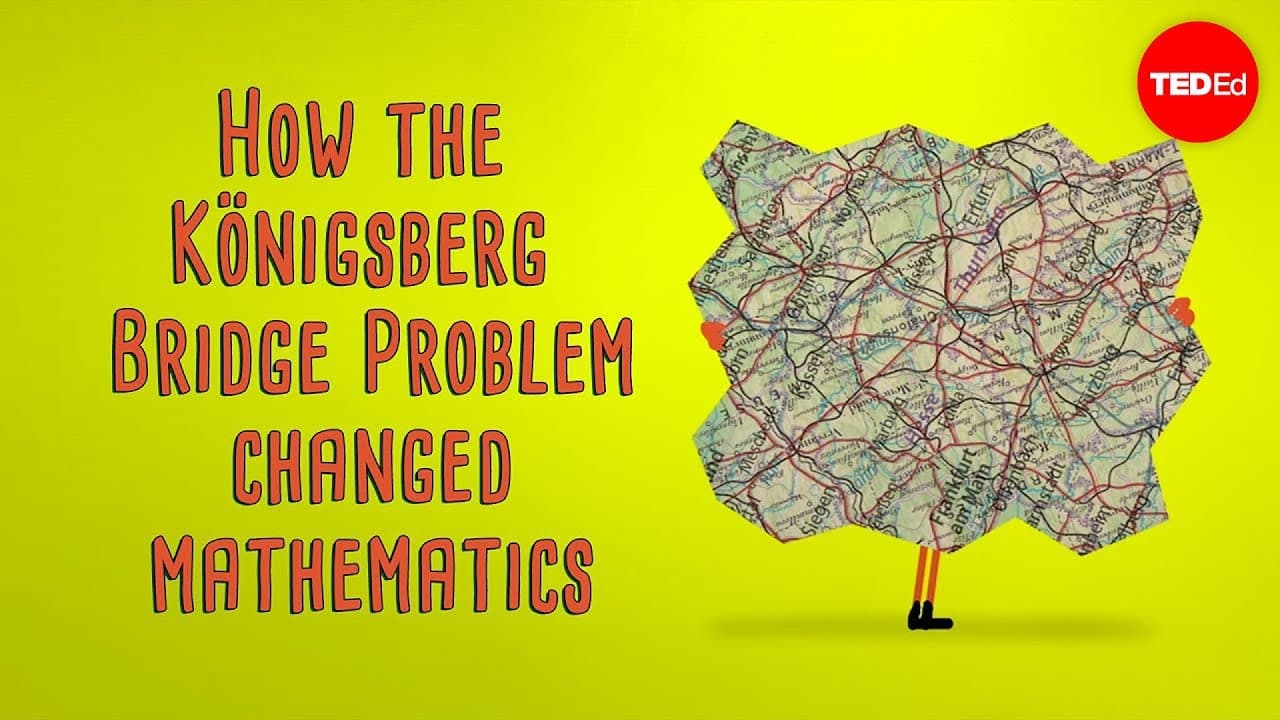
You'd have a hard time finding Königsberg on any modern maps, but one particular quirk in its geography has made it one of the most famous cities in mathematics. The medieval German city lay on both sides of the Pregel River. At the center were two large islands. The two islands were connected to each other and to the river banks by seven bridges.... Read More
Key Insights
- 🌉 Königsberg's seven bridges inspired Leonhard Euler to create graph theory.
- 🦔 Euler's solution introduced nodes, edges, and degrees in graph theory.
- 🌉 A Eulerian path in Königsberg required removing one bridge.
- 🌉 Destroying two bridges during WWII made Königsberg solvable.
- 🥺 The bridge problem led to the emergence of the new field of mathematics.
- 🦕 Nodes' odd and even degrees determined possible Eulerian paths.
- 🦕 Eulerian paths are possible with two odd or all even node degrees.
Install to Summarize YouTube Videos and Get Transcripts
Explore YouTube Video Summarizer or Get YouTube Transcript Extractor
Questions & Answers
Q: What inspired the creation of graph theory?
The problem of the seven bridges of Königsberg, which led to Euler developing the concept of nodes and edges in graph theory, serving as the foundation for the field.
Q: How did Euler's solution impact mathematics?
Euler's solution of the Königsberg bridge problem laid the groundwork for graph theory, a critical branch of mathematics used in various applications like computer science, social networks, and optimization problems.
Q: Why did the destruction of bridges in Königsberg create a solvable path?
Destroying two bridges in Königsberg during World War II inadvertently created a Eulerian path by making all nodes even, showcasing a real-world application of graph theory in solving the bridge problem.
Summary & Key Takeaways
-
Königsberg had two islands connected by seven bridges, inspiring mathematicians.
-
Euler's solution introduced the concept of nodes, edges, and degrees in graph theory.
-
The destruction of two bridges during World War II created a solvable Eulerian path.
Read in Other Languages (beta)
Share This Summary 📚
Summarize YouTube Videos and Get Video Transcripts with 1-Click
Try YouTube Summary with ChatGPT & Claude or YouTube Transcript Generator
Explore More Summaries from TED-Ed 📚



Summarize YouTube Videos and Get Video Transcripts with 1-Click
Try YouTube Summary with ChatGPT & Claude or YouTube Transcript Generator