How to Calculate pH for Polyprotic Acids with Ice Tables
TL;DR
To calculate the pH of a polyprotic acid solution, use ice tables and consider the dissociation constants (Ka) for each step. The first dissociation largely affects the pH, while subsequent steps can be approximated for high concentrations but require quadratic equations for low concentrations. For equivalent concentrations of acidic and basic forms, the pH equals the pKa for that ionization step.
Transcript
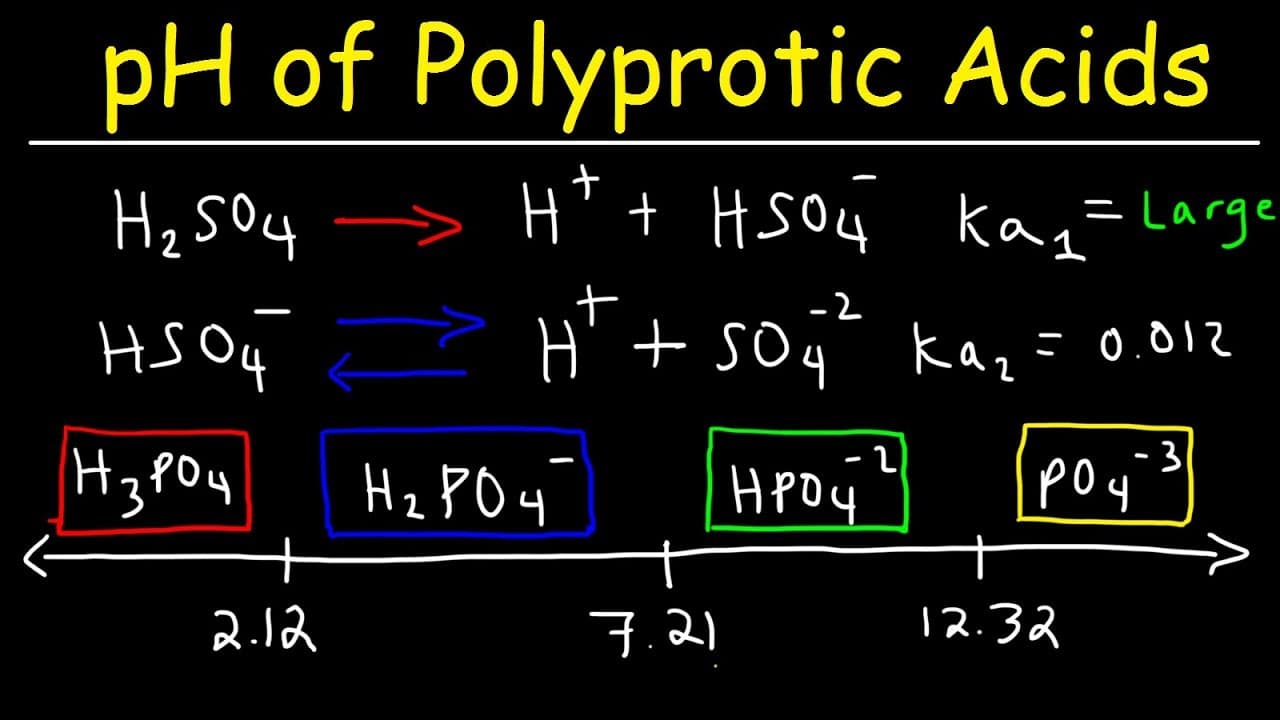
in this lesson we're going to focus on solving problems associated with polyprotic acids so sulfuric acid is a polyprotic acid notice that it has two hydrogens per formal unit so it's a diprotic acid now how can we calculate the ph of h2so4 if the concentration of it is relatively large now you need to understand that there's two dissociation react... Read More
Key Insights
- 😑 Sulfuric acid is a diprotic acid, meaning it has two hydrogen ions that can dissociate.
- ❓ The first dissociation step of sulfuric acid occurs almost completely, while the second dissociation is in equilibrium.
- 😥 Concentration and dissociation constants (Ka) are used to calculate the pH and equilibrium concentrations of each species in the solution.
- 🥶 Approximations can be made for high concentration solutions, but for more accurate results, ice tables and quadratic equations must be used.
- 😘 The contribution of ions from the second dissociation step is generally significant in low concentration solutions.
- 🟰 The pH of a solution with equal concentrations of acidic and basic forms of a polyprotic acid is equal to the pKa value for that ionization step.
Install to Summarize YouTube Videos and Get Transcripts
Explore YouTube Video Summarizer or Get YouTube Transcript Extractor
Questions & Answers
Q: How does the concentration of a polyprotic acid affect the significance of each dissociation step?
When the concentration is high, the contribution of ions from the second dissociation step is generally negligible compared to the first step. However, in low concentration solutions, the second step can have a significant impact on the overall pH and ion concentrations.
Q: How does the approximation method differ from the exact method when calculating the pH of a polyprotic acid solution?
The approximation method only considers the first dissociation step and neglects the contribution from the bisulfate ion. The exact method involves using an ice table and quadratic equation to determine the concentrations of all ions present, resulting in a more accurate pH calculation.
Q: What is the relationship between Ka values and the ease of proton removal in polyprotic acids?
The Ka values represent the acid dissociation constant for each step of proton removal. A larger Ka value indicates that the proton is more easily removed, while a smaller Ka value indicates a higher tendency for equilibrium and a less significant removal of protons.
Q: How can the pH of a solution be determined when both acidic and basic forms of a polyprotic acid are present in equal concentrations?
In a buffer solution with equal amounts of an acidic and basic form of a polyprotic acid, the pH is simply equal to the pKa, which is the negative logarithm of the Ka value for the ionization step between those two forms.
Summary & Key Takeaways
-
Sulfuric acid is a diprotic acid with two dissociation reactions. The first hydrogen ionizes almost 100%, while the second proton is in equilibrium.
-
The concentration and dissociation constants (Kas) of each step are used to calculate the contributions of ions in the solution.
-
In cases of high concentration, approximations can be made, but for accurate results, ice tables and quadratic equations must be used.
Read in Other Languages (beta)
Share This Summary 📚
Summarize YouTube Videos and Get Video Transcripts with 1-Click
Try YouTube Summary with ChatGPT & Claude or YouTube Transcript Generator
Explore More Summaries from The Organic Chemistry Tutor 📚

Summarize YouTube Videos and Get Video Transcripts with 1-Click
Try YouTube Summary with ChatGPT & Claude or YouTube Transcript Generator