RLC circuits (5 of 6) AC Power for an RL Circuit
TL;DR
Analyzing AC power in RL circuits with calculations of impedance, current, power factor, real/ reactive power, and power triangle.
Transcript
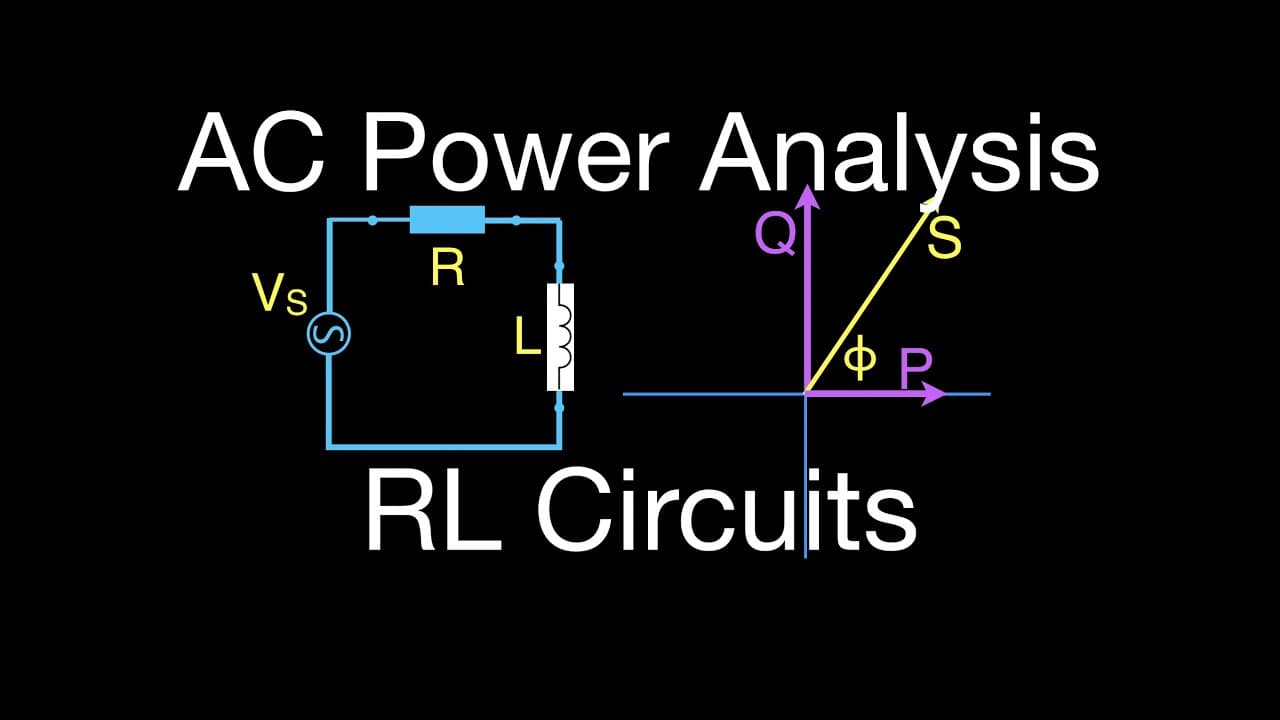
okay well that's right in today's video we're going to be going over AC power for RL circuits and this is the circuit that we have we have an 150 ohm resistor and it is placed in series with a 750 milli Henry inductor and we have a voltage source that has 230 volts and the frequency of that source is 55 Hertz and you can see this is a diagram of ou... Read More
Key Insights
- 💐 Impedance in an RL circuit is crucial for understanding the opposition to current flow.
- ❓ RMS current is essential for determining the effective current in the circuit.
- ✊ Power factor reveals the efficiency of power utilization in an RL circuit.
- 💦 Real power in an RL circuit represents the actual work done by the circuit.
- ✊ Reactive power denotes the energy stored and released by the inductor in an RL circuit.
- ✊ Apparent power combines real and reactive power in an RL circuit.
- ✊ The power triangle provides a graphical representation of power components in an RL circuit.
Install to Summarize YouTube Videos and Get Transcripts
Explore YouTube Video Summarizer or Get YouTube Transcript Extractor
Questions & Answers
Q: How is circuit impedance calculated in an RL circuit?
Circuit impedance in an RL circuit is calculated using the square root of the sum of resistance squared and inductive reactance squared, where inductive reactance is obtained by multiplying 2πfL.
Q: What is the significance of RMS current in an RL circuit?
RMS current represents the effective current flowing through the circuit, calculated using the RMS voltage and impedance. It provides insight into the circuit's power consumption.
Q: How is power factor determined in an RL circuit?
Power factor in an RL circuit is calculated as the cosine of the phase angle, with the ratio of resistance to impedance. It indicates the efficiency of power transfer in the circuit.
Q: Why is the power triangle used in analyzing AC power in RL circuits?
The power triangle visually represents the real power, reactive power, and apparent power in a circuit, aiding in understanding the relationships between these components.
Summary & Key Takeaways
-
Demonstrates how to determine circuit impedance using R and XL.
-
Calculates RMS current through the circuit using Ohm's law.
-
Discusses power factor, phase angle, real power, reactive power, and apparent power in an RL circuit.
Read in Other Languages (beta)
Share This Summary 📚
Summarize YouTube Videos and Get Video Transcripts with 1-Click
Try YouTube Summary with ChatGPT & Claude or YouTube Transcript Generator
Explore More Summaries from Step by Step Science 📚


Summarize YouTube Videos and Get Video Transcripts with 1-Click
Try YouTube Summary with ChatGPT & Claude or YouTube Transcript Generator