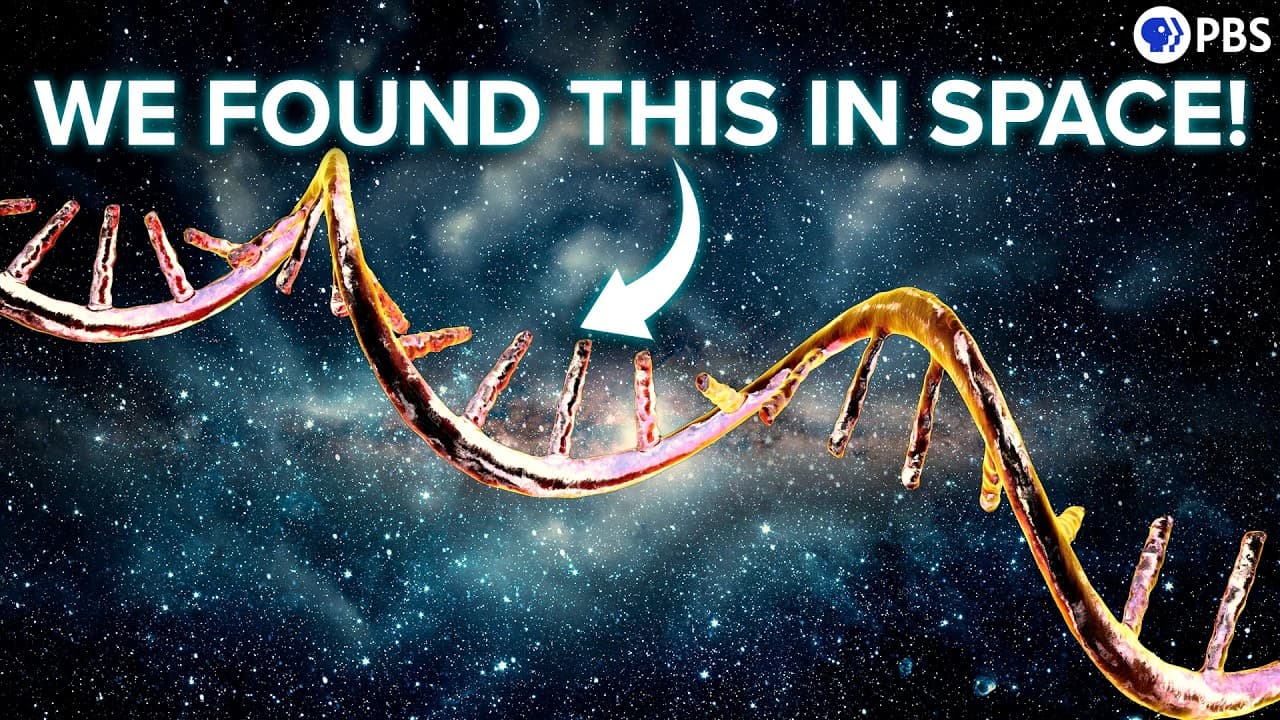
Your DNA's Codes Are (Probably) From Outer Space
TL;DR
DNA's building blocks may have extraterrestrial origins.
Transcript
Thank you to CyberGhost VPN for supporting PBS. Did you know that many of us have up to 4% of our DNA from neanderthals? And that 100% of us may have DNA from outer space? No joke. At least the biochemistry that defined the coding system of your DNA may have happened off-world, and perhaps even long before Earth existed. Before we get started, j... Read More
Key Insights
- Neanderthal DNA makes up about 4% of our genetic code, but all humans might have DNA components from outer space, suggesting extraterrestrial origins of life's building blocks.
- The concept of pseudo-panspermia suggests that complex molecules necessary for life may have formed in space and arrived on Earth, giving life a head start.
- The OSIRIS-REx mission returned samples from asteroid Bennu, revealing all five nucleobases of DNA and RNA, indicating that organic compounds are abundant in space.
- Bennu's samples showed amino acids in both left- and right-handed forms, supporting the idea that these molecules have an abiotic origin.
- The presence of sodium-rich salts in Bennu's samples suggests a water-rich origin, possibly from a protoplanet that existed before being destroyed.
- Pseudo-panspermia is supported by evidence of organic compounds in meteorites and space missions, indicating that life's chemistry might have started in space.
- The OSIRIS-APEX mission aims to study asteroid Apophis, which poses a potential threat to Earth, highlighting the importance of understanding near-Earth objects.
- The presence of DNA and RNA nucleobases in space samples suggests that similar chemical processes might lead to life elsewhere in the universe.
Install to Summarize YouTube Videos and Get Transcripts
Explore YouTube Video Summarizer or Get YouTube Transcript Extractor
Questions & Answers
Q: What is pseudo-panspermia, and how does it relate to the origins of life?
Pseudo-panspermia is the hypothesis that complex organic molecules necessary for life originated in space and were delivered to Earth, providing the building blocks for life. This concept suggests that life's chemistry began in space, offering a head start for the development of life on Earth. The idea is supported by evidence of organic compounds found in meteorites and space missions, indicating that these molecules are abundant in space.
Q: What did the OSIRIS-REx mission discover about asteroid Bennu?
The OSIRIS-REx mission collected samples from asteroid Bennu and found all five nucleobases that serve as the code for DNA and RNA, marking the first time these were found on the same space rock. The samples also contained 14 of the 20 amino acids used by life on Earth, with both left- and right-handed chirality, indicating an abiotic origin. These findings suggest that organic compounds are abundant on asteroids like Bennu.
Q: How does the presence of sodium-rich salts in Bennu's samples inform our understanding of its origin?
The presence of sodium-rich salts in Bennu's samples suggests a water-rich origin, possibly from a protoplanet that existed in the early solar system. These salts are rare in meteorites but were preserved in Bennu's samples due to their storage in pure nitrogen. This indicates that Bennu, or its precursor, was once in an aqueous environment, supporting the idea of a complex chemical history before its current form.
Q: What role does the OSIRIS-APEX mission play in planetary defense?
The OSIRIS-APEX mission aims to study asteroid Apophis, which poses a potential threat to Earth due to its close approach in 2029 and a minuscule chance of impact in 2036. By observing changes in Apophis during its encounter with Earth, the mission will enhance our understanding of near-Earth objects and improve tracking methods. This knowledge could help avert future giant impacts, contributing to planetary defense efforts.
Q: How do the findings from Bennu's samples impact our understanding of life's potential elsewhere in the universe?
The discovery of DNA and RNA nucleobases in Bennu's samples suggests that similar chemical processes might occur on other planets, increasing the likelihood of life elsewhere in the universe. If planets start with a similar chemical cocktail, there's a possibility that life could form in many places, following a path similar to Earth's. This supports the idea that life's building blocks are universal and widespread in the cosmos.
Q: What evidence supports the idea that life's chemistry might have started in space?
Evidence supporting the idea that life's chemistry might have started in space includes the discovery of organic compounds in meteorites, such as the Murchison meteorite, and samples from space missions like OSIRIS-REx. These findings show that amino acids and nucleobases, crucial for life, are present in space, suggesting that life's building blocks could have been delivered to Earth from extraterrestrial sources.
Q: What is the significance of finding both chiralities of amino acids in space samples?
Finding both chiralities of amino acids in space samples, as seen in the Bennu samples, is significant because it indicates an abiotic origin. On Earth, amino acids in life forms are predominantly left-handed, a chirality established early in life's history. The presence of both left- and right-handed amino acids in space samples suggests that these molecules formed independently of terrestrial life, supporting the idea of their extraterrestrial origins.
Q: How does the OSIRIS-REx mission contribute to our understanding of the early solar system?
The OSIRIS-REx mission contributes to our understanding of the early solar system by providing direct samples from asteroid Bennu, which offers insights into the chemical composition and history of space rocks. The discovery of organic compounds and evidence of a water-rich past in Bennu's samples helps reconstruct the conditions and processes that occurred in the early solar system, shedding light on the origins of planets and potentially life.
Summary & Key Takeaways
-
The content explores the possibility that DNA's building blocks originated in space, supported by evidence from the OSIRIS-REx mission's samples from asteroid Bennu. These samples contained nucleobases and amino acids, suggesting that organic compounds are widespread in space and may have contributed to life's emergence on Earth.
-
Pseudo-panspermia proposes that complex molecules necessary for life formed in space and arrived on Earth, giving life a head start. The presence of both chiralities of amino acids in space samples supports their abiotic origin, indicating that life's chemistry might have extraterrestrial roots.
-
The OSIRIS-APEX mission focuses on studying asteroid Apophis, a potential threat to Earth. The mission's findings could enhance our understanding of near-Earth objects and their impact risks, while also providing insights into the origins of life through the study of organic compounds in space.
Read in Other Languages (beta)
Share This Summary 📚
Summarize YouTube Videos and Get Video Transcripts with 1-Click
Try YouTube Summary with ChatGPT & Claude or YouTube Transcript Generator
Explore More Summaries from PBS Space Time 📚




Summarize YouTube Videos and Get Video Transcripts with 1-Click
Try YouTube Summary with ChatGPT & Claude or YouTube Transcript Generator