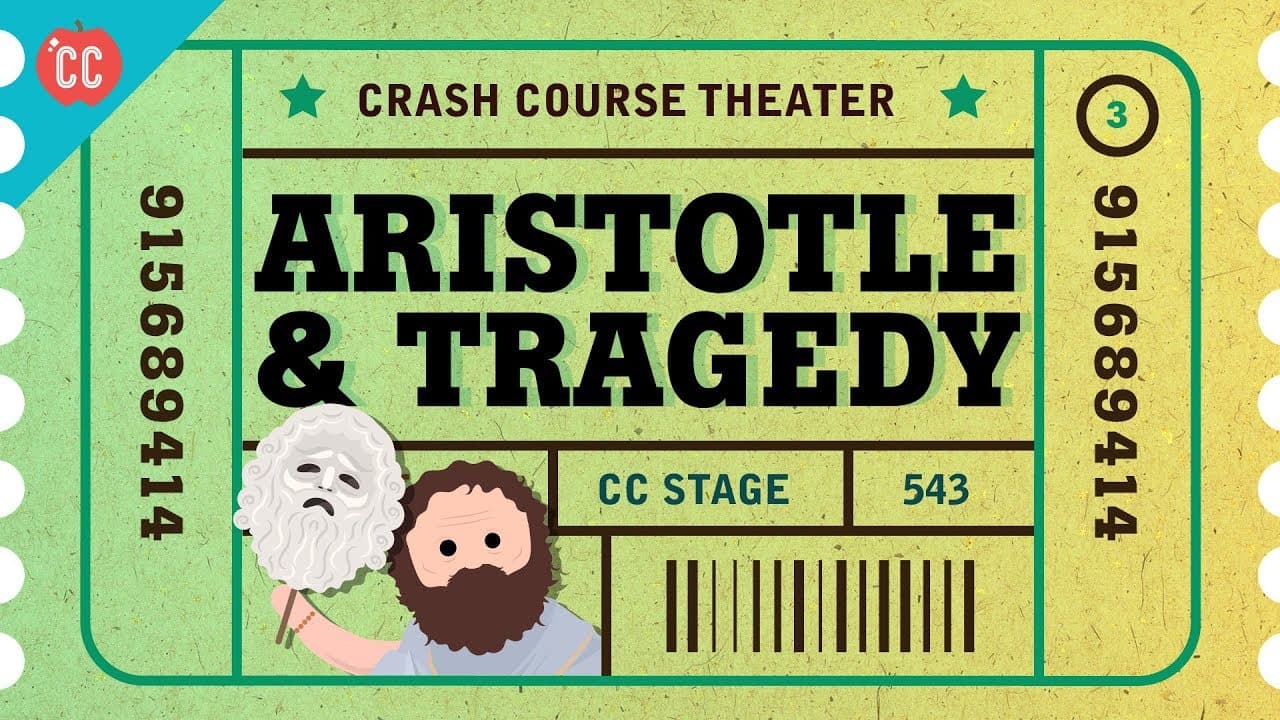
Tragedy Lessons from Aristotle: Crash Course Theater #3
TL;DR
Explores Aristotle's theories on tragedy using Greek plays.
Transcript
Hey there. I’m Mike Rugnetta, this is Crash Course Theater, and today is going to be a tragedy. A Greek tragedy. Which is a lot like a regular tragedy, only older and with more stuffed grape leaves. We’ll be exploring Aristotle’s theories on this artform, written more than a century after the golden age of Athenian drama. Then we’ll apply them retr... Read More
Key Insights
- Aristotle's 'Poetics' is the first substantial work of literary criticism, focusing on tragedy and its elements.
- Tragedy, according to Aristotle, must be serious, complete, and of a certain magnitude, involving legendary heroes or royal families.
- Catharsis is a key component of tragedy, though scholars debate whether it is emotional purgation or intellectual clarification.
- Aristotle outlines six parts of tragedy: Plot, Character, Diction, Thought, Spectacle, and Song, with plot being the most important.
- A tragic plot needs reversal, recognition, and a scene of suffering, often involving noble characters missing the mark.
- The 'Oresteia' trilogy demonstrates Aristotelian tragedy with themes of murder, vengeance, and divine intervention.
- Aristotle's theories continue to influence modern plays and our understanding of dramatic structure.
- The concept of catharsis in tragedy aims to purge emotions, potentially making audiences better citizens.
Install to Summarize YouTube Videos and Get Transcripts
Explore YouTube Video Summarizer or Get YouTube Transcript Extractor
Questions & Answers
Q: What is the primary focus of Aristotle's 'Poetics'?
Aristotle's 'Poetics' primarily focuses on the structure and elements of tragedy. It provides a framework for understanding how tragedies should be constructed, emphasizing the importance of plot, character, diction, thought, spectacle, and song. Aristotle argues that a well-crafted tragedy should evoke catharsis, purging emotions through a serious and complete narrative.
Q: How does Aristotle define tragedy?
Aristotle defines tragedy as an imitation of an action that is serious, complete, and of a certain magnitude, using embellished language and artistic ornamentation. It is presented in the form of action rather than narrative, aiming to evoke pity and fear, leading to the catharsis or purgation of these emotions in the audience.
Q: What are the key elements of a tragic plot according to Aristotle?
According to Aristotle, a tragic plot must include three main elements: reversal, recognition, and a scene of suffering. Reversal involves a sudden change in the protagonist's fortune, recognition is the protagonist's realization of a critical truth, and the scene of suffering involves significant emotional or physical pain, contributing to the overall cathartic experience.
Q: How does the 'Oresteia' trilogy illustrate Aristotelian tragedy?
The 'Oresteia' trilogy by Aeschylus illustrates Aristotelian tragedy through its focus on noble characters experiencing reversal and recognition, leading to suffering. The trilogy's themes of murder, vengeance, and divine intervention align with Aristotle's criteria for tragedy, showcasing the interplay of plot and character that evokes catharsis in the audience.
Q: What role does catharsis play in Aristotle's concept of tragedy?
Catharsis is central to Aristotle's concept of tragedy, serving as the emotional release or purgation experienced by the audience. It is achieved through the evocation of pity and fear, allowing viewers to cleanse themselves of these emotions. This process is thought to make audiences better citizens by providing a safe outlet for emotional expression.
Q: Why does Aristotle prioritize plot over character in tragedy?
Aristotle prioritizes plot over character because he believes the sequence of events is what drives the emotional impact and catharsis of a tragedy. While characters are important, it is the plot's structure and the unfolding of actions that create the tension and resolution necessary for a powerful dramatic experience, leading to the desired emotional release.
Q: How does the 'Oresteia' demonstrate the theme of divine intervention?
The 'Oresteia' demonstrates the theme of divine intervention in its resolution, where the goddess Athena intervenes to establish a trial for Orestes, ultimately leading to the introduction of the jury system. This divine involvement highlights the transition from a cycle of blood vengeance to a more civilized system of justice, reflecting the values of the city-state.
Q: What impact did Aristotle's theories have on modern theater?
Aristotle's theories have had a profound impact on modern theater by providing a foundational understanding of dramatic structure and the emotional effects of storytelling. His emphasis on plot, character, and catharsis continues to influence playwrights and directors, shaping the way stories are crafted to engage audiences and evoke emotional responses.
Summary & Key Takeaways
-
Aristotle's 'Poetics' offers a framework for understanding Greek tragedy, emphasizing plot over character and the importance of catharsis. It defines tragedy as an imitation of a serious action with emotional impact.
-
The 'Oresteia' trilogy by Aeschylus exemplifies Aristotelian tragedy, with themes of murder and vengeance, showcasing the elements of reversal, recognition, and suffering.
-
Aristotle's influence extends to modern theater, with his focus on plot structure and emotional impact continuing to shape dramatic works and audience experiences.
Read in Other Languages (beta)
Share This Summary 📚
Summarize YouTube Videos and Get Video Transcripts with 1-Click
Try YouTube Summary with ChatGPT & Claude or YouTube Transcript Generator
Explore More Summaries from CrashCourse 📚


Summarize YouTube Videos and Get Video Transcripts with 1-Click
Try YouTube Summary with ChatGPT & Claude or YouTube Transcript Generator