120 – Perceptual-Motor Calibration
TL;DR
Explores how perception scales to action capabilities through calibration.
Transcript
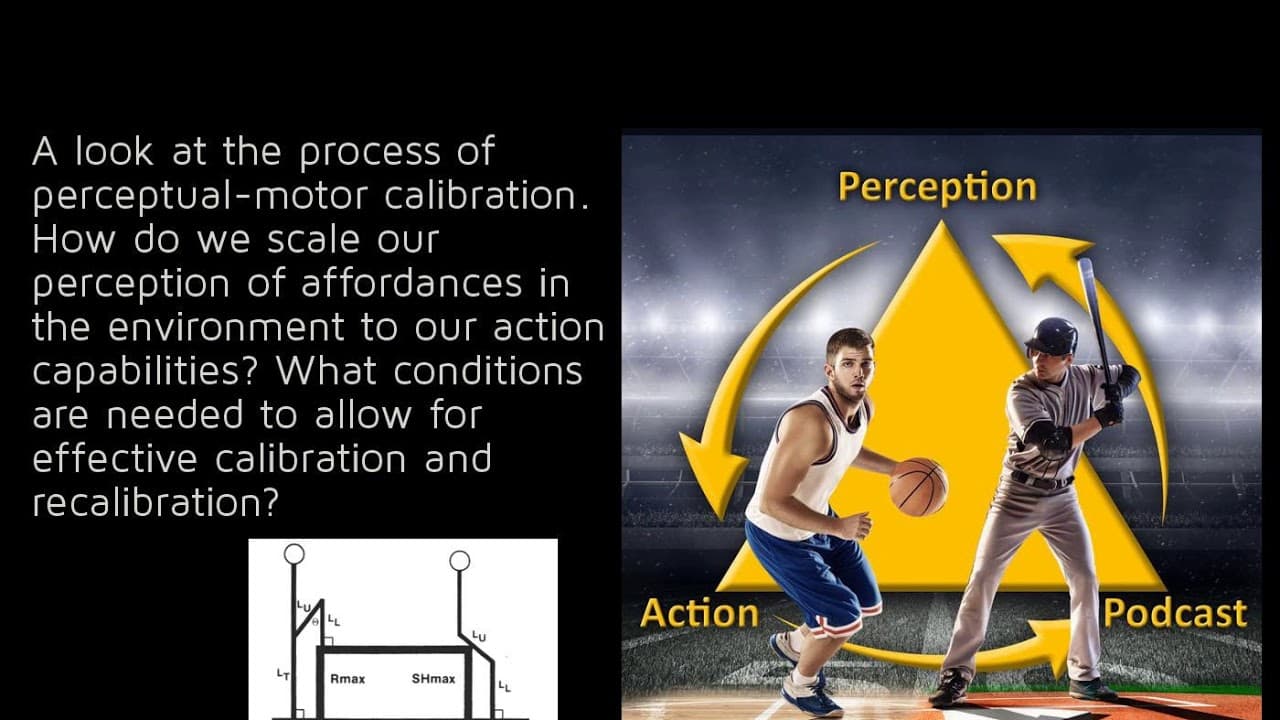
today on the perception and action podcast a look at the process of perceptual motor calibration how do we scale our perception of affordances in the environment to our action capabilities what conditions are needed to allow for effective calibration and recalibration so it's time for a call to action hi everyone this is Rob gray from Arizona State... Read More
Key Insights
- Perceptual-motor calibration involves scaling perception of affordances to match action capabilities, crucial for effective interaction with the environment.
- Calibration is dynamic, requiring ongoing adjustments as action capabilities change due to factors like aging, injury, or equipment modifications.
- The process of calibration involves mapping perceptual information to action-relevant scales, such as converting angular visual data to linear extents.
- Research shows that calibration can be both functional, transferring between similar tasks, and anatomical, specific to individual body parts.
- Effective calibration requires exploration of the perception-action space, allowing individuals to adapt to new conditions and changes in capabilities.
- The mapping theory of calibration suggests that calibration links embodied perception units, like eye height, to action units, like stride length.
- Studies demonstrate that calibration can transfer between limbs for the same action, but anatomical differences may require specific adjustments.
- Coaches should provide opportunities for athletes to explore and recalibrate, especially when changes occur in equipment or physical condition.
Install to Summarize YouTube Videos and Get Transcripts
Explore YouTube Video Summarizer or Get YouTube Transcript Extractor
Questions & Answers
Q: What is perceptual-motor calibration?
Perceptual-motor calibration is the process of aligning perception with action capabilities, enabling individuals to effectively interact with their environment. It involves scaling perceptual information to match bodily actions, ensuring that affordances are accurately perceived and acted upon. This process is crucial for distinguishing possible from impossible actions.
Q: Why is calibration considered dynamic?
Calibration is dynamic because it requires ongoing adjustments as action capabilities change due to factors like aging, injury, or equipment modifications. This continuous process ensures that perception remains aligned with current capabilities, allowing individuals to adapt to new conditions and maintain effective performance.
Q: How does calibration relate to the mapping theory?
The mapping theory of calibration suggests that calibration links embodied perception units, like eye height, to action units, like stride length. Through exploration, individuals learn how many action units correspond to certain perception units, enabling effective scaling of perceptual information for accurate action execution.
Q: What role does exploration play in calibration?
Exploration is crucial for effective calibration, as it allows individuals to gather information necessary for aligning perception with action capabilities. By exploring the perception-action space, individuals can adapt to new conditions and recalibrate when changes occur in their environment or capabilities, ensuring continued performance.
Q: Can calibration transfer between different limbs?
Yes, calibration can transfer between different limbs for the same action, as long as the perceptual and action units involved are the same. However, anatomical differences between limbs may require specific adjustments, emphasizing that calibration is both functional and anatomical, adapting to individual body part characteristics.
Q: What are some factors that influence the timeframe for calibration?
The timeframe for calibration can vary significantly, influenced by factors such as the degree of exploration allowed and the amount of feedback received. Some studies show calibration occurring within seconds, while others indicate it may take up to 30 minutes, highlighting the importance of exploration and feedback in the calibration process.
Q: How do changes in action capabilities affect calibration?
Changes in action capabilities, such as those due to aging, injury, or equipment modifications, necessitate recalibration to ensure perception remains aligned with current capabilities. This dynamic process involves adjusting the scaling of perceptual information to match new action possibilities, maintaining effective interaction with the environment.
Q: What insights can coaches gain from understanding calibration?
Coaches can benefit from understanding calibration by recognizing the importance of providing opportunities for athletes to explore and recalibrate, especially when changes occur in equipment or physical condition. This understanding can inform training strategies that emphasize exploration and adaptation, enhancing athletes' ability to maintain performance.
Summary & Key Takeaways
-
Perceptual-motor calibration is the process of aligning perception with action capabilities, allowing individuals to effectively interact with their environment. This involves scaling perceptual information to match bodily actions, ensuring that affordances are accurately perceived and acted upon.
-
Calibration is a dynamic process, requiring continuous adjustments as action capabilities change due to factors like aging, injury, or new equipment. Effective calibration relies on exploring the perception-action space, enabling individuals to adapt to new conditions and maintain performance.
-
Research indicates that calibration is both functional and anatomical. It can transfer between similar tasks using the same perceptual and action units but also requires specific adjustments for anatomical differences between body parts, emphasizing the need for tailored calibration strategies.
Read in Other Languages (beta)
Share This Summary 📚
Summarize YouTube Videos and Get Video Transcripts with 1-Click
Try YouTube Summary with ChatGPT & Claude or YouTube Transcript Generator
Explore More Summaries from Rob Gray 📚
Summarize YouTube Videos and Get Video Transcripts with 1-Click
Try YouTube Summary with ChatGPT & Claude or YouTube Transcript Generator