Resistors in Electric Circuits (9 of 16) Combination Resistors No. 1
TL;DR
Solving a combination circuit involving parallel and series resistors to find total voltage, resistance, and current.
Transcript
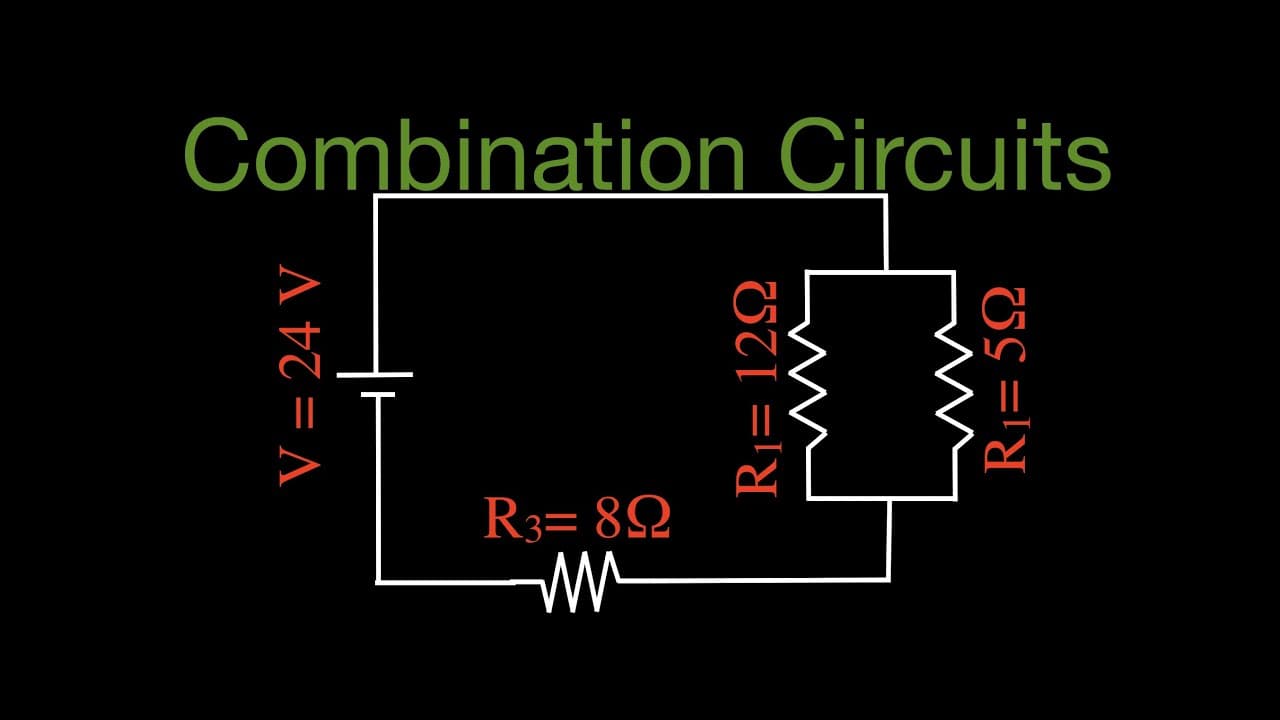
Okay in this video I'm going to go over a problem involving combination circuits and in this problem we're going to have two parallel resistors and those two parallel resistors are going to be in series with a third resistor. So this is a common circuit using resistors only. Okay this is what we got here we got R1 R2, R1 R2 as you can see are paral... Read More
Key Insights
- ❓ Combination circuits involve parallel and series resistors, necessitating step-by-step analysis.
- ❓ Finding equivalent resistance simplifies complex circuits into manageable components.
- 💦 Ohm's law is essential for determining total current and calculating voltage drops.
- ❓ Current distribution through parallel resistors is crucial in solving combination circuit problems.
- 🆘 Labeling and organizing variables help in solving complex electronic circuits accurately.
- 🦻 Voltage across parallel resistors remains the same, aiding in calculations and verifying solutions.
- 🤩 Calculation precision and understanding circuit configurations are key to solving electronic problems effectively.
Install to Summarize YouTube Videos and Get Transcripts
Explore YouTube Video Summarizer or Get YouTube Transcript Extractor
Questions & Answers
Q: How is the equivalent resistance of the parallel resistors calculated?
The equivalent resistance of R1 & R2 is found using 1/(1/R1 + 1/R2), yielding 3.53 ohms, simplifying the parallel resistors.
Q: Why is the voltage drop across parallel resistors the same?
In parallel elements, like resistors, the voltage drop is equal across each element, ensuring 24V total voltage distributes equally.
Q: How is total current calculated in the circuit?
Using Ohm's law (V=IR), total current is I=V/R, resulting in 2.08A by considering total voltage (24V) and total resistance (11.53 ohms).
Q: How is the current through individual resistors determined?
Current through R3 is total current (2.08A), while currents through R1 and R2 are calculated using Ohm's law with respective resistances and voltages.
Summary & Key Takeaways
-
Problem involves two parallel resistors in series with a third resistor in a combination circuit.
-
Steps to solve: find total voltage (24V), equivalent resistance (3.53 ohms for R1 & R2, total 11.53 ohms), total current (2.08A).
-
Breakdown includes voltage drops across each resistor and calculating current through each.
Read in Other Languages (beta)
Share This Summary 📚
Summarize YouTube Videos and Get Video Transcripts with 1-Click
Try YouTube Summary with ChatGPT & Claude or YouTube Transcript Generator
Explore More Summaries from Step by Step Science 📚



Summarize YouTube Videos and Get Video Transcripts with 1-Click
Try YouTube Summary with ChatGPT & Claude or YouTube Transcript Generator