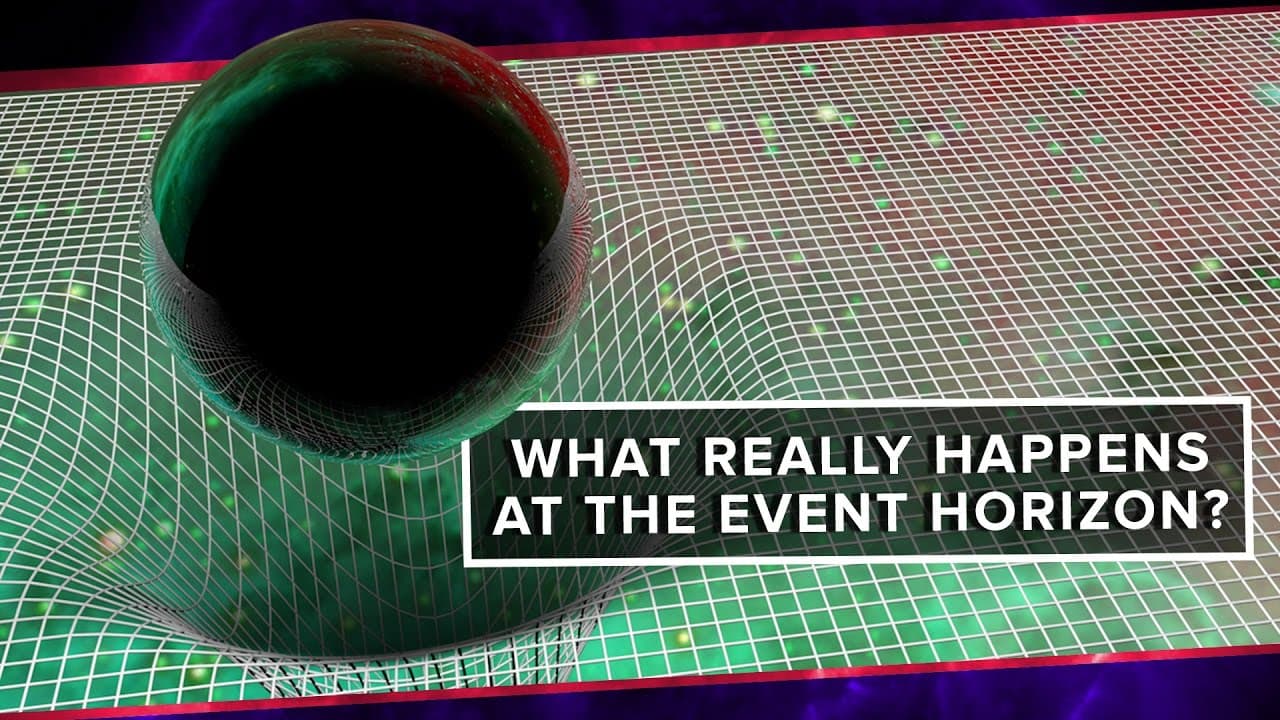
What Happens at the Event Horizon? | Space Time | PBS Digital Studios
TL;DR
Explores the mysteries of black holes using Penrose diagrams.
Transcript
This episode is supported by The Great Courses Plus. At the event horizon of the black hole, space and time are fundamentally changed. Even professional physicists disagree on what we expect to happen there. But there is a powerful tool in physics that can give us real intuition into the true nature of the event horizon. Its time you learned it. Bl... Read More
Key Insights
- The event horizon of a black hole is a region where space and time are fundamentally altered, making escape impossible once crossed.
- Penrose diagrams are used to understand the complex nature of black holes, offering insights into the behavior of light and matter near the event horizon.
- Objects falling into a black hole appear frozen at the event horizon from an outside perspective due to the effects of space-time warping.
- Inside a black hole, all paths lead to the singularity, and escaping back to the outside universe would require faster-than-light travel.
- The Penrose diagram transforms space-time diagrams to compactify infinite space-time and maintain consistent light paths, aiding in understanding black hole dynamics.
- A Schwarzschild black hole is a non-rotating, uncharged black hole, with a Penrose diagram that includes untraversable wormholes and theoretical white holes.
- The concept of a light cone helps visualize the potential paths and influences in space-time, with the event horizon altering these trajectories.
- Black holes present a rich field for theoretical exploration, with potential implications for understanding the universe's fundamental nature.
Install to Summarize YouTube Videos and Get Transcripts
Explore YouTube Video Summarizer or Get YouTube Transcript Extractor
Questions & Answers
Q: What is the event horizon of a black hole?
The event horizon of a black hole is the boundary beyond which nothing can escape the gravitational pull, not even light. It marks the point where the escape velocity equals the speed of light. Once an object crosses this boundary, it is lost to the universe forever, and from an outside perspective, it appears frozen at the horizon due to time dilation effects.
Q: How do Penrose diagrams help in understanding black holes?
Penrose diagrams are a powerful tool in physics that help visualize the complex nature of space-time near black holes. They transform regular space-time diagrams to compactify infinite space-time and ensure light follows consistent paths. This makes it easier to understand the behavior of objects and light as they approach or cross the event horizon, providing a clearer picture of black hole dynamics.
Q: What happens to objects falling into a black hole?
Objects falling into a black hole appear to freeze at the event horizon from an outside observer's perspective due to the warping of space-time. However, from the object's own perspective, it continues to fall towards the singularity, where all paths inevitably lead. Inside the black hole, space flows inward faster than light, making escape impossible without faster-than-light travel.
Q: What is a Schwarzschild black hole?
A Schwarzschild black hole is a theoretical model of a black hole that is non-rotating and uncharged. It is described by the Schwarzschild solution to Einstein's field equations in general relativity. This model serves as a basis for exploring the fundamental properties of black holes, including the behavior of light and matter near the event horizon, and is often represented using Penrose diagrams.
Q: What is the significance of light cones in black hole physics?
Light cones represent the potential paths and influences in space-time. In black hole physics, they help visualize how the event horizon alters these trajectories. As an object approaches the event horizon, its future light cone bends towards the black hole, indicating that fewer possible paths lead away. Inside the event horizon, all paths lead to the singularity, illustrating the inescapable nature of black holes.
Q: Can anything escape from inside a black hole?
Once inside the event horizon of a black hole, escape is impossible using conventional means. All paths within the black hole lead inexorably towards the singularity, where space flows inward faster than light. To escape, an object would need to travel faster than light, which is not possible according to our current understanding of physics.
Q: What are white holes and wormholes in black hole theory?
White holes and wormholes are theoretical constructs in black hole physics. A white hole is a hypothetical region where matter and light can escape but not enter, essentially the reverse of a black hole. Wormholes, or Einstein-Rosen Bridges, are theoretical passages through space-time that could connect separate regions of the universe. While they appear in mathematical models, their physical existence remains speculative.
Q: How does the video address the complexities of black hole physics?
The video uses Penrose diagrams to simplify and explain the complex dynamics of black holes, focusing on the event horizon and the behavior of light and matter. It explores theoretical models like the Schwarzschild black hole, discusses the implications of light cones, and touches on advanced concepts like wormholes and white holes, providing a comprehensive overview of black hole physics.
Summary & Key Takeaways
-
The video explores the concept of the event horizon of black holes, where space and time are dramatically altered, making escape impossible once crossed. Using Penrose diagrams, the episode delves into the complex nature of black holes, providing insights into the behavior of light and matter near these mysterious regions.
-
Penrose diagrams, a tool used by physicists, help visualize the intricate dynamics near a black hole's event horizon. These diagrams compactify infinite space-time and maintain consistent light paths, aiding in understanding how objects and light behave when approaching or crossing the event horizon.
-
A Schwarzschild black hole, a non-rotating and uncharged black hole, serves as a model for exploring these concepts. The video discusses how light cones, representing potential paths and influences, are altered by the event horizon, offering a deeper understanding of black holes' theoretical implications.
Read in Other Languages (beta)
Share This Summary 📚
Summarize YouTube Videos and Get Video Transcripts with 1-Click
Try YouTube Summary with ChatGPT & Claude or YouTube Transcript Generator
Explore More Summaries from PBS Space Time 📚
Summarize YouTube Videos and Get Video Transcripts with 1-Click
Try YouTube Summary with ChatGPT & Claude or YouTube Transcript Generator