Photoelectric Effect (6 of 8) Stopping Potential, An Explanation
TL;DR
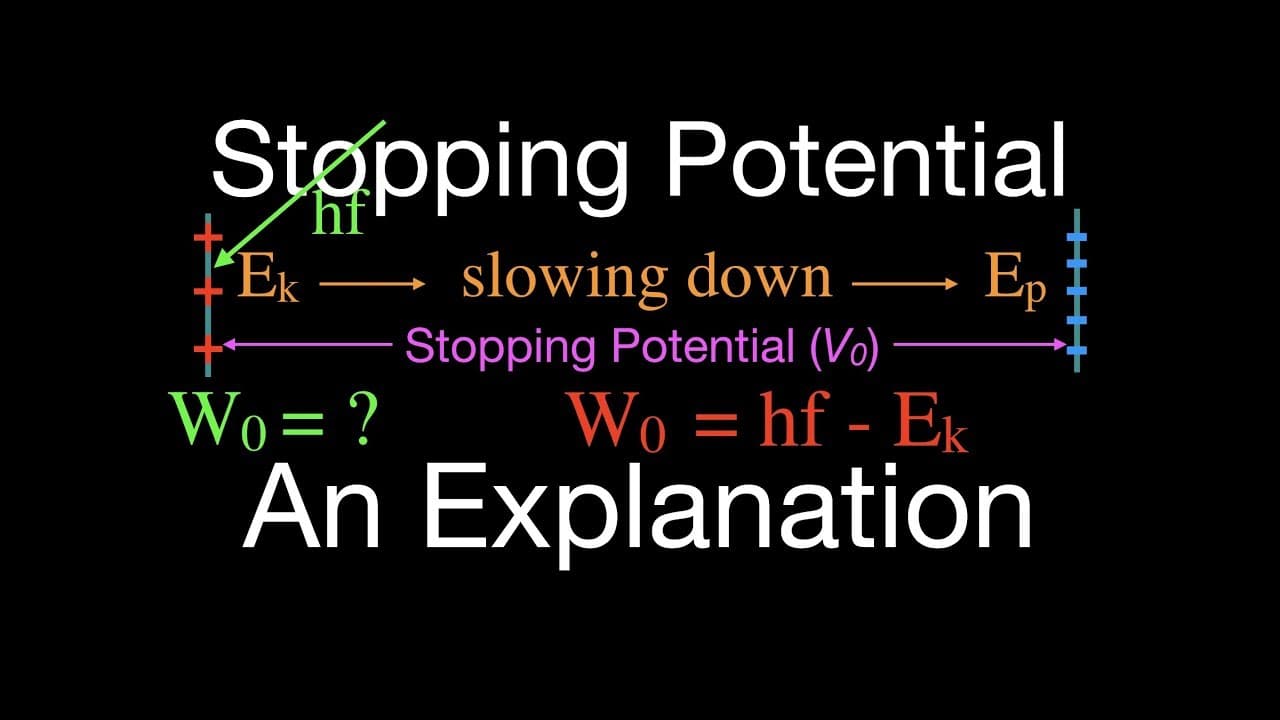
Using stopping potential, calculate work function of sodium metal in photoelectric effect experiment.
Transcript
today's video is another exciting video in the topic of the photoelectric effect and for today's exciting video we're going over a stopping potential I've already made a video talking about the cutoff frequency and explanation the photo effect and also several other example problems that I made you can link to those in the upper right hand corner o... Read More
Key Insights
- 🙅 Stopping potential halts photoelectrons, allowing for measurement of their kinetic energy.
- 💦 Converting kinetic energy to potential energy aids in determining the work function of the metal.
- 🙂 Incident light's energy and wavelength play crucial roles in calculating the work function accurately.
- 🙂 The experiment showcases the relationship between light energy, electron behavior, and metal properties.
- ✋ Understanding the concept of stopping potential is vital in photoelectric effect experiments.
- 💦 Work function calculation provides valuable insights into the characteristics of the metal being studied.
- 💦 The step-by-step process demonstrates how stopping potential can be utilized to determine the work function.
Install to Summarize YouTube Videos and Get Transcripts
Explore YouTube Video Summarizer or Get YouTube Transcript Extractor
Questions & Answers
Q: What is stopping potential in the context of the photoelectric effect?
Stopping potential is the potential applied between plates to stop photoelectrons by converting their kinetic energy into potential energy, allowing measurement of their maximum kinetic energy.
Q: How is work function calculated using stopping potential and incident light energy?
Work function is derived by subtracting the kinetic energy of photoelectrons (determined by stopping potential) from the energy of the incident light, providing insight into the metal's work function value.
Q: Why is it essential to convert kinetic energy of photoelectrons into potential energy?
Converting kinetic energy to potential energy through stopping potential helps determine the work function of the metal, showcasing how light energy affects electron behavior and properties of the metal.
Q: What role does the wavelength of incident light play in the calculation of work function?
The wavelength influences the energy of the incident light, which, in conjunction with stopping potential, allows for the accurate calculation of the work function of the metal in the photoelectric effect experiment.
Summary & Key Takeaways
-
Stopping potential is the potential needed to halt photoelectrons from reaching anode in photoelectric effect.
-
Experiment involves shining light on metal plate, measuring kinetic energy of photoelectrons, converting it into potential energy.
-
By calculating work function using stopping potential and energy of incident light, the experiment determines work function of metal.
Read in Other Languages (beta)
Share This Summary 📚
Summarize YouTube Videos and Get Video Transcripts with 1-Click
Try YouTube Summary with ChatGPT & Claude or YouTube Transcript Generator
Explore More Summaries from Step by Step Science 📚
Summarize YouTube Videos and Get Video Transcripts with 1-Click
Try YouTube Summary with ChatGPT & Claude or YouTube Transcript Generator