L01.9 Countable Additivity
TL;DR
This content discusses probability laws on infinite sample spaces and introduces the concept of countable additivity.
Transcript
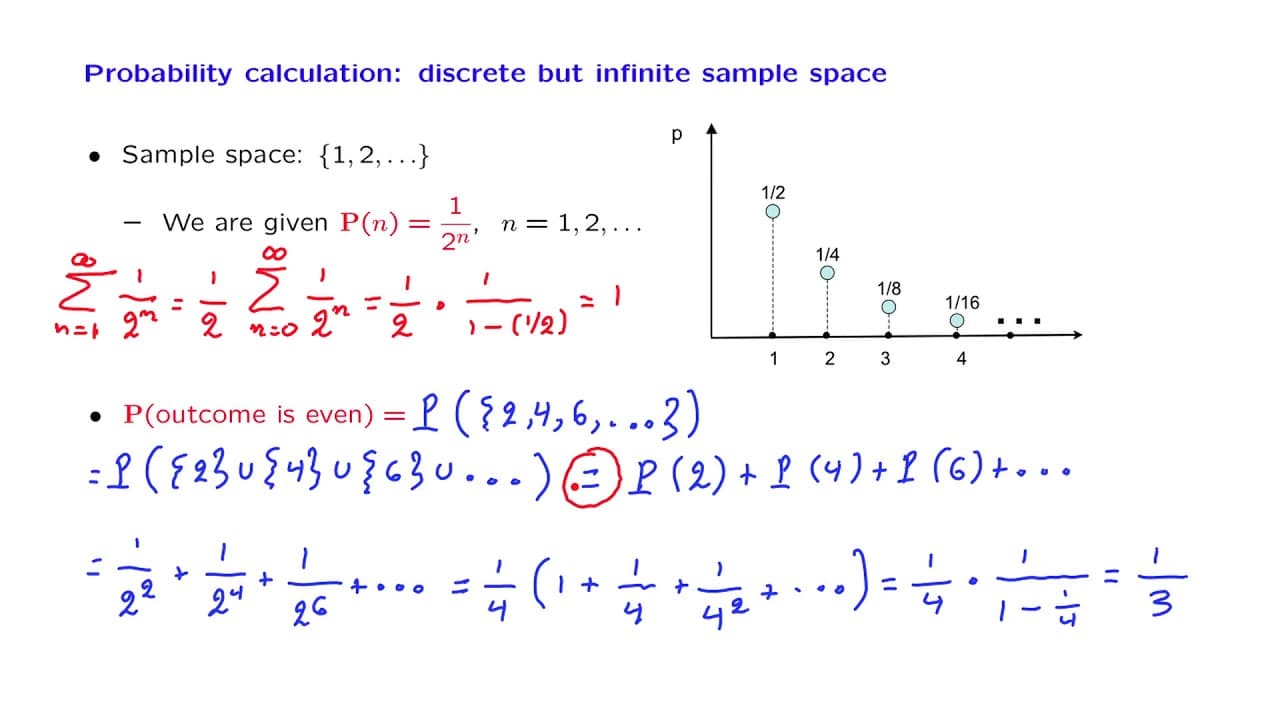
We have seen so far an example of a probability law on a discrete and finite sample space as well as an example with an infinite and continuous sample space. Let us now look at an example involving a discrete but infinite sample space. We carry out an experiment whose outcome is an arbitrary positive integer. As an example of such an experiment, su... Read More
Key Insights
- 👾 Probability laws can be defined on both discrete and finite, as well as infinite and continuous, sample spaces.
- 😫 An experiment with a discrete but infinite sample space can have an infinite set of possible outcomes.
- 👾 The probability law for a sample space with infinite outcomes can be determined by specifying the probabilities of events containing single elements.
- 👻 The additivity property of probability allows us to calculate the probability of a union of events, even if they are infinitely many, as long as they form a sequence.
- 👾 The concept of countable additivity is crucial in probability theory, especially when dealing with infinite sample spaces.
- 😫 The unit square serves as an example of an uncountable set, where the elements cannot be arranged in a sequence.
- ❓ The issue of countable additivity and the legitimacy of probability models, such as the area model, involve deep mathematical concepts in Measure Theory.
Install to Summarize YouTube Videos and Get Transcripts
Explore YouTube Video Summarizer or Get YouTube Transcript Extractor
Questions & Answers
Q: What is an example of an experiment with a discrete but infinite sample space?
One example is the experiment of tossing a coin until heads appears, where the outcome is the number of tosses needed. This experiment has an infinite sample space.
Q: How is the probability law determined for events in a sample space with infinite outcomes?
In this example, the probability law only specifies the probability of events containing a single element. This information is not enough to determine the probability of any subset.
Q: Do the probabilities given in the example add up to 1?
Yes, a quick check shows that the sum of the probabilities for all possible values of n, from 1 to infinity, is equal to 1.
Q: How is the probability of a general event, such as the outcome being even, calculated?
The probability of an event like the outcome being even can be found by summing the probabilities of the individual elements (even numbers) in the set, using the concept of countable additivity.
Summary & Key Takeaways
-
This content provides examples of probability laws on discrete and finite sample spaces, as well as on infinite and continuous sample spaces.
-
It explains an experiment where the outcome is an arbitrary positive integer, such as the number of coin tosses until heads appears.
-
The calculation of probability for general events, such as the probability of the outcome being even, is discussed using the concept of countable additivity.
Read in Other Languages (beta)
Share This Summary 📚
Summarize YouTube Videos and Get Video Transcripts with 1-Click
Try YouTube Summary with ChatGPT & Claude or YouTube Transcript Generator
Explore More Summaries from MIT OpenCourseWare 📚


Summarize YouTube Videos and Get Video Transcripts with 1-Click
Try YouTube Summary with ChatGPT & Claude or YouTube Transcript Generator