31.7 Worked Example - Two Blocks and a Pulley Using Energy
TL;DR
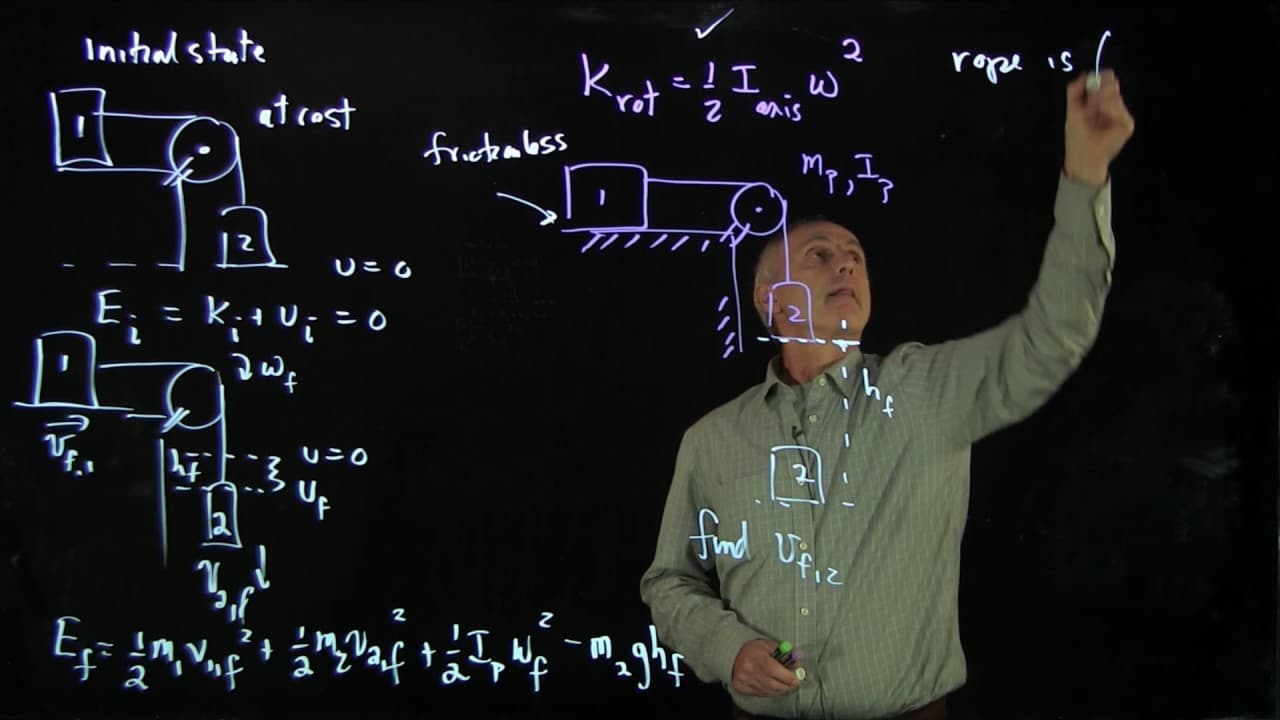
An analysis of the energy principle and how it applies to rotational kinetic energy in a system consisting of a pulley and two blocks.
Transcript
When we used our energy principle, suppose we have an object that starts at a height h0. And this object is dropped, and when it gets to the ground, it has some final velocity. And when we applied our energy principle, assuming that there was no air resistance, what we saw was that the change in kinetic energy plus the change of potential energy wa... Read More
Key Insights
- 🦾 The energy principle states that the total mechanical energy of a system is conserved in the absence of external forces.
- 🐎 Rotational kinetic energy can be calculated using the formula 1/2Iω^2, where I is the moment of inertia and ω is the angular speed.
- ❓ In systems with pulleys, the constraint condition ensures that the velocities of different components are related.
- ❓ By considering both rotational and translational kinetic energy, one can determine the final velocity of objects in a system.
Install to Summarize YouTube Videos and Get Transcripts
Explore YouTube Video Summarizer or Get YouTube Transcript Extractor
Questions & Answers
Q: What is the energy principle and how does it apply to an object falling?
The energy principle states that the change in kinetic energy plus the change in potential energy is zero in the absence of air resistance. When an object is dropped from a height h0, its final velocity can be calculated using the formula square root of 2gh0.
Q: How can rotational kinetic energy be included in the energy principle?
Rotational kinetic energy can be included in the energy principle by considering the moment of inertia of a rotating object. In the example of a pulley and two blocks, the rotational kinetic energy of the pulley is calculated using 1/2Iω^2, where I is the moment of inertia and ω is the angular speed.
Q: What is the constraint condition in the system with the pulley and blocks?
The constraint condition in this system is that the rope is fixed in length, so as block 1 moves, the pulley rotates and block 2 moves. This means that the final velocities of block 1 and block 2 are equal.
Q: How can the final velocity of block 2 be calculated in the given system?
By applying the energy principle and considering both the translational and rotational kinetic energy, the final velocity of block 2 can be found using the equation: Vfinal = square root of (2m2ghfinal) / (1 + m2 + (I/r^2)).
Summary & Key Takeaways
-
The energy principle states that the change in kinetic energy plus the change in potential energy is equal to zero in the absence of air resistance.
-
The kinetic energy of an object falling can be calculated using the formula square root of 2gh0, where g is the acceleration due to gravity and h0 is the initial height.
-
In a system with a pulley, blocks, and a frictionless surface, the final velocity of one of the blocks can be found by considering the rotational and translational kinetic energy, as well as potential energy.
Read in Other Languages (beta)
Share This Summary 📚
Summarize YouTube Videos and Get Video Transcripts with 1-Click
Try YouTube Summary with ChatGPT & Claude or YouTube Transcript Generator
Explore More Summaries from MIT OpenCourseWare 📚


Summarize YouTube Videos and Get Video Transcripts with 1-Click
Try YouTube Summary with ChatGPT & Claude or YouTube Transcript Generator