Products
Features
YouTube Video Summarizer
Summarize YouTube videos
Web & PDF Highlighter
Highlight web pages & PDFs
Chat with PDF
Ask any PDF questions with AI
Ask AI Clone
Chat with your highlights & memories
Audio Transcriber
Transcribe audio files to text
Glasp Reader
Read and highlight articles
Kindle Highlight Export
Export your Kindle highlights
Idea Hatch
Hatch ideas from your highlights
Integrations
Obsidian Plugin
Notion Integration
Pocket Integration
Instapaper Integration
Medium Integration
Readwise Integration
Snipd Integration
Hypothesis Integration
Apps & Extensions
Chrome Extension
Safari Extension
Edge Add-ons
Firefox Add-ons
iOS App
Android App
Discover
Discover
Ideas
Discover new ideas and insights
Articles
Curated articles and insights
Books
Book recommendations by great minds
Posts
Essays and notes from readers
Quotes
Inspiring quotes collection
Videos
Curated videos and summaries
Explore Glasp
Glasp Newsletter
Weekly insights and updates
Glasp Talk
Interview series with great minds
Glasp Blog
Latest news and articles
Glasp Use Cases
Learn how others use Glasp
Build & Support
Glasp API
Access Glasp's API for developers
MCP Connector
Connect Glasp to Claude & ChatGPT
Community
Glasp Reddit Community
Students
Student discount and benefits
FAQs
Frequently Asked Questions
AboutPricing
DashboardLog inSign up

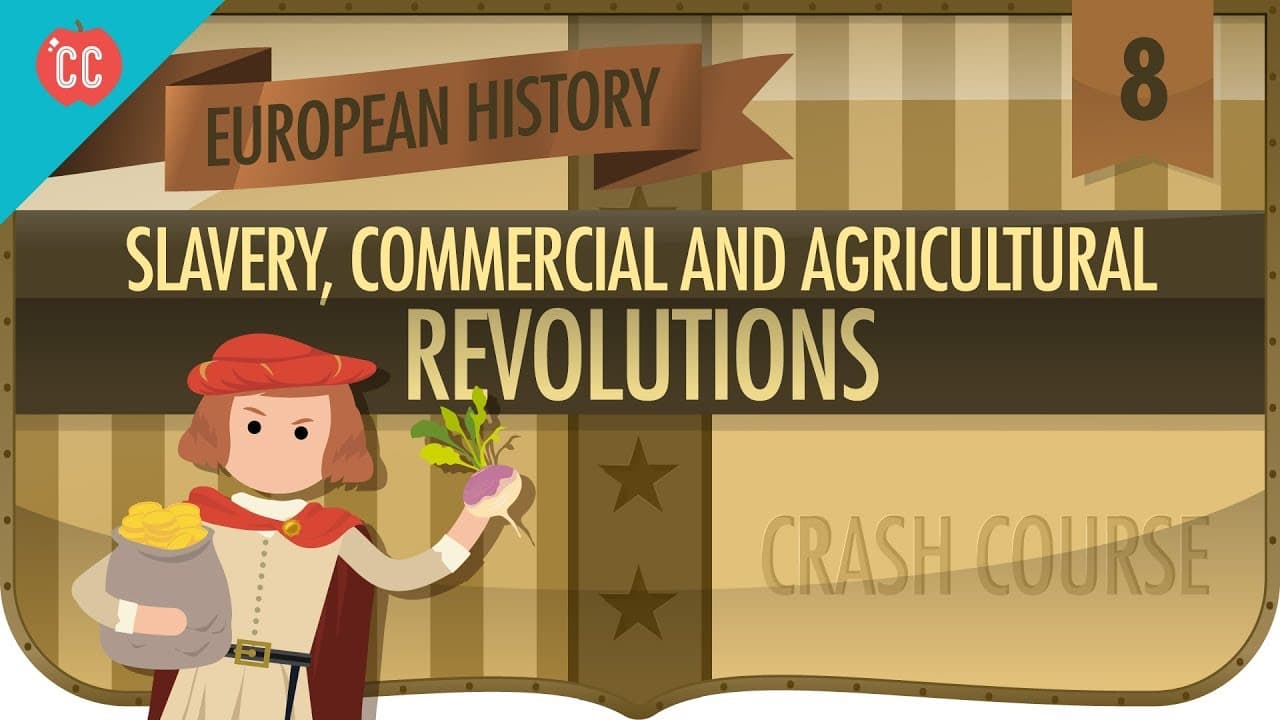
Commerce, Agriculture, and Slavery: Crash Course European History #8
701.3K views
•
June 2, 2019
by
CrashCourse
YouTube video player
Commerce, Agriculture, and Slavery: Crash Course European History #8

TL;DR

From improved agriculture to rise in commerce, European history saw an increase in food production and wealth.

Transcript

Hi I’m John Green and this is Crash Course European History. So, last time, we were focusing on queens and kings and rivalries.Today we’re gonna take a break from struggles over religion and political disputes that made for so much violence and look instead at some basics of everyday life--the foods people ate centuries ago, the kinds of things peo... Read More

Key Insights

  • 😋 Europe's early history was marred by famine and subsistence economies, but the agricultural revolution between 1500-1750 transformed food production and wealth.
  • ⛽ Innovations like crop rotation and mechanized farming practices improved agricultural yields and fueled population growth.
  • 🏤 The European slave trade, driven by the demand for commodities, contributed to the economic growth and wealth of European societies.
  • 👶 Capitalism, emerging from the agricultural and commercial revolutions, shifted societal values towards profit-making and created a new class of wealthy traders.

Install to Summarize YouTube Videos and Get Transcripts

Explore YouTube Video Summarizer or Get YouTube Transcript Extractor

Questions & Answers

Q: How did the agricultural revolution impact European society?

The agricultural revolution boosted food production, population growth, and wealth by introducing innovations like crop rotation and mechanized farming practices.

Q: What role did the Columbian exchange play in European history?

The Columbian exchange facilitated the transfer of new crops like maize and potatoes, leading to increased food production and growth in European populations.

Q: How did the European slave trade contribute to economic growth?

The European slave trade provided forced labor for commodities like sugar and tobacco, fueling economic growth and wealth in European societies.

Q: How did the rise of capitalism change European societal values?

Capitalism, driven by private ownership of enterprises, shifted values towards profit-making and created a class of wealthy traders who competed with the nobility for influence.

Summary & Key Takeaways

  • Europe's early history was marked by famine and subsistence economies, but the agricultural revolution between 1500-1750 led to population growth and wealth.

  • Innovations like crop rotation, land reclamation, and enclosure improved agricultural yields.

  • The expansion of trade, Columbian exchange, and new crops like maize and potatoes transformed European society.


Read in Other Languages (beta)

English

Share This Summary 📚

Summarize YouTube Videos and Get Video Transcripts with 1-Click

Download browser extensions on:

Try YouTube Summary with ChatGPT & Claude or YouTube Transcript Generator

Explore More Summaries from CrashCourse 📚
What Are Biomaterials in Medical Engineering? thumbnail
What Are Biomaterials in Medical Engineering?
CrashCourse
How to Transfer Colleges | Crash Course | How to College thumbnail
How to Transfer Colleges | Crash Course | How to College
CrashCourse
What Are Aldehydes and Ketones in Organic Chemistry? thumbnail
What Are Aldehydes and Ketones in Organic Chemistry?
CrashCourse
Drugs, Dyes, & Mass Transfer: Crash Course Engineering #16 thumbnail
Drugs, Dyes, & Mass Transfer: Crash Course Engineering #16
CrashCourse
What Is Utilitarianism in Philosophy? thumbnail
What Is Utilitarianism in Philosophy?
CrashCourse
21st Century Challenges: Crash Course European History #49 thumbnail
21st Century Challenges: Crash Course European History #49
CrashCourse

Summarize YouTube Videos and Get Video Transcripts with 1-Click

Download browser extensions on:

Try YouTube Summary with ChatGPT & Claude or YouTube Transcript Generator

Apps & Extensions

  • Chrome Extension
  • Safari Extension
  • Edge Add-ons
  • Firefox Add-ons
  • iOS App
  • Android App

Key Features

  • YouTube Video Summarizer
  • Web & PDF Summarizer
  • Web & PDF Highlighter
  • Chat with PDF
  • Ask AI Clone
  • Audio Transcriber
  • Glasp Reader
  • Kindle Highlight Export
  • Idea Hatch

Integrations

  • Obsidian Plugin
  • Notion Integration
  • Pocket Integration
  • Instapaper Integration
  • Medium Integration
  • Readwise Integration
  • Snipd Integration
  • Hypothesis Integration

More Features

  • APIs
  • MCP Connector
  • Blog & Post
  • Embed Links
  • Image Highlight
  • Personality Test
  • Quote Shots

Company

  • About us
  • Blog
  • Community
  • FAQs
  • Job Board
  • Newsletter
  • Pricing
Terms

•

Privacy

•

Guidelines

© 2026 Glasp Inc. All rights reserved.