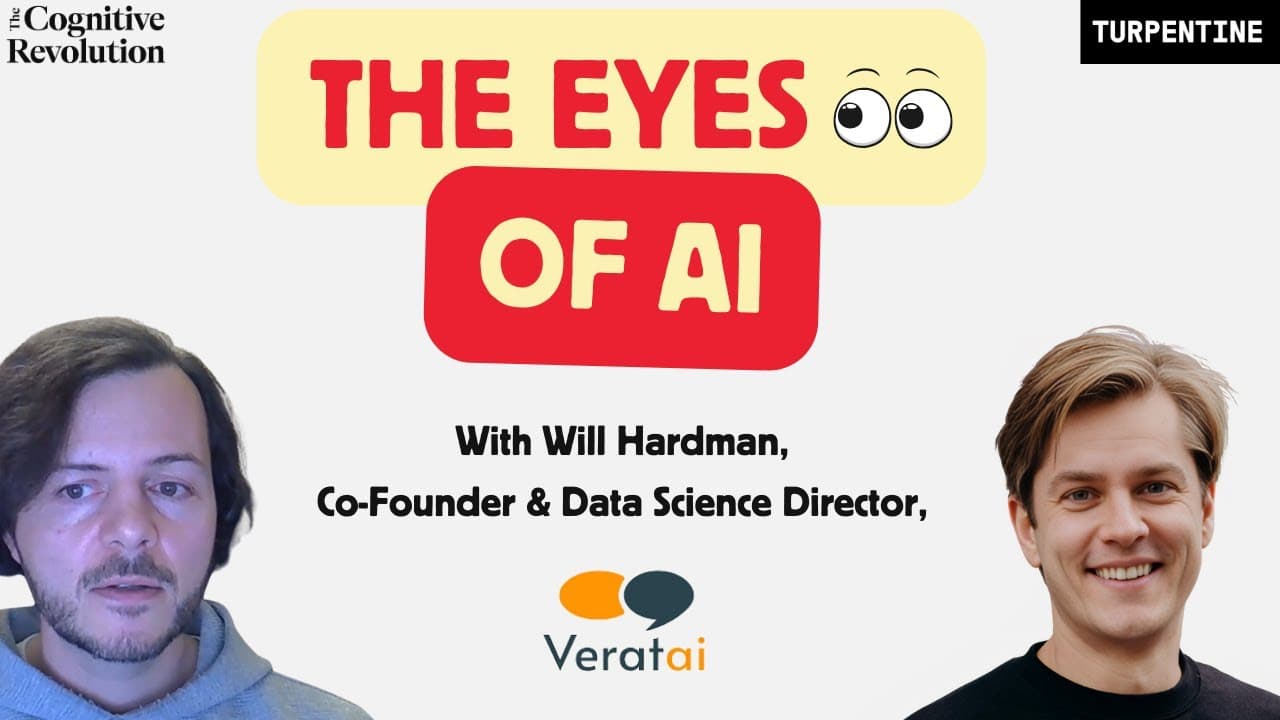
Teaching AI to See: A Technical Deep-Dive on Vision Language Models with Will Hardman of Veratai
TL;DR
Exploration of Vision Language Models' evolution and applications.
Transcript
is multimodal understanding in Ani important on the path towards AGI it's not entirely clear that it is but some people argue that it is so one reason that one might want to research these things is to see if by integrating information from different modalities you obtain another kind of transformational leap in the ability of a a system to underst... Read More
Key Insights
- Vision language models (VLMs) are evolving rapidly, integrating multimodal data to enhance AI's understanding and reasoning abilities.
- DeepMind's Flamingo model introduced cross-attention layers, significantly improving VLMs' ability to process images and text.
- The LAVA model demonstrated the importance of instruction tuning, using synthetic data to enhance VLMs' task diversity.
- The InternVL series from Shanghai University highlights efficient training and scaling strategies, pushing open-source VLM capabilities.
- Pre-training strategies for VLMs involve multiple stages, focusing on aligning vision and language models before fine-tuning.
- Evaluation frameworks like MMMU and Blink are crucial for assessing VLMs' perception, knowledge, and reasoning skills.
- Chinese research teams are making significant strides in VLM development, challenging Western dominance in AI innovation.
- Generative pre-training and multimodal generation are emerging areas, expanding VLMs' potential applications and capabilities.
Install to Summarize YouTube Videos and Get Transcripts
Explore YouTube Video Summarizer or Get YouTube Transcript Extractor
Questions & Answers
Q: What is the significance of the Flamingo model in VLM development?
The Flamingo model by DeepMind is significant for introducing cross-attention layers, which allow for more effective integration of image and text data. This innovation enables the model to process and understand multimodal inputs more efficiently, marking a pivotal moment in the evolution of vision language models. By freezing the language model and focusing on cross-attention, Flamingo improved training efficiency and task performance, paving the way for subsequent VLM advancements.
Q: How does the LAVA model enhance instruction tuning for VLMs?
The LAVA model enhances instruction tuning by generating synthetic data using a strong language model like GPT-4. This process involves creating conversational dialogues between a questioner and a vision assistant, simulating the assistant's ability to see images based on textual descriptions and bounding boxes. By leveraging synthetic data, LAVA expands the range of tasks VLMs can perform, improving their conversational capabilities and complex reasoning skills, demonstrating the power of high-quality instruction tuning.
Q: What role do evaluation frameworks like MMMU play in VLM assessment?
Evaluation frameworks like MMMU are critical for assessing vision language models' capabilities in perception, knowledge, and reasoning. MMMU provides a comprehensive Benchmark with expert-level questions across various disciplines, requiring models to demonstrate high-level understanding and inference abilities. By evaluating models on tasks that require multimodal comprehension, MMMU helps identify strengths and weaknesses, guiding further research and development in VLM technology.
Q: How are Chinese research teams contributing to VLM advancements?
Chinese research teams, such as those behind the InternVL series, are making significant contributions to VLM advancements by focusing on efficient training and scaling strategies. These teams are developing open-source models that compete with leading proprietary models, demonstrating innovative approaches to pre-training, data augmentation, and high-resolution image processing. Their work challenges Western dominance in AI, highlighting China's growing influence in cutting-edge AI research and development.
Q: What are the key stages in pre-training VLMs like QNVL?
Pre-training VLMs like QNVL involves multiple stages, starting with aligning vision and language models using low-quality, high-volume data. The process progresses to multitask pre-training with high-quality, diverse data sets, unfreezing the language model for comprehensive training. The final stage involves supervised fine-tuning with carefully curated data, enhancing the model's task performance and reasoning abilities. This structured approach ensures effective integration of multimodal data and optimal model capabilities.
Q: What innovations are introduced in the InternVL model series?
The InternVL model series introduces several innovations, including scaling up vision transformers, dynamic high-resolution image processing, and progressive scaling strategies for efficient training. These advancements enable the models to handle high-resolution images, align more effectively with language models, and train on large token sets efficiently. By focusing on these areas, the InternVL series pushes the boundaries of open-source VLM capabilities, making them competitive with proprietary models.
Q: Why is generative pre-training important for VLMs?
Generative pre-training is important for VLMs as it enhances their ability to generate and understand multimodal content. By training models to produce coherent outputs from diverse inputs, generative pre-training expands VLMs' applications, enabling them to handle tasks like image generation and complex reasoning. This approach leverages the strengths of both vision and language models, fostering more robust AI systems capable of performing a wide range of tasks with improved accuracy and creativity.
Q: How do VLMs impact AI's path towards AGI?
VLMs impact AI's path towards AGI by integrating multimodal data, enhancing AI's understanding and reasoning capabilities. By processing and reasoning over multiple data types, VLMs contribute to a more holistic AI system, potentially leading to transformational leaps in AI's ability to comprehend and interact with the world. While the necessity of multimodal understanding for AGI is debated, VLMs represent a significant step towards more advanced, versatile AI systems that mimic human-like perception and cognition.
Summary & Key Takeaways
-
This episode delves into the technical evolution of vision language models (VLMs), exploring their development from early vision transformers to advanced architectures like InternVL and Llama3V. Key innovations and architectural decisions are discussed, highlighting their impact on AI's multimodal capabilities.
-
Will Hardman, founder of AI advisory firm Veritai, provides expert insights into VLMs, covering topics such as cross-attention, instruction tuning, and efficient training strategies. The episode examines evaluation frameworks and the role of Chinese research teams in advancing VLM technology.
-
The discussion emphasizes the importance of pre-training strategies, data quality, and diverse task representation in enhancing VLMs' performance. The episode concludes with an exploration of generative pre-training and the potential of multimodal generation in expanding AI's applications.
Read in Other Languages (beta)
Share This Summary 📚
Summarize YouTube Videos and Get Video Transcripts with 1-Click
Try YouTube Summary with ChatGPT & Claude or YouTube Transcript Generator
Explore More Summaries from Cognitive Revolution "How AI Changes Everything" 📚





Summarize YouTube Videos and Get Video Transcripts with 1-Click
Try YouTube Summary with ChatGPT & Claude or YouTube Transcript Generator