OpenAI's Sora Made Me Crazy AI Videos—Then the CTO Answered (Most of) My Questions | WSJ
TL;DR
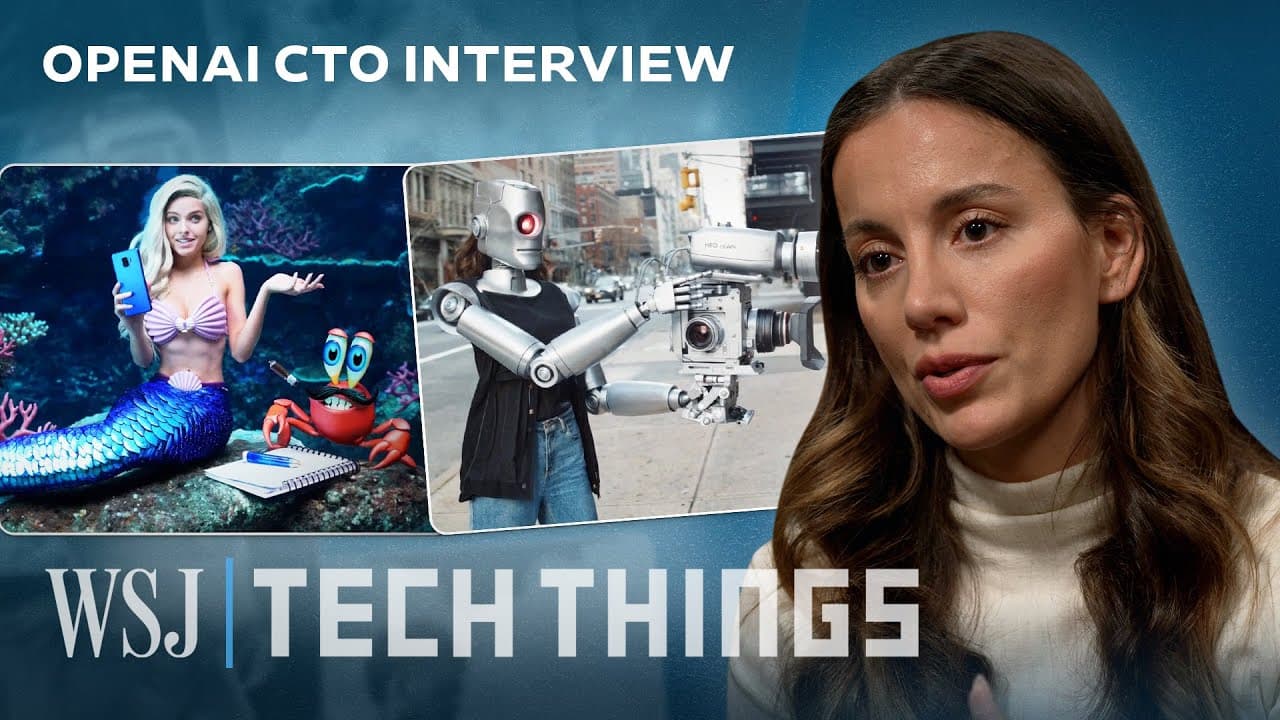
OpenAI's AI model, Sora, generates hyper realistic and detailed videos based on text prompts, but it still has flaws and imperfections.
Transcript
- The video captures sort of the detail of the prompt when it comes to the hair and you know, sort of like professionally-styled women. - But you can also see some issues. - Certainly, especially when it comes to the hands. - [Joanna] These two women, not real. They were created by Sora, OpenAI's text-to-video AI model. But these two women, very re... Read More
Key Insights
- 👨🔬 Sora, OpenAI's AI model, generates highly realistic and detailed videos, but it is still a research output, making it more expensive than models like ChatGPT and DALL-E.
- 🎮 Continuity and consistency between frames are crucial for creating a realistic video, and Sora excels in this aspect but still has imperfections and glitches.
- 🎮 OpenAI is committed to ensuring the safety, reliability, and trustworthiness of AI-generated videos before widely deploying them.
- 😒 The use of watermarking and content provenance is being explored to differentiate between real and AI-generated content and combat misinformation.
- 😪 Red teaming, testing for vulnerabilities and biases, is an essential part of the development process to address potential ethical concerns.
- 👤 OpenAI emphasizes collaboration with creators and users to shape the development and deployment of AI tools, including addressing limitations and navigating complex societal questions.
- 🦺 AI tools, including Sora, have the potential to extend creativity and knowledge but require careful consideration of safety, ethical, and societal implications.
Install to Summarize YouTube Videos and Get Transcripts
Explore YouTube Video Summarizer or Get YouTube Transcript Extractor
Questions & Answers
Q: How does Sora work?
Sora is a diffusion model, a type of generative model that starts with random noise and creates a distilled image. It analyzes videos to learn about objects and actions, then generates scenes based on a text prompt.
Q: How does Sora achieve such smooth and realistic videos?
Sora ensures smoothness and realism by maintaining consistency between frames, creating a sense of continuity. This gives a more realistic and immersive experience. However, it is not perfect and can still have some glitches.
Q: What data was used to train Sora?
OpenAI used publicly available and licensed data to train Sora. While it is unclear if YouTube, Facebook, or Instagram videos were used, the licensed data does include content from Shutterstock.
Q: When will Sora be available to the public?
OpenAI aims to make Sora available at a similar cost to DALL-E, but the exact timeline is uncertain. Hopefully, it will be released sometime within the year, possibly a few months after the interview.
Summary & Key Takeaways
-
OpenAI's Sora is a video generation model that creates one-minute videos based on text prompts, producing highly detailed and realistic results.
-
Sora analyzes videos to understand objects and actions, then generates scenes by defining timelines and adding detail to each frame.
-
While the AI-generated videos are impressive, they still have glitches and imperfections, such as inconsistencies in following the prompt and issues with continuity.
Read in Other Languages (beta)
Share This Summary 📚
Summarize YouTube Videos and Get Video Transcripts with 1-Click
Try YouTube Summary with ChatGPT & Claude or YouTube Transcript Generator
Explore More Summaries from The Wall Street Journal 📚






Summarize YouTube Videos and Get Video Transcripts with 1-Click
Try YouTube Summary with ChatGPT & Claude or YouTube Transcript Generator