Open House 2017 - Barcoding the Brain
TL;DR
Barcoding neurons enables faster brain mapping and disease research.
Transcript
- So, to get with, I was just wondering, how many of you, use a GPS or some sort of a map, to get around places? Right, like even here today. That's basically all of you. So, I think is pretty fair to say, having a map is an incredible useful thing. If, you know try to situate yourself, you try to not get lost, or try to get places. So, Neuroscient... Read More
Key Insights
- Mapping the brain is essential for understanding its complex structure, but traditional methods are slow due to the sheer number of neurons and their intricate connections.
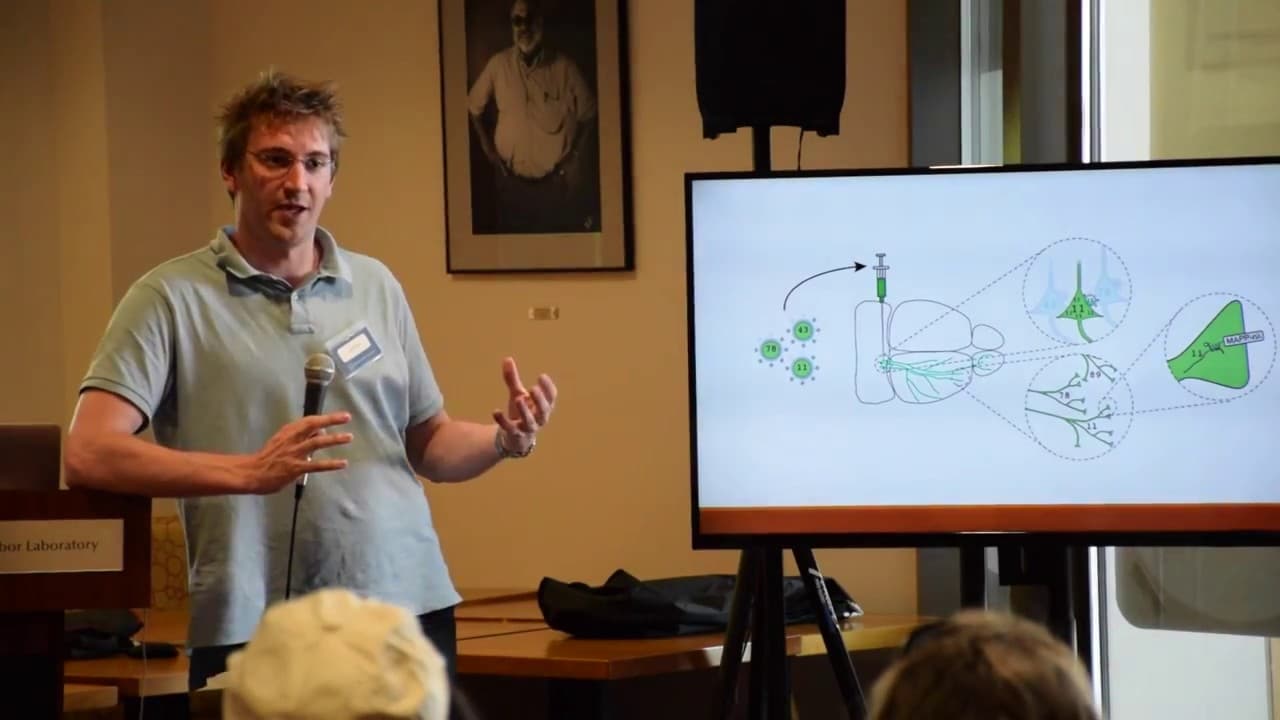
- Neuroscientists have developed a new method of mapping the brain using barcodes, allowing them to label thousands of neurons uniquely and efficiently.
- Barcodes are introduced into neurons using a deactivated virus, and these barcodes are made of DNA sequences that can be easily tracked.
- This method significantly speeds up the process of brain mapping, making it 100,000 times faster than previous techniques.
- The new barcoding method allows researchers to study both healthy brain wiring and the changes that occur in neurological diseases like autism and schizophrenia.
- DNA sequencing technology, which has become faster and cheaper, is used to read the barcodes, enabling detailed analysis of neuronal connections.
- Barcoding is not only useful for mapping brain wiring but is also being applied in cancer research to track cell lineage and tumor growth.
- Future advancements may allow for the barcoding of entire human brains, providing unprecedented insights into individual brain differences and disease mechanisms.
Install to Summarize YouTube Videos and Get Transcripts
Explore YouTube Video Summarizer or Get YouTube Transcript Extractor
Questions & Answers
Q: How does barcoding improve brain mapping?
Barcoding improves brain mapping by allowing scientists to label and track thousands of neurons simultaneously. This method uses DNA sequences as unique identifiers for each neuron, which can be easily read using DNA sequencing technology. This approach drastically reduces the time and effort needed compared to traditional microscopy methods.
Q: What are the barcodes made of?
The barcodes used in brain mapping are made of DNA or RNA sequences. These sequences consist of thirty random letters, which provide a unique identifier for each neuron. The use of DNA allows for a vast number of unique combinations, enabling the labeling of millions of neurons within a single experiment.
Q: How are barcodes introduced into neurons?
Barcodes are introduced into neurons using a deactivated virus. The virus acts as a delivery vehicle, carrying the DNA sequences into the neuronal cells. This process ensures that each neuron receives a unique barcode, which can then be used to track its connections throughout the brain.
Q: What role does DNA sequencing play in this process?
DNA sequencing is crucial for reading the barcodes introduced into the neurons. It allows researchers to identify and track the unique DNA sequences associated with each neuron. Advances in sequencing technology have made this process faster and more cost-effective, facilitating large-scale brain mapping projects.
Q: Can this method be used to study brain diseases?
Yes, the barcoding method can be used to study brain diseases. By mapping neuronal connections in both healthy and diseased brains, researchers can identify changes in wiring patterns associated with conditions like autism and schizophrenia. This understanding can lead to better insights into disease mechanisms and potential treatments.
Q: Is barcoding being used in other fields of research?
Barcoding is also being used in cancer research to track tumor growth and cell lineage. By introducing barcodes into tumor cells, researchers can monitor how the tumor develops and spreads. This information is valuable for understanding cancer progression and developing targeted therapies.
Q: What are the future prospects of brain barcoding?
Future prospects of brain barcoding include the potential to map entire human brains. This would provide unprecedented insights into individual brain differences and the specific changes that occur in neurological diseases. Advances in technology may also allow for more precise and comprehensive mapping techniques.
Q: What challenges are associated with this method?
Challenges associated with this method include ensuring the accuracy of barcode introduction and avoiding errors during DNA sequencing. Additionally, the technique requires the use of viruses to introduce barcodes, which must be carefully controlled to prevent unintended effects. Despite these challenges, the method offers significant advantages over traditional brain mapping techniques.
Summary & Key Takeaways
-
Neuroscientists have developed a novel method for mapping the brain using barcodes, which allows for the unique labeling of thousands of neurons. This technique is significantly faster than traditional methods, enabling comprehensive analysis of brain wiring.
-
The barcoding process involves introducing DNA sequences into neurons via deactivated viruses. These sequences act as unique identifiers, allowing researchers to track neuronal connections without the need for labor-intensive microscopy.
-
This method is revolutionizing neuroscience by providing insights into both healthy brain function and the alterations seen in neurological diseases. It also holds potential for applications in cancer research by tracking cell lineage and tumor development.
Read in Other Languages (beta)
Share This Summary 📚
Summarize YouTube Videos and Get Video Transcripts with 1-Click
Try YouTube Summary with ChatGPT & Claude or YouTube Transcript Generator
Explore More Summaries from Cold Spring Harbor Laboratory 📚




Summarize YouTube Videos and Get Video Transcripts with 1-Click
Try YouTube Summary with ChatGPT & Claude or YouTube Transcript Generator