Thanks To Gaia We Now Know Exactly Where 1.7 Billion Stars Are In The Milky Way
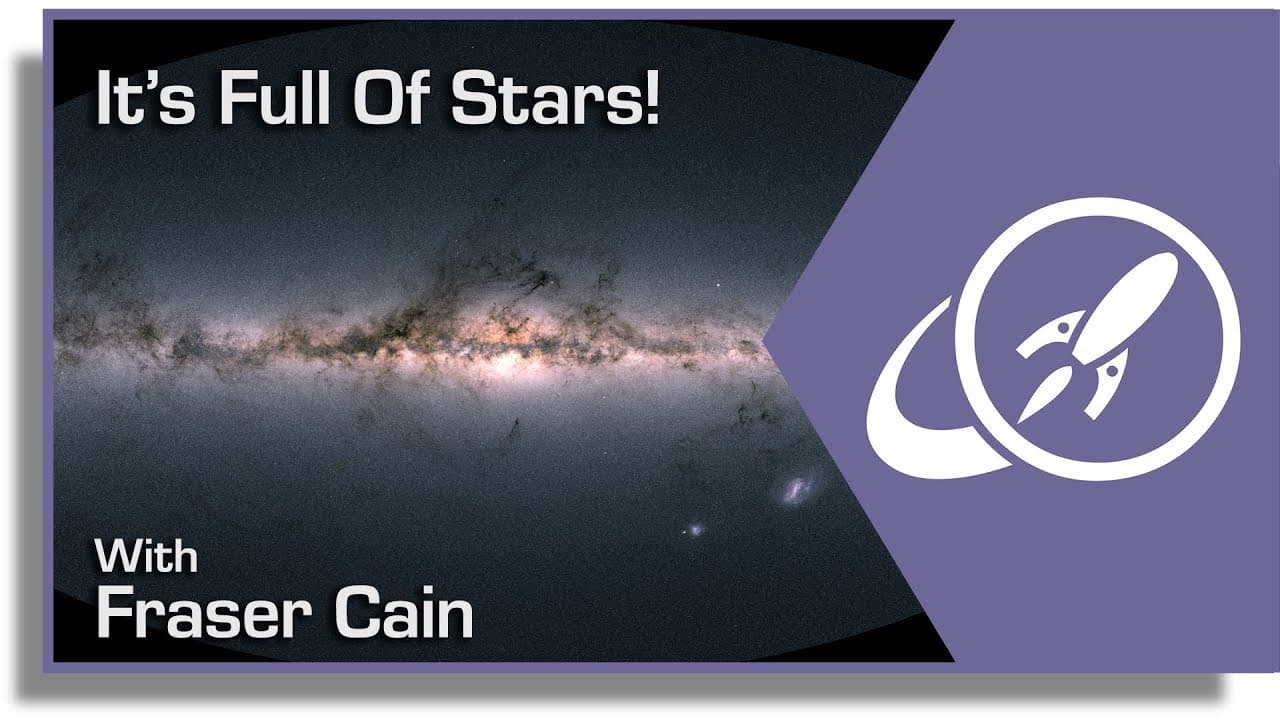
TL;DR
The European Space Agency's Gaia mission released a catalog of 1.7 billion stars, providing groundbreaking insights into the Milky Way and beyond.
Transcript
We live in the Milky Way, a galaxy that contains 100 to 400 billion stars. But even though we live inside it, and can observe an incomprehensible number of stars strewn across the night sky, we actually know very little about the galaxy around us. But last month the European Space Agency increased our knowledge of our place in the Universe a tiny b... Read More
Key Insights
- 🤩 Gaia's data catalog of 1.7 billion stars revolutionizes our understanding of the Milky Way and beyond.
- 💁 The mission's precise mapping offers astronomers valuable insights into stellar evolution, formation, and dynamics.
- 🤩 Gaia's data release includes information on asteroids, quasars, variable stars, and brown dwarf stars, expanding our knowledge of the Universe.
- 🦻 The data also aids in predicting asteroid movements, discovering extrasolar planets, and studying gravitational effects.
Install to Summarize YouTube Videos and Get Transcripts
Explore YouTube Video Summarizer or Get YouTube Transcript Extractor
Questions & Answers
Q: What is the significance of the Gaia mission's data release?
The Gaia mission's data release sheds light on the precise mapping of stars, exoplanets, asteroids, and even dark matter, offering astronomers unprecedented insights into our galaxy and beyond.
Q: How does Gaia's astrometry technique work in cataloging stars?
Gaia's astrometry technique involves detecting slight shifts in star positions over six months, allowing it to determine distances, movements, and even surface temperatures of the observed stars.
Q: Besides mapping stars, what additional celestial objects did Gaia's data reveal?
Gaia's data not only mapped stars but also unveiled information about asteroids, quasars, variable stars, brown dwarf stars, and even provided a reference frame for precise coordinates in the Universe.
Q: How will Gaia's data contribute to scientific knowledge in the future?
Gaia's data will aid in studying stellar formation, understanding the dynamics of celestial objects, predicting asteroid movements, and testing fundamental theories like General Relativity in the coming years.
Summary & Key Takeaways
-
ESA's Gaia mission delivered a catalog of 1.7 billion stars, unveiling a detailed map of the Milky Way's stars, exoplanets, asteroids, dark matter, and more.
-
Gaia's data offers astronomers the most precise measurements ever made of the galaxy, opening new avenues for research and discoveries.
-
The mission's extensive data not only maps out the local Universe but also aids in understanding distant objects like quasars, asteroids, and even testing Einstein's Theory of General Relativity.
Read in Other Languages (beta)
Share This Summary 📚
Summarize YouTube Videos and Get Video Transcripts with 1-Click
Try YouTube Summary with ChatGPT & Claude or YouTube Transcript Generator
Explore More Summaries from Fraser Cain 📚





Summarize YouTube Videos and Get Video Transcripts with 1-Click
Try YouTube Summary with ChatGPT & Claude or YouTube Transcript Generator