Hypertonic, Hypotonic, and Isotonic Solutions
TL;DR
This video explains the differences between hypertonic, hypotonic, and isotonic solutions and how they affect cells.
Transcript
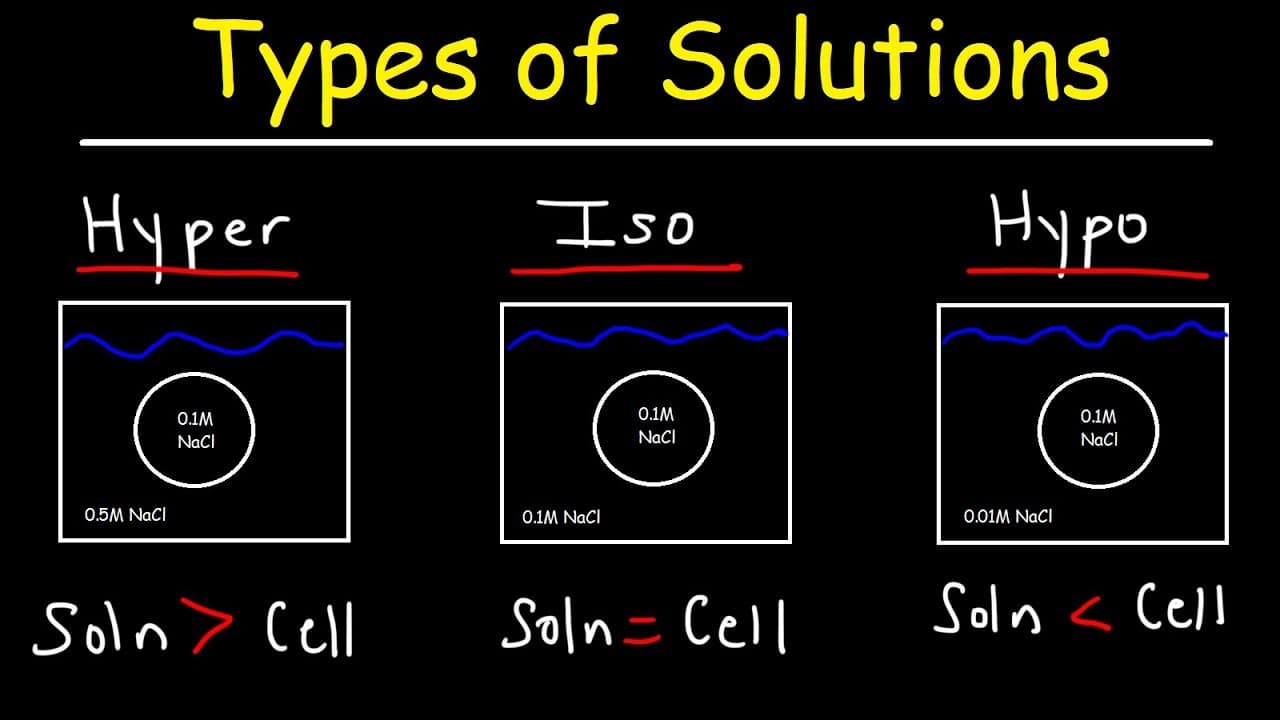
so here we have three containers with salt water solutions and in each container we placed a giant cell let's assume it's a one huge giant cell now looking at these three solutions which one is a hypertonic solution a hypotonic solution and an isotonic solution what would you say well we can easily spot the isotonic solution the word iso means the ... Read More
Key Insights
- 🥺 Hypertonic solutions have higher solute concentration outside the cell, leading to water flowing out and the cell shrinking.
- 💐 Hypotonic solutions have lower solute concentration outside the cell, causing water to flow in and the cell to expand.
- 💦 In isotonic solutions, solute concentrations inside and outside the cell are equal, resulting in no net movement of water.
- 😘 Osmosis is the diffusion of water from high to low concentration.
- 😑 Water is attracted to ions in a solution, causing it to flow towards higher solute concentrations.
- 💦 The direction of net water movement can be analyzed based on either the concentration of water or the solute concentration.
Install to Summarize YouTube Videos and Get Transcripts
Explore YouTube Video Summarizer or Get YouTube Transcript Extractor
Questions & Answers
Q: What is the difference between hypertonic, hypotonic, and isotonic solutions?
Hypertonic solution has a higher solute concentration outside the cell, causing water to flow out and the cell to shrink. Hypotonic solution has a lower solute concentration outside the cell, causing water to flow in and the cell to swell. Isotonic solution has equal solute concentrations inside and outside the cell, resulting in no net movement of water.
Q: Why does water flow out of the cell in a hypertonic solution?
In a hypertonic solution, the higher solute concentration outside the cell attracts water molecules, causing them to flow out of the cell. This leads to a shrinkage of the cell.
Q: How does a cell behave in an isotonic solution?
In an isotonic solution, there is no net movement of water into or out of the cell as the solute concentrations inside and outside the cell are equal. The cell maintains its shape without shrinking or expanding.
Q: What happens to a cell in a hypotonic solution?
In a hypotonic solution, with lower solute concentration outside the cell, water flows into the cell, causing it to swell. Continued influx of water can even cause the cell to burst in a process called cytolysis.
Summary & Key Takeaways
-
The video discusses three containers with salt water solutions and giant cells placed in them.
-
The middle container contains an isotonic solution, where the solute concentration inside and outside the cell is equal.
-
The container on the left contains a hypertonic solution, with a higher solute concentration outside the cell, causing water to flow out and the cell to shrivel.
Read in Other Languages (beta)
Share This Summary 📚
Summarize YouTube Videos and Get Video Transcripts with 1-Click
Try YouTube Summary with ChatGPT & Claude or YouTube Transcript Generator
Explore More Summaries from The Organic Chemistry Tutor 📚




Summarize YouTube Videos and Get Video Transcripts with 1-Click
Try YouTube Summary with ChatGPT & Claude or YouTube Transcript Generator