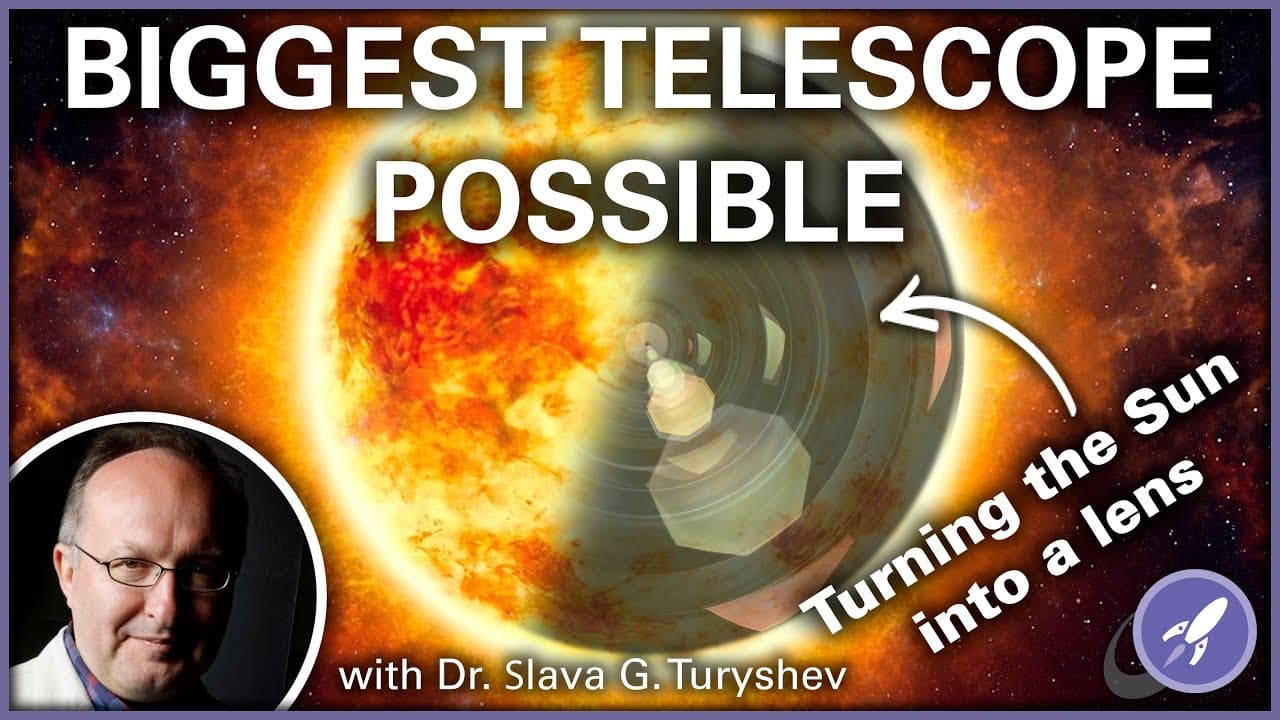
Turning the Sun Into a Giant Telescope with Dr. Slava Turyshev
TL;DR
Dr. Slava Turyshev discusses the Solar Gravitational Lens mission, pushing mission design limits with longevity, power, and autonomy challenges, enabling high-speed spacecraft in space exploration.
Transcript
Fraser Cain: Hi, everyone, I'm Fraser Cain. I'm the publisher of Universe Today I've been a space and astronomy journalist for over 20 years. And with these interviews, I try to bring you behind the scenes so you can hear the space and astronomy research the ideas that are coming directly from the scientists themselves. And today, I'm joined by Dr.... Read More
Key Insights
- 🎟️ Solar Gravitational Lens mission aims to reach the focal region for exoplanet imaging.
- ✊ Challenges include power, communication, and longevity for a 25-year mission.
- ✊ Technologies such as solar sailing and distributed power sources will enable autonomous spacecraft operations.
- 🚄 Future missions could use high-speed spacecraft for in-depth exploration of the Solar System.
Install to Summarize YouTube Videos and Get Transcripts
Explore YouTube Video Summarizer or Get YouTube Transcript Extractor
Questions & Answers
Q: What are the key technical challenges in developing a Solar Gravitational Lens mission?
The main challenges are power generation, communication, and ensuring longevity of equipment over a 25-year mission duration.
Q: How will the spacecraft achieve autonomy for operations in the focal region?
The spacecraft will need to operate autonomously as umbilical communication from Earth won't be possible, requiring reliable onboard systems.
Q: How will the spacecraft navigate and maintain alignment with the exoplanet for imaging?
The spacecraft will establish a local reference frame using amplified light from the host star and continuously monitor its position in relation to the optical axis.
Q: How will power generation be maintained over the 25-year mission duration?
The mission includes innovative technologies such as distributed power sources and radiation-hardened batteries to ensure power availability throughout the mission.
Summary & Key Takeaways
-
Dr. Slava Turyshev details the Solar Gravitational Lens mission, aiming to reach the focal region for exoplanet imaging.
-
Challenges include power, communication, and longevity for a mission lasting 25 years or more.
-
Technology includes solar sailing spacecraft and distributed power sources for autonomous operations.
Read in Other Languages (beta)
Share This Summary 📚
Summarize YouTube Videos and Get Video Transcripts with 1-Click
Try YouTube Summary with ChatGPT & Claude or YouTube Transcript Generator
Explore More Summaries from Fraser Cain 📚



Summarize YouTube Videos and Get Video Transcripts with 1-Click
Try YouTube Summary with ChatGPT & Claude or YouTube Transcript Generator