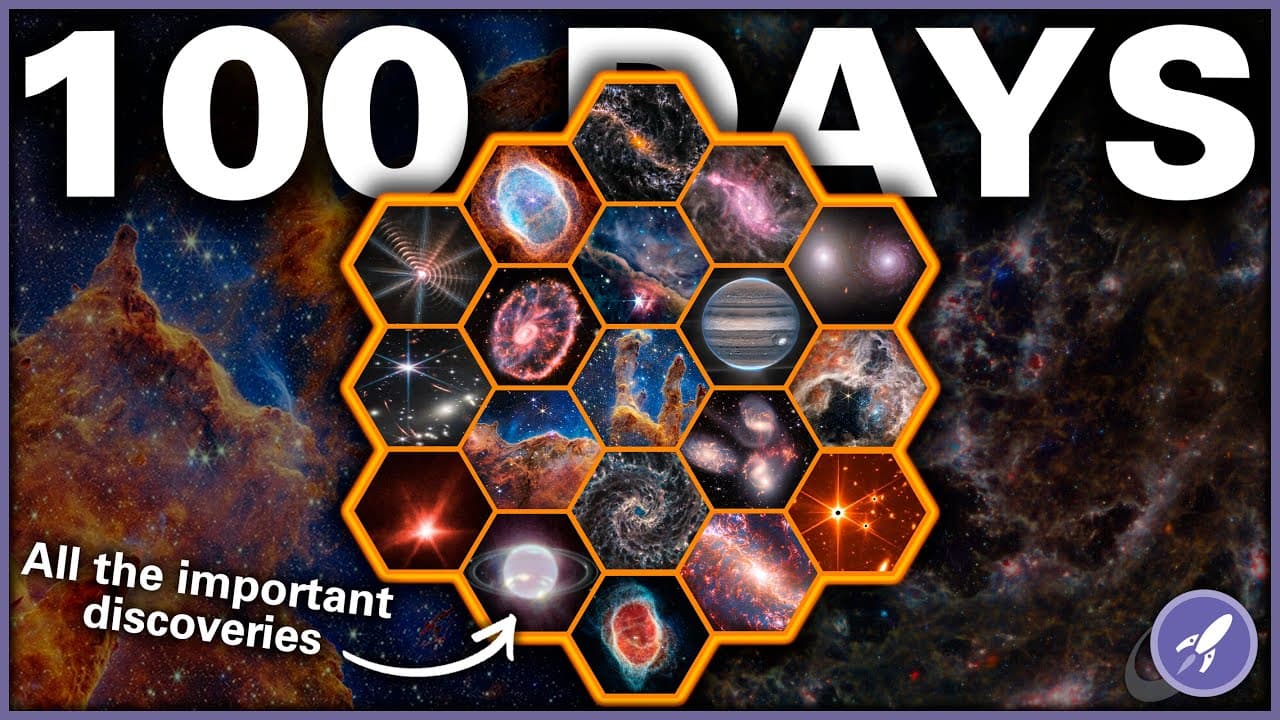
What Did NASA Discover in James Webb's First 100 Days
TL;DR
- James Webb Telescope has made significant discoveries in the first 100 days, including insights into galaxy evolution and exoplanets.
Transcript
on July 12 2022 we saw the first set of images from James Webb the Karina nebula s Max 0723 Wasp 96b the southern Ring Nebula and Stefan's quintet we're now exactly 100 days since those first Five results were released it's time for an update hi everyone I'm Fraser Kane I am the publisher of universe today I've been a space in astronomy journalist ... Read More
Key Insights
- 💁 James Webb Telescope explores early galaxy formation and challenges existing models of galaxy evolution.
- 🤩 Insights from the telescope include mature galaxies and stars shortly after the Big Bang.
- 🤗 The discovery of water vapor and carbon dioxide in exoplanet atmospheres opens new avenues for exoplanet research.
- 🔬 The telescope's observations of objects within the solar system provide valuable data for planetary science.
- 🧑🌾 James Webb Telescope's ability to see in the far infrared realm enables the study of faint objects from the early universe.
- 💁 Observations of globular clusters offer insights into their formation and history.
- 👾 The telescope's longer-than-expected lifespan and minor damages demonstrate its resilience in space.
Install to Summarize YouTube Videos and Get Transcripts
Explore YouTube Video Summarizer or Get YouTube Transcript Extractor
Questions & Answers
Q: What are the primary science objectives of the James Webb Telescope?
The primary science objectives include studying the end of the Dark Ages, first light, reionization, ancient galaxies, star formation, planetary systems, and the origins of life.
Q: How has the telescope changed our understanding of galaxy evolution in the early universe?
James Webb Telescope has revealed surprisingly mature galaxies and stars just 250 million years after the Big Bang. This challenges previous assumptions about galaxy formation and indicates a more complex process.
Q: What insights have been gained about exoplanets from the James Webb Telescope?
The telescope detected water vapor and carbon dioxide in exoplanet atmospheres, providing crucial information about the chemical compositions of distant worlds.
Q: How has the James Webb Telescope contributed to our understanding of objects within the solar system?
The telescope has captured detailed images of Jupiter, Mars, and Neptune, showcasing unique features such as auroras, storms, and rings.
Summary & Key Takeaways
-
James Webb Telescope conducted a variety of observations in the first 100 days since launch.
-
Significant findings include insights into early galaxy formation and mature galaxies.
-
The telescope also studied exoplanets, globular clusters, and objects within the solar system.
Read in Other Languages (beta)
Share This Summary 📚
Summarize YouTube Videos and Get Video Transcripts with 1-Click
Try YouTube Summary with ChatGPT & Claude or YouTube Transcript Generator
Explore More Summaries from Fraser Cain 📚



Summarize YouTube Videos and Get Video Transcripts with 1-Click
Try YouTube Summary with ChatGPT & Claude or YouTube Transcript Generator