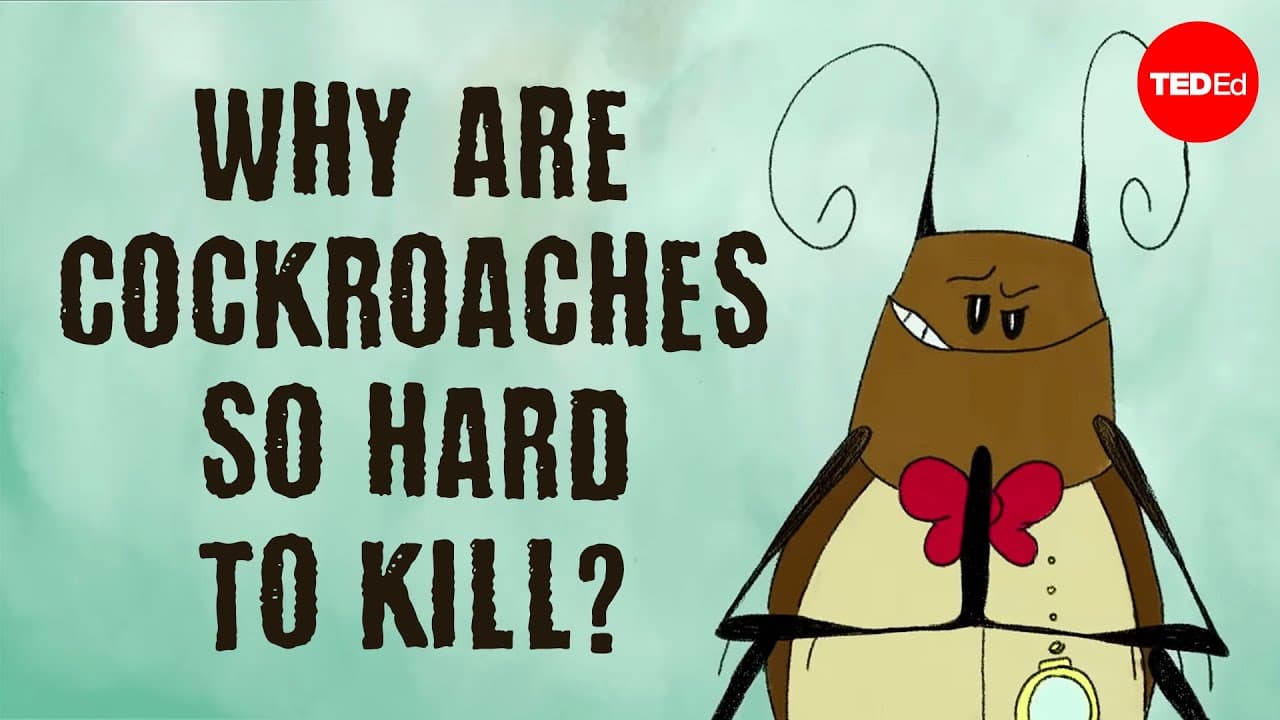
Why are cockroaches so hard to kill? - Ameya Gondhalekar
TL;DR
Cockroaches' resilience stems from physical adaptions, speed, digestion capabilities, gene immunity, and pesticide resistance.
Transcript
In the Egyptian Book of the Dead, there’s a banishment spell that declares, “Be far from me, O vile cockroach.” More than 3,000 years later, we’re still trying to oust these insects. But from poison traps to hastily brandished slippers, cockroaches seem to weather just about everything we throw at them. So what makes cockroaches so hard to kill... Read More
Key Insights
- 🐎 Cockroaches' adaptions, like speed and physical structure, help them escape threats quickly.
- 🏪 Their ability to thrive in nutrient-poor environments is due to storing nitrogen-containing wastes.
- 🪳 Cockroaches have genes that provide immunity against pathogens and defenses against pesticides.
- 🪳 Pesticide resistance in cockroach populations can evolve quickly, making them challenging to eradicate.
- 🪳 Contrary to popular belief, cockroaches have only mild tolerance to radiation and would not likely survive a nuclear apocalypse.
- 🪳 Cockroaches' resilience poses challenges for pest control but also highlights their incredible diversity and abilities to adapt.
- 🪳 Cockroaches' interactions with pathogens, pesticides, and mutations showcase their remarkable survival strategies.
Install to Summarize YouTube Videos and Get Transcripts
Explore YouTube Video Summarizer or Get YouTube Transcript Extractor
Questions & Answers
Q: Why are cockroaches so hard to kill?
Cockroaches' resilience is attributed to their adaptions like speed, physical structure, and sensory hairs which help them detect threats and flee rapidly.
Q: How do cockroaches survive in nutrient-poor environments?
Cockroaches thrive in nutrient-poor environments by storing nitrogen-containing wastes in their bodies and having resident bacteria recycle nitrogen into useful molecules.
Q: What makes cockroaches immune to pathogens?
Cockroaches possess genes that provide immunity against pathogens, often duplicated many times over, so their immune system can efficiently unleash antimicrobial molecules.
Q: How do cockroaches defend against pesticides?
Cockroaches have evolved resistance to pesticides through genetic mutations that render the pesticides harmless by producing detoxification enzymes and excreting the chemicals as waste.
Summary & Key Takeaways
-
Cockroaches' resilience stems from their adaptions, speed, digestion capabilities, gene immunity, and pesticide resistance.
-
They store nitrogen-containing wastes in their bodies, have genes that provide immunity against pathogens, and can withstand high compressive forces.
-
Cockroaches can survive in nutrient-poor environments, eat decaying foods, and possess defenses against pesticides.
Read in Other Languages (beta)
Share This Summary 📚
Summarize YouTube Videos and Get Video Transcripts with 1-Click
Try YouTube Summary with ChatGPT & Claude or YouTube Transcript Generator
Explore More Summaries from TED-Ed 📚






Summarize YouTube Videos and Get Video Transcripts with 1-Click
Try YouTube Summary with ChatGPT & Claude or YouTube Transcript Generator