Products
Features
YouTube Video Summarizer
Summarize YouTube videos
Web & PDF Highlighter
Highlight web pages & PDFs
Chat with PDF
Ask any PDF questions with AI
Ask AI Clone
Chat with your highlights & memories
Audio Transcriber
Transcribe audio files to text
Glasp Reader
Read and highlight articles
Kindle Highlight Export
Export your Kindle highlights
Idea Hatch
Hatch ideas from your highlights
Integrations
Obsidian Plugin
Notion Integration
Pocket Integration
Instapaper Integration
Medium Integration
Readwise Integration
Snipd Integration
Hypothesis Integration
Apps & Extensions
Chrome Extension
Safari Extension
Edge Add-ons
Firefox Add-ons
iOS App
Android App
Discover
Discover
Ideas
Discover new ideas and insights
Articles
Curated articles and insights
Books
Book recommendations by great minds
Posts
Essays and notes from readers
Quotes
Inspiring quotes collection
Videos
Curated videos and summaries
Explore Glasp
Glasp Newsletter
Weekly insights and updates
Glasp Talk
Interview series with great minds
Glasp Blog
Latest news and articles
Glasp Use Cases
Learn how others use Glasp
Build & Support
Glasp API
Access Glasp's API for developers
MCP Connector
Connect Glasp to Claude & ChatGPT
Community
Glasp Reddit Community
Students
Student discount and benefits
FAQs
Frequently Asked Questions
AboutPricing
DashboardLog inSign up

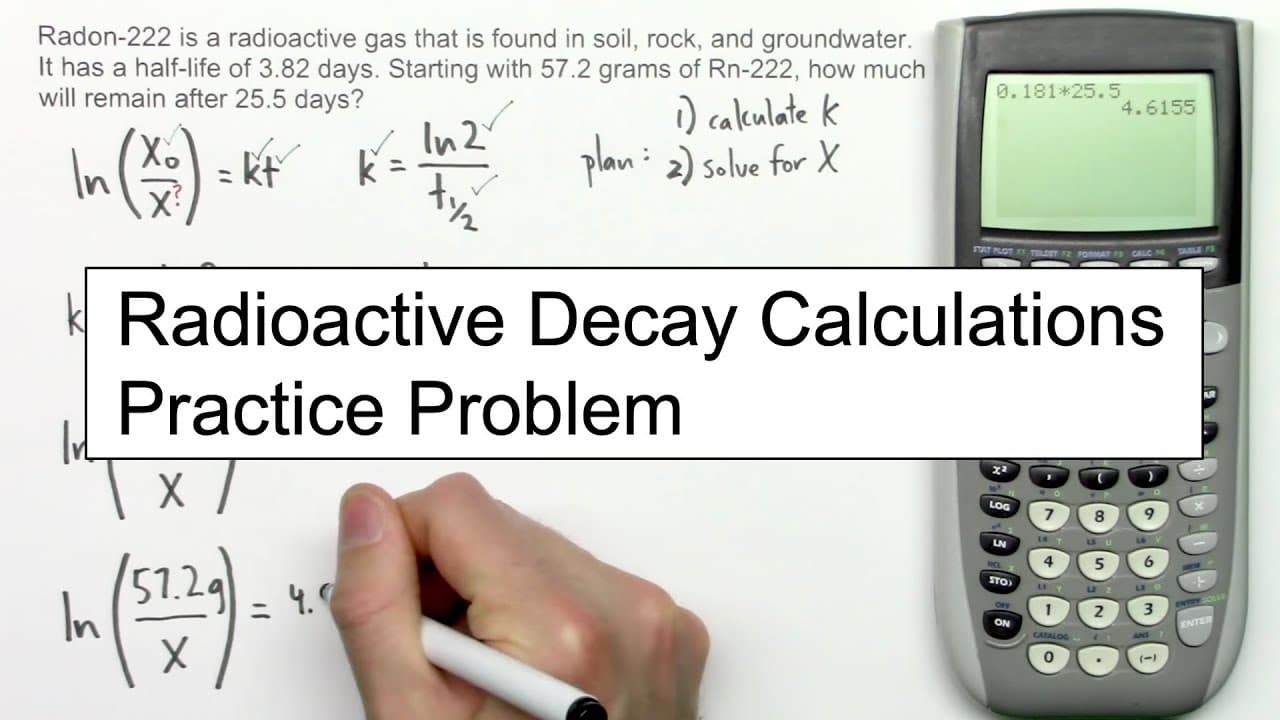
Radioactive Decay Calculations Practice Problem
31.5K views
•
June 30, 2022
by
Tyler DeWitt
YouTube video player
Radioactive Decay Calculations Practice Problem

TL;DR

Solving for remaining radon-222 after 25.5 days using decay equations and mathematical calculations.

Transcript

radon-222 is a radioactive gas that is found in soil rock and groundwater it has a half-life of 3.8 two days starting with 57.2 grams of radon-222 how much will remain after twenty five point five days okay so in this problem we're talking about half-life we have a radioactive isotope here we're interested in the amount that we start with the amoun... Read More

Key Insights

  • 🥳 Radon-222 undergoes radioactive decay with a half-life of 3.82 days.
  • ❓ Decay calculations involve utilizing decay equations and mathematical formulas.
  • 🦻 The natural logarithm function aids in simplifying exponential decay calculations.
  • ❓ Understanding the decay process of radon-222 is essential for solving nuclear decay problems accurately.
  • ⌛ The initial quantity of radon-222 is crucial in determining the remaining amount after a specified time.
  • 👌 Calculating the decay constant, K, is a crucial step in solving radioactive decay equations.
  • ☠️ Mathematical calculations play a vital role in determining the decay rate and remaining quantity of radioactive substances.

Install to Summarize YouTube Videos and Get Transcripts

Explore YouTube Video Summarizer or Get YouTube Transcript Extractor

Questions & Answers

Q: What is radon-222, and why is it important in radioactive decay calculations?

Radon-222 is a radioactive gas found in soil and groundwater, crucial for understanding decay processes due to its predictable half-life and decay rate.

Q: How is the half-life of radon-222 utilized in the decay calculations?

The half-life of radon-222, 3.82 days, is a key parameter used in decay equations to determine the amount of remaining substance after a specific time period.

Q: Why are mathematical equations and calculations necessary for solving nuclear decay problems?

Mathematical formulas, like the decay equations used in this scenario, provide a systematic approach to solving complex decay problems involving radioactive isotopes and their decay rates.

Q: How is the natural logarithm function applied in the decay calculations?

The natural logarithm function, Ln, is used to remove e from the exponential equation, simplifying the calculation process and allowing for the determination of the remaining quantity accurately.

Summary & Key Takeaways

  • Radon-222, a radioactive gas, decays with a half-life of 3.82 days.

  • Calculating the remaining amount of radon-222 after 25.5 days using decay equations.

  • Utilizing mathematical formulas to determine the decay process and final quantity.


Read in Other Languages (beta)

English

Share This Summary 📚

Summarize YouTube Videos and Get Video Transcripts with 1-Click

Download browser extensions on:

Try YouTube Summary with ChatGPT & Claude or YouTube Transcript Generator

Explore More Summaries from Tyler DeWitt 📚
What Happens when Stuff Dissolves? thumbnail
What Happens when Stuff Dissolves?
Tyler DeWitt
AP® Chemistry Kinetics Questions Free Response thumbnail
AP® Chemistry Kinetics Questions Free Response
Tyler DeWitt
Super Common Mistake: Diatomic Elements thumbnail
Super Common Mistake: Diatomic Elements
Tyler DeWitt
Converting Between Grams and Moles (Part 2) thumbnail
Converting Between Grams and Moles (Part 2)
Tyler DeWitt
Cellscape VR Biology Guided Tour for Kids thumbnail
Cellscape VR Biology Guided Tour for Kids
Tyler DeWitt
Kinetics and Reaction Rates (AP Chemistry) thumbnail
Kinetics and Reaction Rates (AP Chemistry)
Tyler DeWitt

Summarize YouTube Videos and Get Video Transcripts with 1-Click

Download browser extensions on:

Try YouTube Summary with ChatGPT & Claude or YouTube Transcript Generator

Apps & Extensions

  • Chrome Extension
  • Safari Extension
  • Edge Add-ons
  • Firefox Add-ons
  • iOS App
  • Android App

Key Features

  • YouTube Video Summarizer
  • Web & PDF Summarizer
  • Web & PDF Highlighter
  • Chat with PDF
  • Ask AI Clone
  • Audio Transcriber
  • Glasp Reader
  • Kindle Highlight Export
  • Idea Hatch

Integrations

  • Obsidian Plugin
  • Notion Integration
  • Pocket Integration
  • Instapaper Integration
  • Medium Integration
  • Readwise Integration
  • Snipd Integration
  • Hypothesis Integration

More Features

  • APIs
  • MCP Connector
  • Blog & Post
  • Embed Links
  • Image Highlight
  • Personality Test
  • Quote Shots

Company

  • About us
  • Blog
  • Community
  • FAQs
  • Job Board
  • Newsletter
  • Pricing
Terms

•

Privacy

•

Guidelines

© 2026 Glasp Inc. All rights reserved.