Volume Flow Rate & Mass Flow Rate - Fluid Dynamics Physics Problems
TL;DR
This video explains how to calculate mass and volume flow rates in fluid systems and provides examples with step-by-step calculations.
Transcript
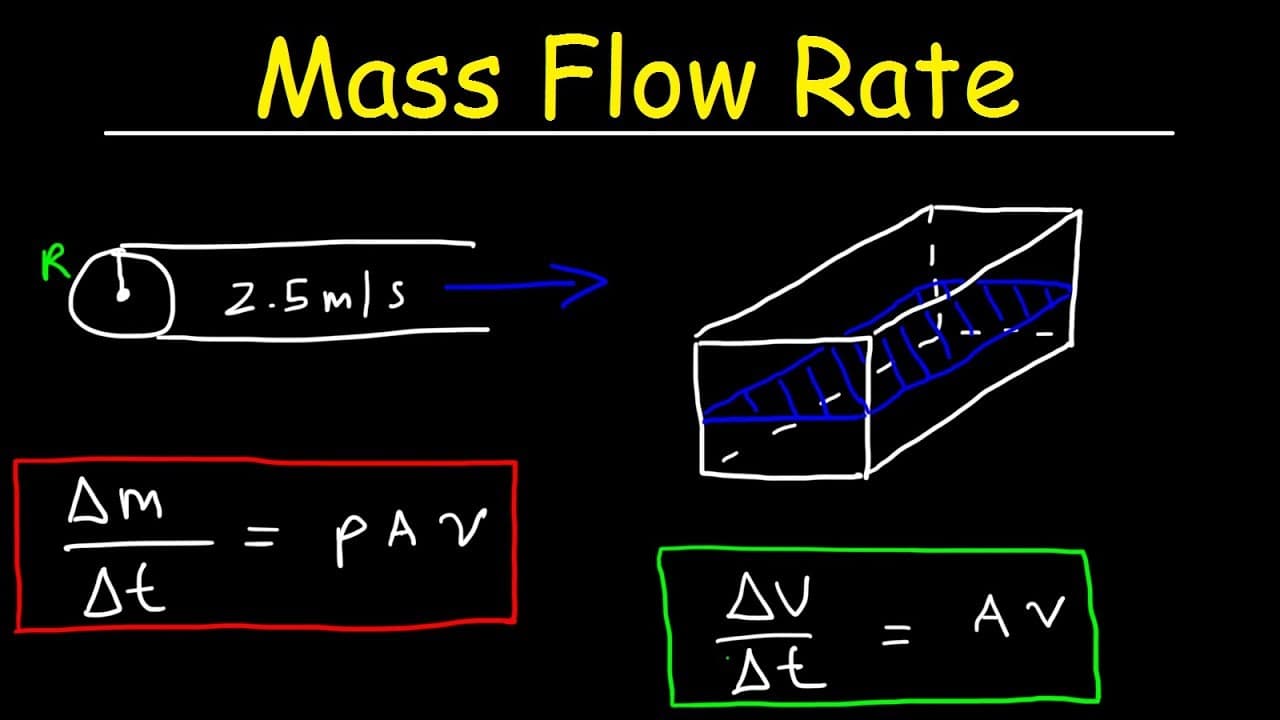
in this video we're going to focus on the mass flow rate and volume flow rate in fluids so let's start with this problem water flows through a circular pipe with a radius of 15 centimeters at a rate of 1.5 meters per second into a storage tank calculate the mass flow rate so let's draw a picture so let's say we have a circular pipe and water flows ... Read More
Key Insights
- ☠️ Mass flow rate is determined by the density, cross-sectional area, and speed of the fluid.
- ☠️ The volume flow rate is calculated using the cross-sectional area of the pipe and the speed of the fluid.
Install to Summarize YouTube Videos and Get Transcripts
Explore YouTube Video Summarizer or Get YouTube Transcript Extractor
Questions & Answers
Q: How is mass flow rate calculated?
Mass flow rate is calculated by multiplying the density of the fluid by the cross-sectional area of the pipe and the speed of the fluid. It represents the mass of the fluid flowing through the pipe per unit of time.
Q: Why is volume flow rate important in fluid systems?
Volume flow rate is important in fluid systems because it helps determine how quickly a fluid is filling or emptying a container. It can be used to calculate the time it takes to fill or empty a tank or pool.
Q: What is the relationship between velocity and volume flow rate?
Velocity and volume flow rate are directly related. As the velocity of the fluid increases, the volume flow rate also increases, assuming the cross-sectional area remains constant.
Q: How can the time to fill a container be calculated using volume flow rate?
To calculate the time to fill a container, divide the volume of the container by the volume flow rate. This will give you the time in seconds, which can be converted to minutes or hours if needed.
Summary & Key Takeaways
-
The video introduces the concept of mass flow rate, which is the amount of mass that flows through a pipe in a given time period.
-
It explains how to calculate the mass flow rate using the density, cross-sectional area of the pipe, and the speed of the fluid.
-
The video also covers volume flow rate, which is the rate at which the volume of a fluid is changing, and demonstrates how to calculate it using the cross-sectional area and speed of the fluid.
Read in Other Languages (beta)
Share This Summary 📚
Summarize YouTube Videos and Get Video Transcripts with 1-Click
Try YouTube Summary with ChatGPT & Claude or YouTube Transcript Generator
Explore More Summaries from The Organic Chemistry Tutor 📚


Summarize YouTube Videos and Get Video Transcripts with 1-Click
Try YouTube Summary with ChatGPT & Claude or YouTube Transcript Generator