Two Supernovae Hit Earth // Rogue Planets in Orion Nebula // A Star That Disappeared
TL;DR
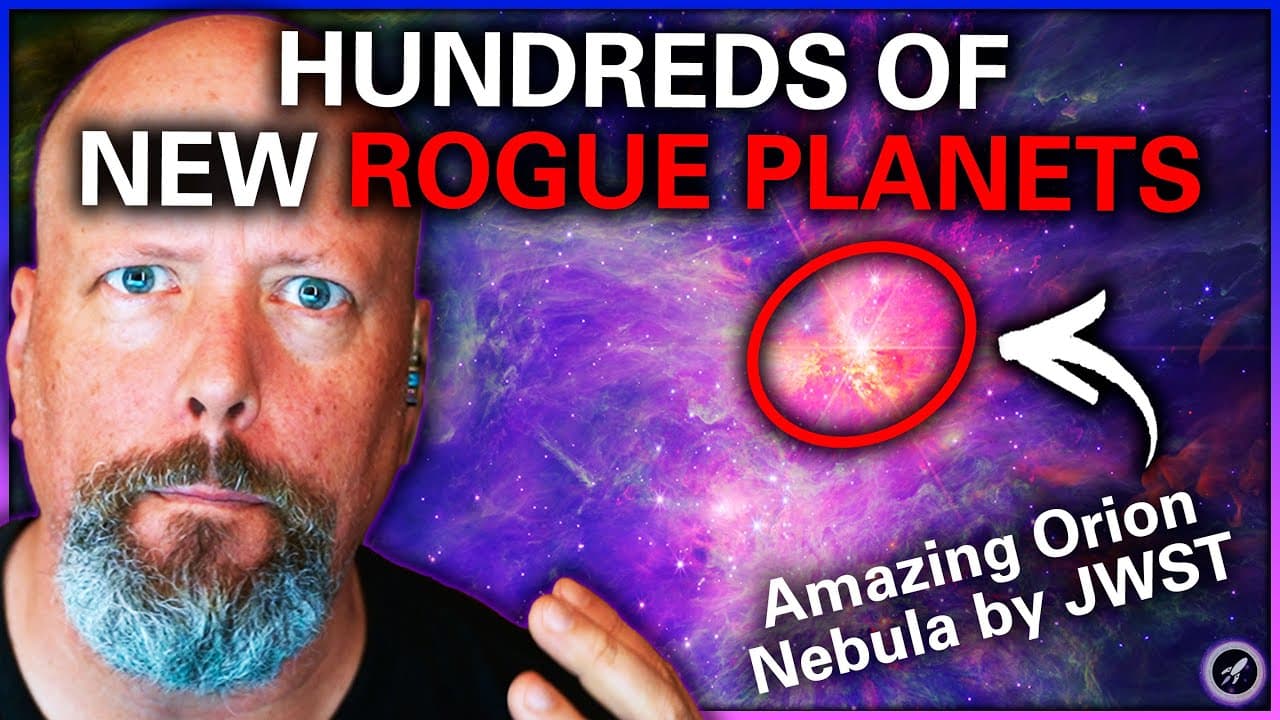
JWST's stunning image of Orion Nebula reveals rogue planets, cosmic web structure, and a mysterious disappearing star.
Transcript
a mindbending jwst image of the Orion Nebula filled with rogue planets seeing the cosmic web and an explanation for a massive star that just disappeared all this and more in this week's space bites all right I've got a real treat for you today and this is one of the coolest images of the uion nebula that I've ever seen of course it comes from the J... Read More
Key Insights
- 🙂 JWST's image of the Orion Nebula unveils hundreds of Jupiter-sized rogue planets, shedding light on planetary formation.
- 🕸️ Mapping the cosmic web using specialized instruments like the Keck Cosmic Web Imager offers insights into galactic connections.
- 🤩 The enigmatic disappearance of a massive star poses possible explanations of failed supernovae or stellar mergers that defy conventional models.
- 😘 Revised estimates suggest the Milky Way's mass may be lower than previously thought, impacting dark matter theories.
- 🛟 Supernova occurrences in Earth's history, within the last few million years, serve as reminders of cosmic events' lingering effects.
- 👾 The dynamic nature of space phenomena, such as the changing appearance of the Cygnus Loop Nebula over 20 years, demonstrates astronomical time scales.
- 👻 New Horizons mission's extended funding allows for further exploration of Kuiper Belt objects, boosting scientific operations.
Install to Summarize YouTube Videos and Get Transcripts
Explore YouTube Video Summarizer or Get YouTube Transcript Extractor
Questions & Answers
Q: How many free-floating Jupiter-sized planets were found in the Orion Nebula?
Scientists discovered 540 rogue planets, dubbed "jumbos," floating within the nebula, raising questions about their origin and formation.
Q: What is the cosmic web, and how do astronomers study it?
The cosmic web consists of gas filaments binding galactic structures. Astronomers utilize tools like the Keck Cosmic Web Imager to map these invisible connections.
Q: What is the mysterious phenomenon of a disappeared star, and what are the proposed explanations?
The vanishing star that exhibited supernova-like behavior could be attributed to an unnova or a failed supernova, or possibly a merger between multiple stars.
Q: How has the mass estimate of the Milky Way changed, and what implications does it have?
Gaia observations indicate that the Milky Way's mass may be significantly lower at about 200 billion solar masses, challenging previous estimates and dark matter theories.
Summary & Key Takeaways
-
The James Webb Space Telescope captured a mesmerizing image of the Orion Nebula, showcasing 540 free-floating Jupiter-sized planets.
-
Observations of the cosmic web using specialized instruments like the Keck Cosmic Web Imager offer insights into galactic structure.
-
The baffling disappearance of a massive star hints at the possibility of a failed supernova or stellar merger.
Read in Other Languages (beta)
Share This Summary 📚
Summarize YouTube Videos and Get Video Transcripts with 1-Click
Try YouTube Summary with ChatGPT & Claude or YouTube Transcript Generator
Explore More Summaries from Fraser Cain / Universe Today Podcast 📚




Summarize YouTube Videos and Get Video Transcripts with 1-Click
Try YouTube Summary with ChatGPT & Claude or YouTube Transcript Generator