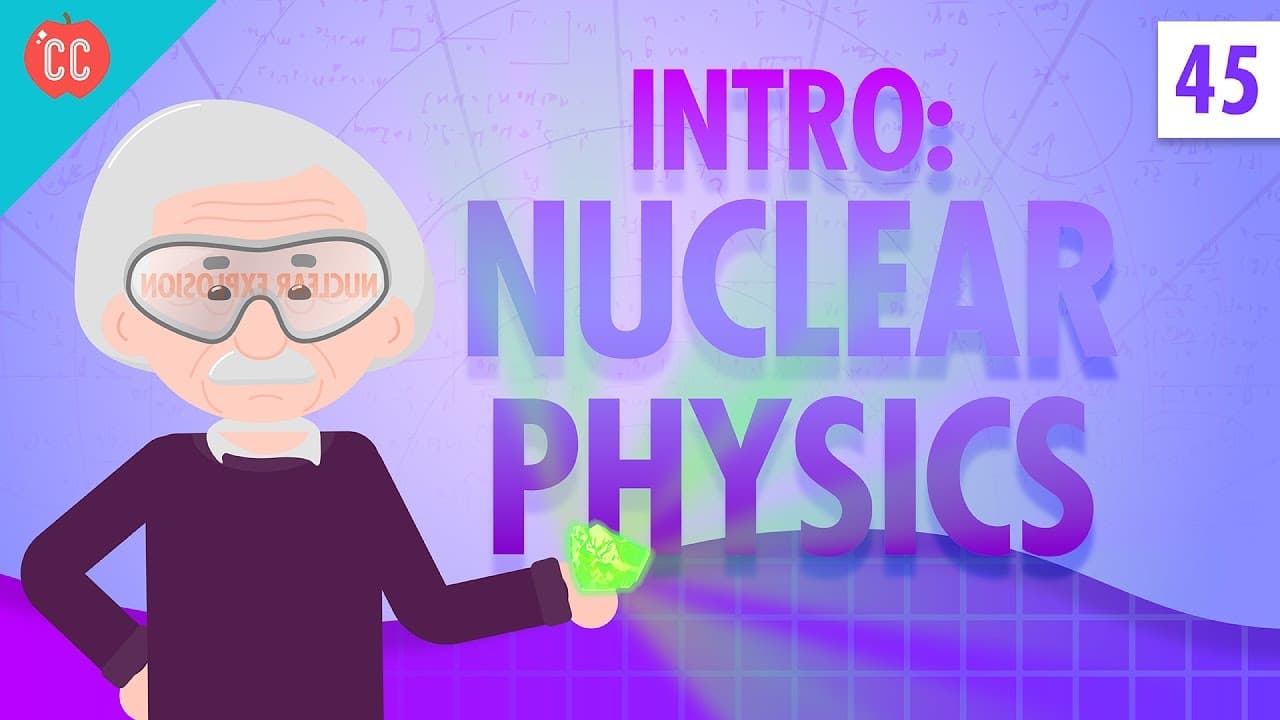
Nuclear Physics: Crash Course Physics #45
TL;DR
Explains nuclear physics fundamentals and E=mc² significance.
Transcript
E=mc^2 You hear it all the time. But what does it mean? During his study of special relativity, Albert Einstein found that mass and energy are equivalent, and that they can be converted back and forth between one another. He described that relationship mathematically, saying that the energy of a particle is equal to its mass, times the speed of lig... Read More
Key Insights
- Mass-energy equivalence, expressed by E=mc², is crucial in nuclear physics, highlighting the interchangeability of mass and energy.
- The atomic nucleus consists of protons and neutrons, collectively known as nucleons, which determine the element's identity and mass.
- Isotopes are nuclei with the same atomic number but different mass numbers, and elements typically have a more stable isotope.
- Binding energy accounts for the mass difference in a stable nucleus and is calculated using E=mc², indicating the energy needed to break a nucleus apart.
- The strong nuclear force binds protons and neutrons within the nucleus, overcoming the repulsive electric force among protons.
- Unstable nuclei undergo radioactive decay, emitting alpha particles, beta particles, or gamma rays, each with distinct characteristics and penetrating powers.
- Beta decay involves a neutron transforming into a proton, emitting an electron and a neutrino, driven by the weak force altering quarks.
- Gamma decay involves the release of high-energy photons from an excited nucleus, with no transmutation, but significant penetrating power.
Install to Summarize YouTube Videos and Get Transcripts
Explore YouTube Video Summarizer or Get YouTube Transcript Extractor
Questions & Answers
Q: What is the significance of E=mc² in nuclear physics?
E=mc² signifies the mass-energy equivalence, a fundamental concept in nuclear physics. It explains how mass can be converted into energy and vice versa, which is crucial for understanding nuclear reactions. This principle helps quantify the energy released or absorbed in nuclear processes, such as radioactive decay and nuclear fusion.
Q: How do atomic and mass numbers define an element?
The atomic number represents the number of protons in an atom's nucleus and determines the element's identity. The mass number is the sum of protons and neutrons, indicating the nucleus's total nucleon count. Together, these numbers help distinguish isotopes, which have the same atomic number but different mass numbers.
Q: What role does binding energy play in nuclear stability?
Binding energy is the energy required to break a nucleus into its constituent protons and neutrons. It accounts for the mass difference between a nucleus and its separate nucleons. A higher binding energy indicates greater nuclear stability, as more energy is needed to disrupt the nucleus, preventing spontaneous decay.
Q: How does the strong nuclear force maintain nuclear integrity?
The strong nuclear force is an attractive force acting between protons and neutrons, overcoming the repulsive electric force among protons. It operates over very short distances, binding nucleons within the nucleus. This force is essential for maintaining nuclear integrity, especially in larger atoms requiring additional neutrons for stability.
Q: What causes radioactive decay in unstable nuclei?
Radioactive decay occurs when unstable nuclei transform into more stable configurations, emitting particles or energy. This process is driven by the imbalance of forces within the nucleus, such as excess protons or neutrons. Decay types include alpha, beta, and gamma, each with distinct mechanisms and resulting in different emissions.
Q: How does beta decay differ from other decay types?
Beta decay involves a neutron converting into a proton, emitting an electron and a neutrino. Unlike alpha decay, which emits nucleons, beta decay changes the nucleus's charge without altering its nucleon count. This process is governed by the weak force, which alters quarks, the fundamental particles within protons and neutrons.
Q: What is the nature of gamma decay?
Gamma decay involves the emission of high-energy photons, known as gamma rays, from an excited nucleus. Unlike alpha and beta decay, gamma decay does not result in transmutation, as the nucleus's elemental identity remains unchanged. Gamma rays have significant penetrating power, requiring substantial shielding to block them.
Q: How do isotopes differ in stability and abundance?
Isotopes are nuclei with the same atomic number but different mass numbers, due to varying neutron counts. Most elements have a more stable isotope, characterized by a balanced proton-to-neutron ratio. Stable isotopes are more abundant, while unstable isotopes undergo radioactive decay, contributing to their scarcity in nature.
Summary & Key Takeaways
-
The episode explores the fundamental concepts of nuclear physics, starting with Einstein's E=mc², which illustrates the mass-energy equivalence principle. It delves into the structure of atomic nuclei, composed of protons and neutrons, and explains how isotopes differ in mass numbers but share atomic numbers.
-
The discussion covers the concept of binding energy, crucial for understanding nuclear stability and reactions. It highlights the role of the strong nuclear force in holding nuclei together, despite the repulsive forces between protons, and introduces radioactivity as a result of unstable nuclei decaying into more stable forms.
-
The episode categorizes radioactive decay into alpha, beta, and gamma types, each with unique properties and penetrating capabilities. It explains beta decay's reliance on the weak force and quark transformation, while gamma decay involves high-energy photon emission without changing the nucleus's elemental identity.
Read in Other Languages (beta)
Share This Summary 📚
Summarize YouTube Videos and Get Video Transcripts with 1-Click
Try YouTube Summary with ChatGPT & Claude or YouTube Transcript Generator
Explore More Summaries from CrashCourse 📚





Summarize YouTube Videos and Get Video Transcripts with 1-Click
Try YouTube Summary with ChatGPT & Claude or YouTube Transcript Generator