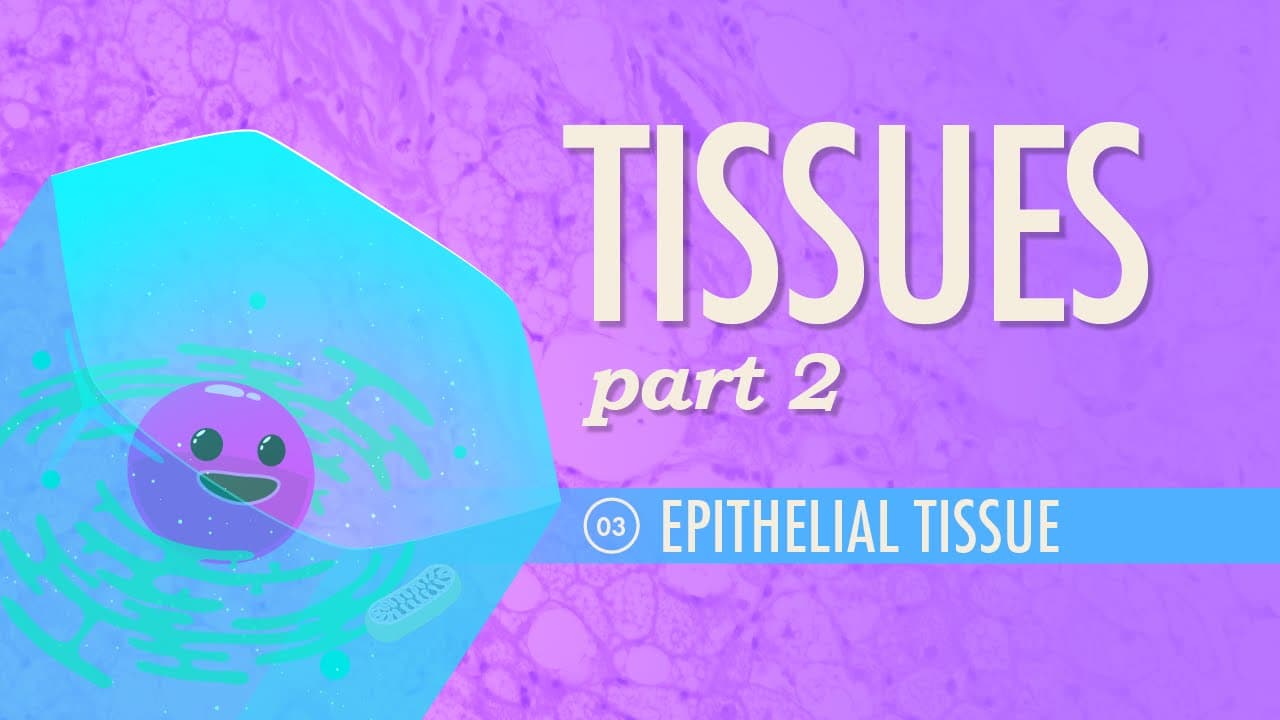
Tissues, Part 2 - Epithelial Tissue: Crash Course Anatomy & Physiology #3
TL;DR
Epithelial tissue organizes and protects body systems.
Transcript
As any teacher will tell you, when you’re dealing with certain elements that are being feisty and fidgety and basically not cooperating, there’s pretty much only one thing you can do: you gotta keep ‘em separated. And there’s a whole system of biological tissue that’s dedicated to doing just that -- creating order where there would otherwise be tot... Read More
Key Insights
- Epithelial tissue is essential for organizing and protecting the body's systems, acting like a barrier that creates order and prevents chaos.
- The tissue is divided into proper epithelium, which covers and lines the body, and glandular epithelium, which forms glands and secretes substances.
- Epithelial cells are avascular, relying on nearby connective tissues for nutrients, and come in three shapes: squamous, cuboidal, and columnar.
- The shape of epithelial cells correlates with their function, with squamous cells facilitating absorption and cuboidal or columnar cells supporting secretion.
- Epithelial tissue is classified by layering: simple (one layer), stratified (multiple layers), and pseudostratified (appears multilayered but is not).
- Epithelial cells are polar, with an apical side exposed to external or internal surfaces and a basal side attached to a basement membrane.
- Glandular epithelial tissue forms endocrine glands, which secrete hormones into the bloodstream, and exocrine glands, which release substances into ducts.
- Epithelial tissue plays a critical role in absorption, filtration, and excretion, as well as facilitating secretions like sweat, mucus, and hormones.
Install to Summarize YouTube Videos and Get Transcripts
Explore YouTube Video Summarizer or Get YouTube Transcript Extractor
Questions & Answers
Q: What role does epithelial tissue play in the body?
Epithelial tissue acts as a crucial organizational and protective barrier in the body. It lines and covers organs, creating order and preventing chaos by separating different body systems. This tissue type is involved in absorption, filtration, and secretion processes, ensuring that the body's internal environment remains stable and functional.
Q: How is epithelial tissue classified?
Epithelial tissue is classified based on cell shape and layering. The cell shapes include squamous (flat), cuboidal (cube-like), and columnar (tall and thick). The layering can be simple (one layer), stratified (multiple layers), or pseudostratified (appears multilayered but is actually a single layer). These classifications help determine the tissue's specific functions.
Q: What are the two types of glandular epithelial tissue?
Glandular epithelial tissue forms two types of glands: endocrine and exocrine. Endocrine glands secrete hormones directly into the bloodstream or nearby cells, affecting various bodily functions. Exocrine glands release their secretions, such as sweat, saliva, and mucus, into ducts that lead to external surfaces or into internal cavities, facilitating different physiological processes.
Q: Why is the polarity of epithelial cells important?
The polarity of epithelial cells is important because it ensures that each cell has distinct functional sides. The apical side faces an external or internal surface, facilitating absorption and secretion, while the basal side is attached to the basement membrane, anchoring the tissue and maintaining structural integrity. This polarity is crucial for the selective permeability and proper functioning of epithelial tissues.
Q: How does epithelial tissue contribute to protection?
Epithelial tissue contributes to protection by forming barriers that shield deeper tissues from physical damage, pathogens, and dehydration. It lines body cavities and surfaces, creating a first line of defense. Additionally, the tissue regenerates quickly, allowing for rapid repair in case of injury, and the layered structure, especially in stratified epithelium, provides added durability and resilience.
Q: What is the significance of epithelial tissue being avascular?
The avascular nature of epithelial tissue means it lacks its own blood supply, relying instead on the blood supply from underlying connective tissues for nutrients and waste removal. This characteristic is significant because it allows epithelial tissues to form tight barriers without the interference of blood vessels, maintaining their protective and selective permeability functions effectively.
Q: How does cell shape relate to epithelial tissue function?
The shape of epithelial cells is closely related to their function. Squamous cells, being flat, facilitate easy diffusion and absorption, making them ideal for areas like the lungs. Cuboidal and columnar cells, being larger, contain more organelles for secretion and absorption, making them suitable for glandular tissues and the lining of organs that require these functions, such as the stomach.
Q: What is the role of glandular epithelial tissue in secretion?
Glandular epithelial tissue plays a crucial role in secretion by forming glands that release various substances needed for body functions. Endocrine glands secrete hormones into the bloodstream, regulating processes like metabolism and growth. Exocrine glands release substances like enzymes, mucus, and sweat into ducts, aiding in digestion, lubrication, and temperature regulation, respectively.
Summary & Key Takeaways
-
Epithelial tissue is crucial for maintaining order and function in the body by lining and covering organs, protecting deeper tissues from injury or infection.
-
The tissue is categorized by cell shape (squamous, cuboidal, columnar) and layering (simple, stratified, pseudostratified), each serving specific functions.
-
Glandular epithelium forms endocrine and exocrine glands, playing a vital role in secretion, while epithelial cells are polar and selectively permeable.
Read in Other Languages (beta)
Share This Summary 📚
Summarize YouTube Videos and Get Video Transcripts with 1-Click
Try YouTube Summary with ChatGPT & Claude or YouTube Transcript Generator
Explore More Summaries from CrashCourse 📚





Summarize YouTube Videos and Get Video Transcripts with 1-Click
Try YouTube Summary with ChatGPT & Claude or YouTube Transcript Generator