Synthetic Biology: Programming Living Bacteria - Christopher Voigt
TL;DR
Chris Voigt discusses programming cells using synthetic biology.
Transcript
I'm Chris Voigt, I'm a synthetic biologist in the biological engineering department at MIT. And today I'm going to talk to you about some of the work that we've been doing to create a programming language for living bacteria. And so when you think of programming, you might think about building a piece of software for a computer or trying to control... Read More
Key Insights
- Synthetic biology enables programming of living bacteria by creating a language that compiles into DNA, allowing cells to perform specific functions.
- Biological computation is crucial for harnessing the potential of engineered biology, which contributes significantly to the economy through products like medicines and plastics.
- Cells naturally perform complex computations using regulatory networks, and synthetic circuits aim to replicate these functions for biotechnological applications.
- The development of synthetic circuits has been limited by challenges in design, construction, and debugging, but recent advancements have begun to address these issues.
- Voigt's lab created software that compiles user-written programs into DNA sequences, enabling faster and more efficient design and testing of genetic circuits.
- By utilizing non-interfering repressor proteins, Voigt's team has built a library of insulated gates, allowing for diverse and robust circuit configurations.
- The software uses Verilog, a language from electrical engineering, repurposed to compile circuits into DNA, facilitating seamless integration into living cells.
- Applications of these genetic circuits span various fields, including agriculture, therapeutics, and industrial processes, demonstrating their versatile potential.
Install to Summarize YouTube Videos and Get Transcripts
Explore YouTube Video Summarizer or Get YouTube Transcript Extractor
Questions & Answers
Q: What is the main goal of Chris Voigt's research?
Chris Voigt's research aims to develop a programming language for living bacteria, allowing synthetic biologists to precisely control cellular functions. By creating a software that compiles user-written programs into DNA sequences, Voigt's team seeks to harness the potential of engineered biology for various applications, including the production of complex chemicals and performing sophisticated tasks.
Q: How does the software developed by Voigt's lab work?
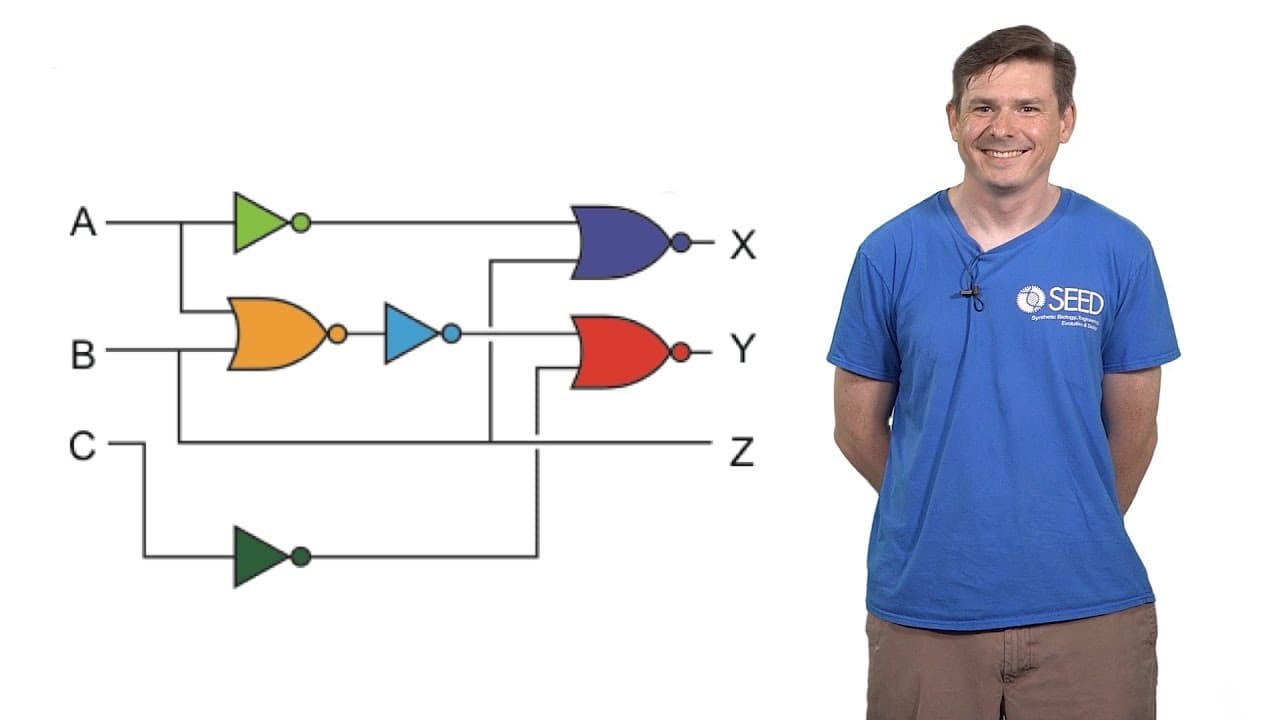
The software developed by Voigt's lab allows users to write programs using a language similar to Verilog, which is then compiled into a circuit diagram made of interconnected gates. The software creates a DNA sequence based on this diagram, which can be synthesized and inserted into cells. This process enables the design and testing of genetic circuits that perform specific functions within living bacteria.
Q: What challenges in synthetic biology does Voigt's research address?
Voigt's research addresses several challenges in synthetic biology, including the design, construction, and debugging of genetic circuits. By creating a library of non-interfering gates and developing software that automates circuit design, Voigt's team has streamlined the process, allowing for faster and more efficient creation of complex synthetic circuits. This has opened new possibilities for applications in biotechnology.
Q: What are the potential applications of the genetic circuits developed by Voigt's lab?
The genetic circuits developed by Voigt's lab have potential applications in various fields, including agriculture, therapeutics, and industrial processes. For example, they can be used to create bacteria that interact with plants to improve crop yields, produce therapeutic compounds within the human gut, or enhance fermentation processes in industrial settings. These applications demonstrate the versatile potential of engineered biology.
Q: How does the use of Verilog benefit the development of genetic circuits?
The use of Verilog, a language from electrical engineering, benefits the development of genetic circuits by providing a framework for describing circuit functions in a hardware-independent manner. This allows for the seamless compilation of circuits into DNA sequences, facilitating integration into living cells. By leveraging Verilog, Voigt's lab has created a software that simplifies the design and testing of complex genetic circuits.
Q: What role do non-interfering repressor proteins play in Voigt's research?
Non-interfering repressor proteins are crucial in Voigt's research as they form the basis of the insulated gates used in genetic circuits. By identifying repressor proteins that do not interfere with each other, Voigt's team has built a library of gates that can be combined in various configurations without causing interference. This allows for the creation of robust and diverse circuit designs, enabling precise control over cellular functions.
Q: What advancements have been made in the construction of synthetic circuits?
Advancements in the construction of synthetic circuits include the development of a software that automates the design process, reducing the time and effort required. Additionally, the creation of a library of insulated gates and the use of non-interfering repressor proteins have enabled the construction of more complex and robust circuits. These advancements have accelerated the development of synthetic circuits, opening new possibilities for applications in biotechnology.
Q: How does Voigt's research contribute to the field of biotechnology?
Voigt's research contributes to the field of biotechnology by providing a framework for programming living bacteria, enabling precise control over cellular functions. This allows for the production of complex chemicals and the performance of sophisticated tasks, which have applications in various industries. By streamlining the design and testing of genetic circuits, Voigt's research has the potential to revolutionize the way synthetic biology is applied in biotechnology.
Summary & Key Takeaways
-
Chris Voigt's lab at MIT has developed a programming language for living bacteria, allowing synthetic biologists to write programs that compile into DNA sequences. This enables precise control over cellular functions, facilitating the production of complex chemicals and performing sophisticated tasks.
-
The lab's software utilizes a library of insulated gates that do not interfere with each other, permitting the construction of robust genetic circuits. By leveraging principles from electrical engineering, specifically using Verilog, the software compiles these circuits into DNA, which can then be synthesized and tested in cells.
-
These advancements have accelerated the development of synthetic circuits, reducing the time and effort required for design and testing. Applications of this technology are vast, ranging from medical therapeutics to agricultural enhancements, showcasing the potential of engineered biology in various industries.
Read in Other Languages (beta)
Share This Summary 📚
Summarize YouTube Videos and Get Video Transcripts with 1-Click
Try YouTube Summary with ChatGPT & Claude or YouTube Transcript Generator
Explore More Summaries from iBiology Techniques 📚
Summarize YouTube Videos and Get Video Transcripts with 1-Click
Try YouTube Summary with ChatGPT & Claude or YouTube Transcript Generator