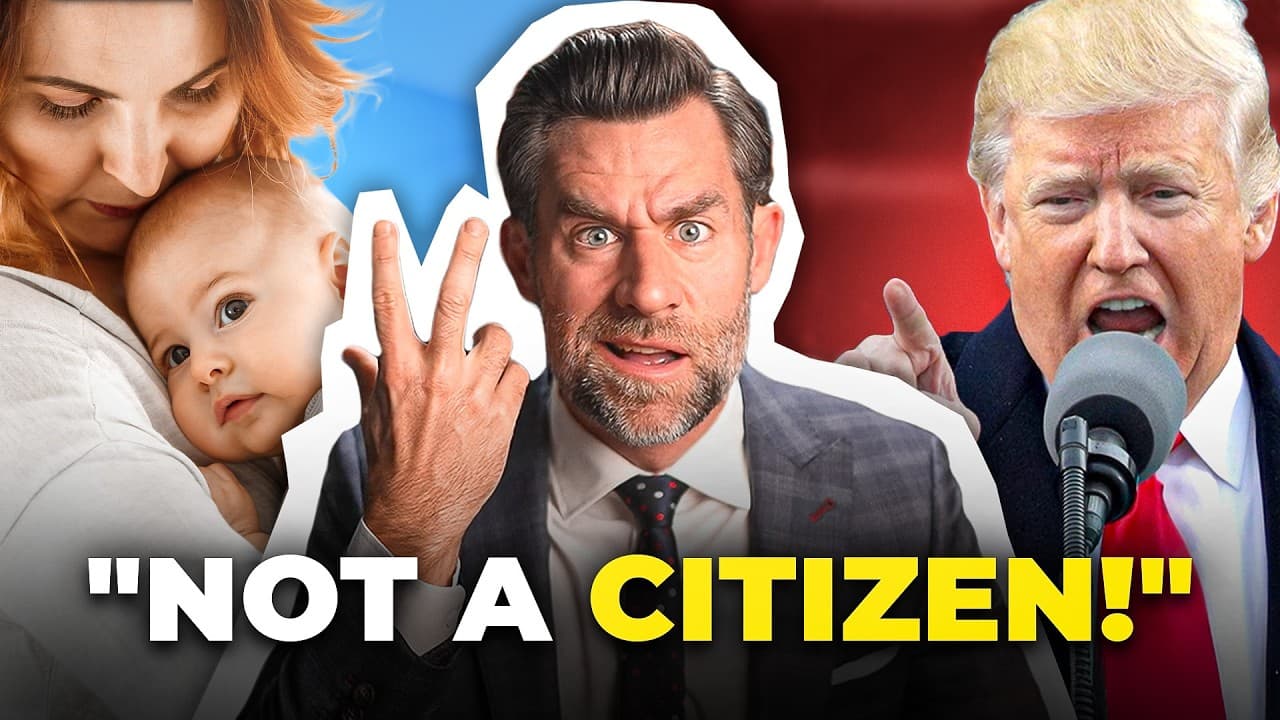
End of Birthright Citizenship? (ft. Liz Dye)
TL;DR
Trump aims to end birthright citizenship, facing legal challenges.
Transcript
- If you were born on US soil, then you are an American citizen. It's written into the Constitution. It was one of the necessary steps after that little spat called the Civil War. But this might not be the case for long. Yes, incoming President Trump has vowed to end birthright citizenship, and the Supreme Court might let him, but can they do that?... Read More
Key Insights
- The 14th Amendment of the US Constitution guarantees citizenship to anyone born on US soil, a principle established post-Civil War.
- Donald Trump has expressed intentions to end birthright citizenship, claiming it incentivizes illegal immigration.
- Legal precedents like Wong Kim Ark and Plyler v. Doe affirm birthright citizenship even for children of undocumented immigrants.
- Some conservative scholars and judges argue against birthright citizenship, suggesting undocumented immigrants are akin to invaders.
- Texas has erected barriers in the Rio Grande, claiming an invasion by undocumented immigrants, a stance recently supported by the Fifth Circuit Court.
- The Supreme Court's current composition raises concerns about potential shifts in interpreting the 14th Amendment.
- Trump's proposed executive order could direct federal agencies to deny citizenship benefits to children of undocumented immigrants.
- Media coverage of Trump's vow to end birthright citizenship varies, reflecting political biases and influencing public perception.
Install to Summarize YouTube Videos and Get Transcripts
Explore YouTube Video Summarizer or Get YouTube Transcript Extractor
Questions & Answers
Q: What is the basis of birthright citizenship in the US?
Birthright citizenship in the US is based on the 14th Amendment, ratified in 1868, which states that all persons born or naturalized in the United States are citizens. This was further affirmed by the Supreme Court in the landmark case of Wong Kim Ark, ensuring citizenship for those born on US soil, regardless of parents' status.
Q: What are Trump's intentions regarding birthright citizenship?
Donald Trump intends to end birthright citizenship, claiming it encourages illegal immigration. He has proposed using executive orders to reinterpret the 14th Amendment, potentially denying citizenship benefits to children of undocumented immigrants, despite existing legal precedents that uphold birthright citizenship.
Q: How have courts historically interpreted the 14th Amendment regarding citizenship?
Courts have historically upheld the 14th Amendment's provision for birthright citizenship, as seen in the Wong Kim Ark case. The Supreme Court has consistently ruled that children born in the US, regardless of their parents' immigration status, are US citizens. This interpretation has been reaffirmed in cases like Plyler v. Doe.
Q: What legal challenges could Trump's plan face?
Trump's plan to end birthright citizenship could face significant legal challenges, given the longstanding precedent set by the 14th Amendment and the Supreme Court. Any executive order attempting to deny citizenship would likely be contested in court, potentially reaching the Supreme Court for a final decision.
Q: What actions has Texas taken regarding immigration?
Texas has erected barriers in the Rio Grande, claiming an invasion by undocumented immigrants. This action is part of a broader strategy to assert state powers over immigration enforcement, challenging federal authority. The Fifth Circuit Court recently supported Texas's right to build these barriers, sparking further legal debates.
Q: What arguments do some conservative scholars make against birthright citizenship?
Some conservative scholars argue that birthright citizenship should not apply to children of undocumented immigrants, likening them to invaders. They claim that the 14th Amendment's jurisdiction clause excludes such individuals, despite longstanding legal interpretations affirming birthright citizenship for all born on US soil.
Q: How does media coverage vary on Trump's birthright citizenship plan?
Media coverage of Trump's plan to end birthright citizenship varies widely. Left-leaning outlets often criticize the plan as legally unfounded, while right-leaning sources highlight its popularity among voters. This variability reflects broader political biases and influences public perception of the issue.
Q: What potential impact could Trump's executive order have if implemented?
If implemented, Trump's executive order could deny citizenship benefits to children of undocumented immigrants, affecting their access to Social Security numbers and passports. Such a move would likely be challenged in court, creating uncertainty and potential legal battles over the interpretation of the 14th Amendment and citizenship rights.
Summary & Key Takeaways
-
The video discusses the historical and legal foundations of birthright citizenship in the United States, rooted in the 14th Amendment. It highlights Donald Trump's intention to end this right through executive action, facing legal challenges and potential Supreme Court review.
-
Legal precedents such as the Wong Kim Ark case have upheld birthright citizenship, affirming that children born on US soil are citizens, regardless of their parents' immigration status. This principle is now being contested by some conservative scholars and judges.
-
Texas has taken measures like building barriers in the Rio Grande, claiming an invasion by undocumented immigrants. This stance has been partially supported by the Fifth Circuit Court, raising questions about the interpretation of the 14th Amendment and state versus federal powers.
Read in Other Languages (beta)
Share This Summary 📚
Summarize YouTube Videos and Get Video Transcripts with 1-Click
Try YouTube Summary with ChatGPT & Claude or YouTube Transcript Generator
Explore More Summaries from LegalEagle 📚


Summarize YouTube Videos and Get Video Transcripts with 1-Click
Try YouTube Summary with ChatGPT & Claude or YouTube Transcript Generator