The Holographic Universe Explained
TL;DR
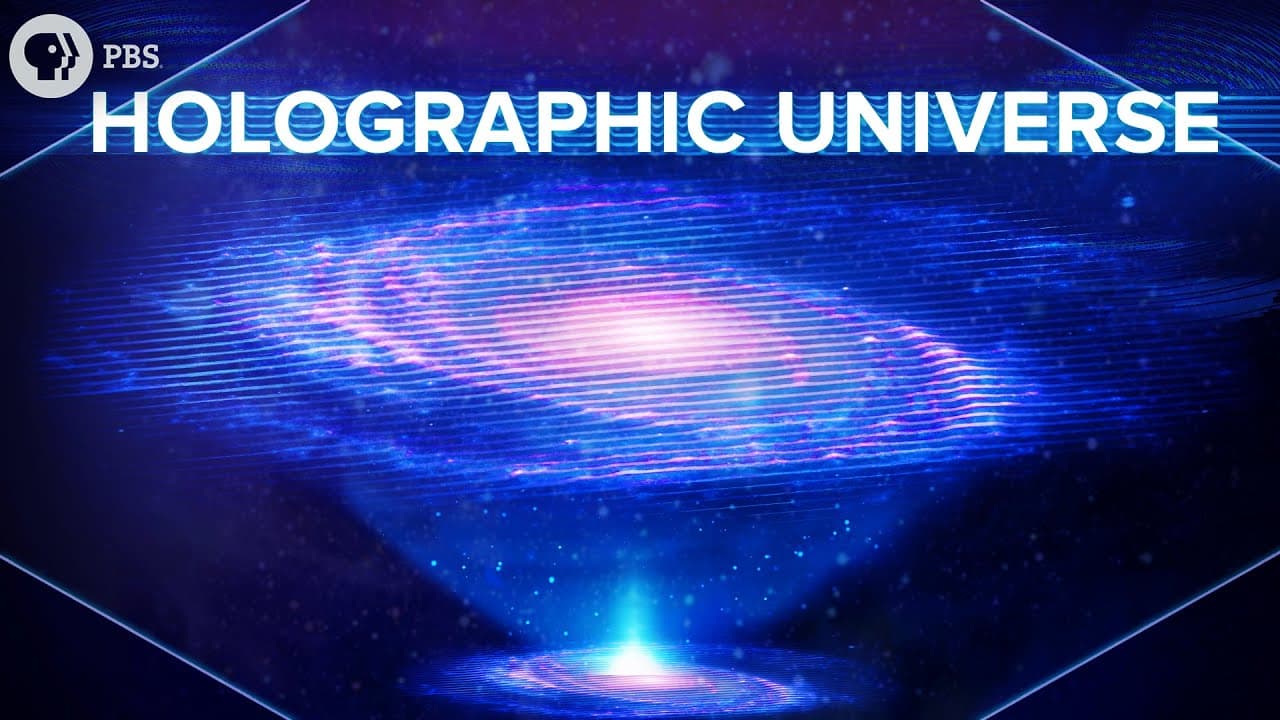
Our universe may be a holographic projection.
Transcript
We live in a universe with 3 dimensions of space and one of time. Up, down, left, right, forward, back, past, future. 3+1 dimensions. Or so our primitive Pleistocene-evolved brains find it useful to believe. And we cling to this intuition, even as physics shows us that this view of reality may be only a very narrow perception. One of the most start... Read More
Key Insights
- The holographic principle suggests our universe could be a projection from a lower-dimensional space, challenging our perception of reality.
- Jacob Bekenstein's work on black hole entropy laid the foundation for understanding information encoding in a holographic universe.
- Hawking radiation and the black hole information paradox highlight the complexities of quantum information conservation in black holes.
- Gerard t' Hooft and Leonard Susskind's work suggests that a 2-D surface can encode all information of a 3-D volume.
- Juan Maldacena's AdS/CFT correspondence provides a concrete realization of a holographic universe using string theory.
- Scale invariance and conformal field theories are crucial in understanding how extra dimensions can be encoded holographically.
- AdS/CFT duality offers insights into quantum gravity and resolves the black hole information paradox.
- Current research aims to generalize AdS/CFT to more accurately represent our universe's structure.
Install to Summarize YouTube Videos and Get Transcripts
Explore YouTube Video Summarizer or Get YouTube Transcript Extractor
Questions & Answers
Q: What is the holographic principle?
The holographic principle is a theoretical concept suggesting that our universe, with its three spatial dimensions and one time dimension, might actually be a projection from a lower-dimensional space. This idea challenges the traditional view of dimensions and proposes that the information in our universe could be encoded on a two-dimensional surface, much like a hologram.
Q: How did black hole thermodynamics contribute to the holographic principle?
Black hole thermodynamics, particularly the work of Jacob Bekenstein, contributed to the holographic principle by exploring the concept of black hole entropy. Bekenstein derived an equation showing that a black hole's entropy is proportional to its surface area, not its volume. This surprising result suggested that information about a volume of space could be encoded on its boundary surface, laying the groundwork for the holographic principle.
Q: What role does string theory play in the holographic principle?
String theory plays a crucial role in the holographic principle by providing a framework to understand how extra dimensions can be encoded. Juan Maldacena's AdS/CFT correspondence, a key development in string theory, describes how a lower-dimensional conformal field theory can correspond to a higher-dimensional gravitational theory. This correspondence offers a concrete realization of a holographic universe, where the information of a 3-D volume can be represented on a 2-D surface.
Q: What is AdS/CFT correspondence?
AdS/CFT correspondence, proposed by Juan Maldacena, is a theoretical framework in string theory that describes a duality between a lower-dimensional conformal field theory (CFT) and a higher-dimensional anti-de Sitter (AdS) space. It suggests that a quantum field theory without gravity on a lower-dimensional surface can correspond to a gravitational theory in a higher-dimensional space, providing insights into quantum gravity and the holographic nature of the universe.
Q: How does the holographic principle relate to the black hole information paradox?
The holographic principle provides a potential resolution to the black hole information paradox, which arises from the apparent loss of information in black holes due to Hawking radiation. By suggesting that the information of a 3-D volume, like the interior of a black hole, can be encoded on a 2-D surface, the principle implies that information is not lost but rather preserved in a lower-dimensional representation, maintaining the foundations of quantum mechanics.
Q: What is scale invariance, and why is it important?
Scale invariance is a property of a physical system where the rules governing the system remain unchanged under a rescaling of lengths or energies. In the context of the holographic principle, scale invariance is crucial because it allows for the encoding of extra dimensions in a holographic universe. Conformal field theories, which exhibit scale invariance, play a key role in understanding how interactions on a 2-D surface can correspond to those in a 3-D volume.
Q: Can AdS/CFT correspondence be applied to our universe?
While AdS/CFT correspondence provides a concrete model of a holographic universe, it does not directly apply to our universe, as our universe does not exhibit the negative curvature of an anti-de Sitter space. However, researchers are working to generalize the correspondence to more accurately represent our universe's structure, potentially offering insights into the true nature of our universe and its holographic properties.
Q: What are the implications of a holographic universe?
The implications of a holographic universe are profound, suggesting that our perceived reality might be a projection from a lower-dimensional space. This challenges our understanding of dimensions and could revolutionize our approach to physics, particularly in areas like quantum gravity and cosmology. It also offers potential resolutions to longstanding paradoxes, such as the black hole information paradox, by providing a framework where information is preserved in a lower-dimensional representation.
Summary & Key Takeaways
-
The holographic principle proposes that our 3+1 dimensional universe might be a projection from a lower-dimensional space, akin to a hologram. This concept challenges our traditional understanding of dimensions and reality, suggesting that what we perceive as a volumetric universe could be encoded on a 2-D surface.
-
The principle emerged from theoretical physics, particularly through studies of black hole thermodynamics and string theory. Key contributors include Jacob Bekenstein, who explored black hole entropy, and Gerard t' Hooft and Leonard Susskind, who proposed the encoding of 3-D information on 2-D surfaces.
-
Juan Maldacena's AdS/CFT correspondence offers a concrete model of a holographic universe, using string theory to describe how a lower-dimensional field theory can correspond to a higher-dimensional gravitational theory. This duality provides insights into quantum gravity and potentially resolves the black hole information paradox.
Read in Other Languages (beta)
Share This Summary 📚
Summarize YouTube Videos and Get Video Transcripts with 1-Click
Try YouTube Summary with ChatGPT & Claude or YouTube Transcript Generator
Explore More Summaries from PBS Space Time 📚



Summarize YouTube Videos and Get Video Transcripts with 1-Click
Try YouTube Summary with ChatGPT & Claude or YouTube Transcript Generator