What Happens to Countries Under Dictatorships?
TL;DR
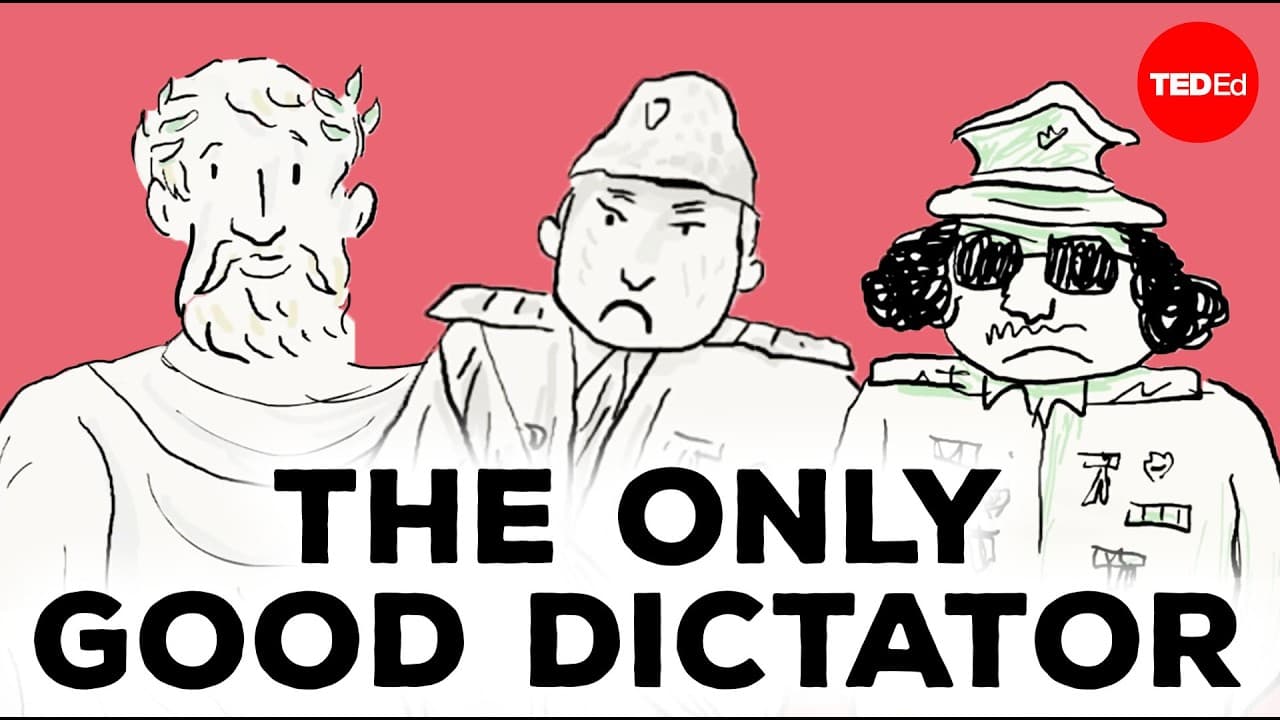
Countries under dictatorships often experience corruption, violence, and a significant erosion of rights and freedoms. Dictators may initially promise efficient solutions but tend to focus on consolidating power, leading to economic and social destruction, while creating a cult of personality. Unlike the myth of the benevolent dictator, no modern dictator readily relinquishes power once acquired.
Transcript
According to legend, the ancient Roman statesman Cincinnatus was plowing his fields when news arrived that the Aequi, Rome’s powerful enemy to the east, had invaded. Rome was in need of swift, decisive action, and the senate had chosen him to serve as dictator, with absolute power over the military and government. Cincinnatus set down his plow, too... Read More
Key Insights
- 😥 Dictators distill complex problems into simple talking points and promise quick solutions.
- ✊ The longer dictators are in power, the more prone they become to paranoia and violence.
- 😃 Dictators rely on yes-men, limit dissent, and build cults of personality to stay in power.
- ✊ The myth of the "benevolent dictator" is shattered by the fact that no modern dictator willingly relinquishes power.
- ❓ Dictators often enrich the few while causing widespread economic, social, and environmental destruction.
- 🗯️ Even so-called benevolent dictators still censor journalists and limit citizen rights and freedoms.
- 👋 The willingness to relinquish power is crucial for the common good, but no modern dictator has truly embraced it.
Install to Summarize YouTube Videos and Get Transcripts
Explore YouTube Video Summarizer or Get YouTube Transcript Extractor
Questions & Answers
Q: What is the myth of the "benevolent dictator"?
The myth suggests that a dictator with absolute power can use it for the common good and efficiently address problems.
Q: How do democracies safeguard against abuse of power?
Democracies have regular, free, and fair elections, impose term limits, establish strong legislative branches and court systems, and maintain a free press.
Q: Why do people sometimes support authoritarian-leaning leaders?
People might support such leaders when a democracy is failing due to corruption, economic instability, or extreme polarization, and authoritarian leaders promise quick solutions.
Q: What strategies do dictators employ to accumulate power?
They can seize control through coups or accumulate power gradually by embracing authoritarian control, dismantling checks on their power, and punishing dissent.
Summary & Key Takeaways
-
The myth of the "benevolent dictator" suggests that a leader with absolute power can effectively address problems and create a just regime.
-
Democracies, on the other hand, safeguard against abuse of power through regular elections, term limits, strong legislative branches, and free press.
-
While some dictators gained power through coups, others were elected democratically but gradually dismantled checks on their power.
Read in Other Languages (beta)
Share This Summary 📚
Summarize YouTube Videos and Get Video Transcripts with 1-Click
Try YouTube Summary with ChatGPT & Claude or YouTube Transcript Generator
Explore More Summaries from TED-Ed 📚






Summarize YouTube Videos and Get Video Transcripts with 1-Click
Try YouTube Summary with ChatGPT & Claude or YouTube Transcript Generator