What Are Chordates and Their Key Traits?
TL;DR
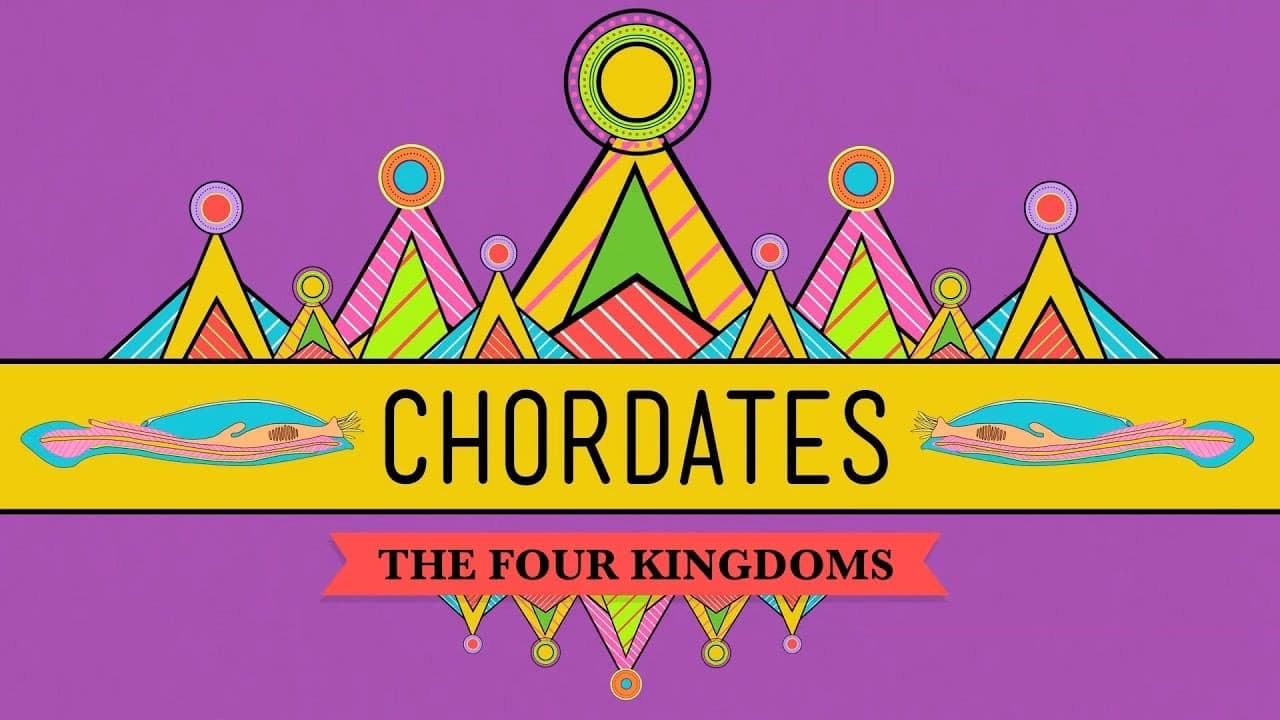
Chordates are a diverse phylum of animals characterized by four key traits: notochord, dorsal hollow nerve cord, pharyngeal slits, and post-anal tail. These traits appear at some stage in every chordate's life cycle. Vertebrates, a subphylum of chordates, have expanded greatly in diversity, including species from fish to mammals, showcasing evolutionary advancements like jaws and amniotic eggs.
Transcript
Next time someone asks you who you think you are, just give them the facts. You're a mammalian amniotic tetrapodal sarcopterygiian osteichthyan gnathostomal vertebrate cranial chordate. Yeah, it's a mouthful. And in order to understand what it means, you're going to have to understand the most complex group of animals on earth, and what it takes to... Read More
Key Insights
- Chordates are defined by four synapomorphic traits: notochord, dorsal hollow nerve cord, pharyngeal slits, and post-anal tail.
- Lancelets, or cephalochordates, retain all four chordate characteristics throughout their lives.
- Vertebrates are the most diverse chordate subphylum, characterized by a backbone and complex nervous systems.
- Gnathostomes, or jawed vertebrates, evolved jaws from pharyngeal slits, greatly enhancing feeding capabilities.
- Osteichthyes, or bony fish, possess a mineralized endoskeleton, a key evolutionary step towards terrestrial life.
- Tetrapods, which include amphibians, reptiles, birds, and mammals, evolved limbs from lobe-finned fish.
- Amniotes, such as reptiles, birds, and mammals, have eggs adapted for terrestrial life, allowing broader ecological niches.
- Mammals are distinguished by hair, mammary glands, and a four-chambered heart, facilitating endothermy and diverse life strategies.
Install to Summarize YouTube Videos and Get Transcripts
Explore YouTube Video Summarizer or Get YouTube Transcript Extractor
Questions & Answers
Q: What are the defining characteristics of chordates?
Chordates are defined by four key synapomorphic traits: the notochord, a flexible rod-like structure; the dorsal hollow nerve cord, which develops into the central nervous system; pharyngeal slits, which serve various functions such as filter-feeding or developing into parts of the ear and throat; and the post-anal tail, which serves various locomotor functions.
Q: How do vertebrates differ from other chordates?
Vertebrates, a subphylum of chordates, are distinguished by their vertebral column or backbone, which provides structural support and protects the spinal cord. This advancement has allowed vertebrates to develop complex nervous systems and diverse body plans, enabling them to occupy a wide range of ecological niches.
Q: What evolutionary advancements are seen in gnathostomes?
Gnathostomes, or jawed vertebrates, evolved jaws from structures that supported pharyngeal slits, allowing them to efficiently capture and process food. This adaptation led to significant diversification and ecological success, as it enabled gnathostomes to exploit new feeding strategies and niches, contributing to their evolutionary dominance.
Q: What is the significance of the amniotic egg in vertebrate evolution?
The amniotic egg represents a major evolutionary advancement, allowing vertebrates to reproduce away from water. It provides a protective environment for the developing embryo, with membranes that facilitate gas exchange and waste removal. This adaptation enabled vertebrates to colonize terrestrial environments more effectively, leading to the diversification of reptiles, birds, and mammals.
Q: How did tetrapods transition from water to land?
Tetrapods transitioned from water to land by evolving limbs from lobe-finned fish. These limbs, supported by bones similar to those in human arms and legs, allowed them to navigate terrestrial environments. Additional adaptations, such as lungs for breathing air and changes in sensory systems, facilitated their successful colonization of land.
Q: What are the key features of mammals that distinguish them from other vertebrates?
Mammals are distinguished by several key features: the presence of hair or fur, mammary glands that produce milk to nourish young, and a four-chambered heart that supports a high metabolism. These traits, along with endothermy, enable mammals to maintain constant body temperatures and thrive in diverse environments.
Q: Why are coelacanths considered significant in evolutionary biology?
Coelacanths are significant because they are considered 'living fossils,' representing a lineage that was thought extinct for millions of years. Their paired lobe fins, which resemble the limb bones of tetrapods, provide insights into the evolutionary transition from aquatic to terrestrial life, making them a valuable subject for studying vertebrate evolution.
Q: How do birds differ from other reptiles in terms of physiology?
Birds differ from other reptiles by being endothermic, meaning they can regulate their body temperature internally. This is supported by a high metabolic rate and a four-chambered heart, which efficiently circulates oxygenated blood. These traits, along with adaptations for flight, such as lightweight bones and feathers, distinguish birds within the reptile clade.
Summary & Key Takeaways
-
Chordates are a complex and diverse phylum characterized by four main traits: the notochord, dorsal hollow nerve cord, pharyngeal slits, and post-anal tail. These traits are present at some stage in every chordate's life cycle. Vertebrates, a subphylum of chordates, have developed a backbone, leading to significant diversification, including the evolution of mammals.
-
The phylum Chordata includes both invertebrates like lancelets and vertebrates, which are distinguished by their vertebral column. Vertebrates have evolved various classes, such as fish, amphibians, reptiles, birds, and mammals, each showcasing unique adaptations like jaws, limbs, and amniotic eggs that have allowed them to thrive in diverse environments.
-
Amniotes, a group within tetrapods, have eggs adapted for terrestrial life, allowing for greater ecological expansion. Mammals, a class of amniotes, have evolved distinct features like hair and mammary glands, enabling them to inhabit a wide range of habitats and develop complex social structures.
Read in Other Languages (beta)
Share This Summary 📚
Summarize YouTube Videos and Get Video Transcripts with 1-Click
Try YouTube Summary with ChatGPT & Claude or YouTube Transcript Generator
Explore More Summaries from CrashCourse 📚




Summarize YouTube Videos and Get Video Transcripts with 1-Click
Try YouTube Summary with ChatGPT & Claude or YouTube Transcript Generator