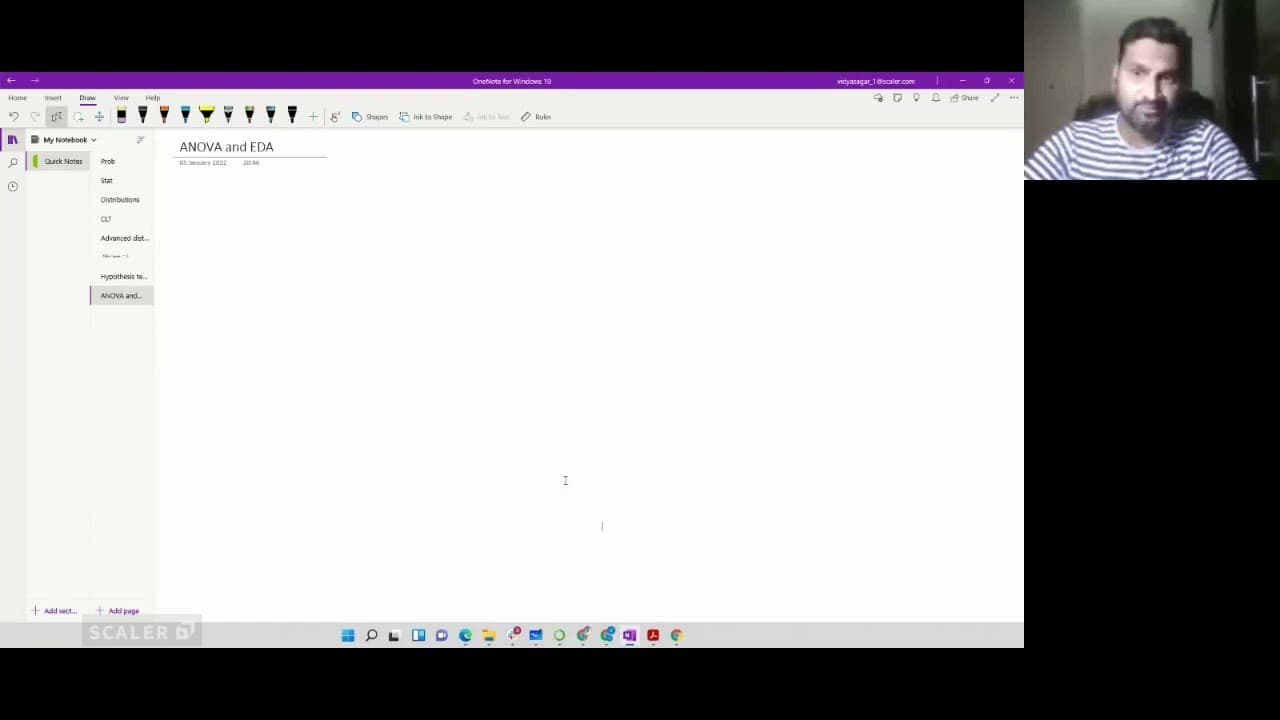
42 DSML Advanced Exploratory Data Analysis 1
TL;DR
Exploring data through exploratory data analysis (EDA) techniques, such as data cleaning, visualization, and statistical analysis, helps understand the relationships between variables and extract valuable insights.
Transcript
foreign hello all good evening and happy New Year hope you all had great time over the holidays okay let's wait a couple more minutes my New Year ah this probably was the calm and Silent celebrations I had this year nothing did I was at home did nothing I was how's all of your celebrations foreign had a great celebration something exciting to share... Read More
Key Insights
- 👻 Exploratory data analysis (EDA) helps bridge the gap of domain knowledge and allows us to understand data, extract insights, and aid in variable selection.
- 👥 Analysis of variance (ANOVA) is a statistical technique used to compare means between multiple groups and is useful when comparing more than two groups.
- 📶 Skewness can help assess if the data follows a normal distribution, and correlation coefficients measure the strength and direction of the linear relationship between two continuous variables.
Install to Summarize YouTube Videos and Get Transcripts
Explore YouTube Video Summarizer or Get YouTube Transcript Extractor
Questions & Answers
Q: What is the main objective of exploratory data analysis (EDA)?
The main objective of EDA is to understand the data, extract valuable insights, and aid in variable selection before building predictive models.
Q: How does analysis of variance (ANOVA) differ from a t-test?
ANOVA is used to compare means between more than two groups, while a t-test compares means between two groups. ANOVA is useful when comparing more than two groups simultaneously.
Q: How can we check if the data follows a normal distribution?
We can check for normal distribution by analyzing the histogram, QQ plot, and running a normality test. Skewness can also be used to measure the degree of skew in the distribution.
Q: What does the correlation coefficient measure?
The correlation coefficient measures the strength and direction of the linear relationship between two continuous variables. A positive correlation indicates that both variables increase or decrease together, while a negative correlation indicates they move in opposite directions.
Key Insights:
- Exploratory data analysis (EDA) helps bridge the gap of domain knowledge and allows us to understand data, extract insights, and aid in variable selection.
- Analysis of variance (ANOVA) is a statistical technique used to compare means between multiple groups and is useful when comparing more than two groups.
- Skewness can help assess if the data follows a normal distribution, and correlation coefficients measure the strength and direction of the linear relationship between two continuous variables.
- Outliers may have minimal impact on the correlation if they are not representative of the overall data pattern.
Summary & Key Takeaways
-
Exploratory data analysis (EDA) plays a vital role in understanding data before building predictive models.
-
EDA helps bridge the gap of domain knowledge by providing valuable insights and aiding in variable selection.
-
Analysis of variance (ANOVA) is a useful tool in comparing means between multiple groups and understanding relationships between variables.
Read in Other Languages (beta)
Share This Summary 📚
Summarize YouTube Videos and Get Video Transcripts with 1-Click
Try YouTube Summary with ChatGPT & Claude or YouTube Transcript Generator
Explore More Summaries from ml008 📚



Summarize YouTube Videos and Get Video Transcripts with 1-Click
Try YouTube Summary with ChatGPT & Claude or YouTube Transcript Generator