47 DSML Advanced Unstructured Data
TL;DR
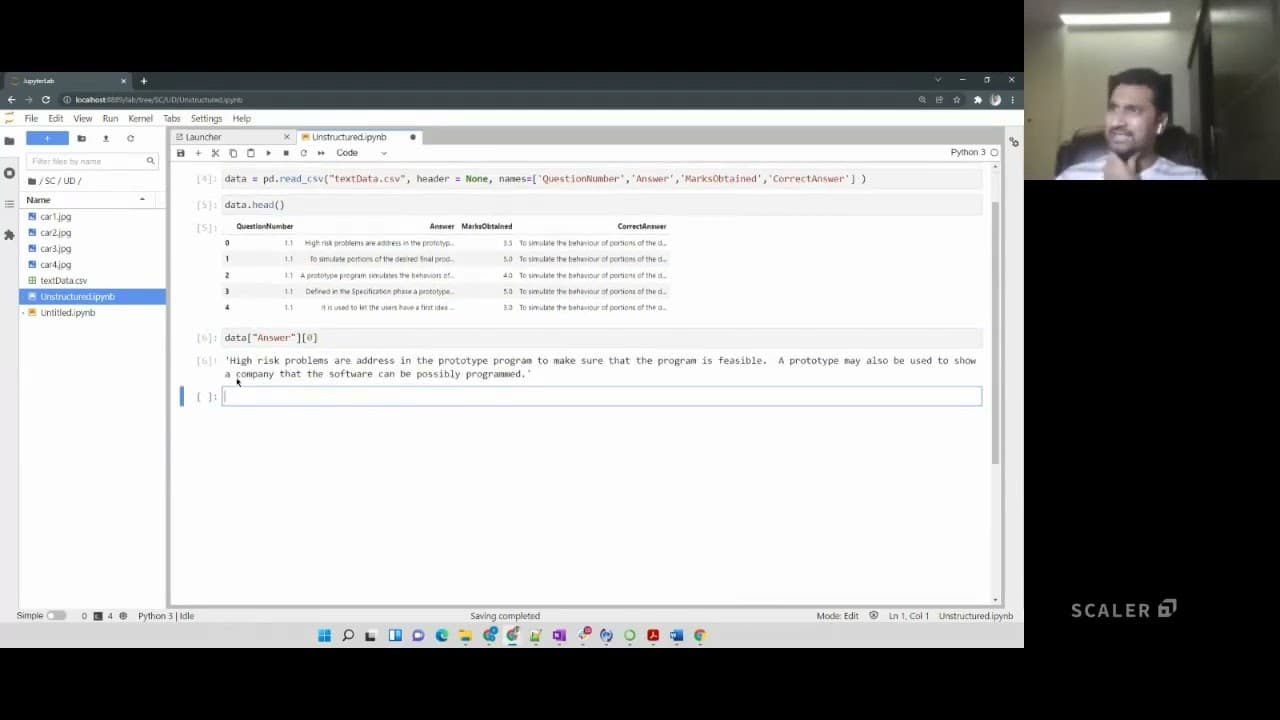
Learn how to process unstructured data, focusing on text data, by cleaning the data and converting it into a structured format for analysis.
Transcript
hello good evening welcome back can you guys hear me hi wish you belated happy sankranti or a equivalent Festival if you have celebrated you can see my screen right which is already shared can someone confirm okay thank you let's wait for a couple of minutes then we get started so in the past one week I hope you had some good session on linear alge... Read More
Key Insights
- 🎰 Unstructured data, such as text and image data, requires processing and structuring before analysis or machine learning.
- 📄 Text data can be sourced from various sources, including web pages, documents, and emails.
- ✋ Cleaning text data involves removing unwanted characters, converting to lowercase, and removing stop words.
- 🍉 Structuring unstructured data involves converting it into a document-term or term-document matrix to enable analysis.
- 💁 Stemming and lemmatization can be used to bring words to their root form for better analysis.
- 🥳 Understanding parts of speech can help in identifying and analyzing nouns in text data.
- 💁 Converting unstructured data into a structured format enables further analysis and insights.
Install to Summarize YouTube Videos and Get Transcripts
Explore YouTube Video Summarizer or Get YouTube Transcript Extractor
Questions & Answers
Q: What are the most common types of unstructured data?
The two most popular types of unstructured data are text data and image data. Other types include voice and other data sources.
Q: Why is it necessary to process and structure unstructured data?
Unstructured data cannot be directly analyzed or used for machine learning tasks. It needs to be processed and structured to extract insights and patterns from the data.
Q: How can we clean text data?
Text data often contains unwanted characters, or 'garbage', which needs to be removed. Additionally, lowercase conversion and removing stop words can help clean the data.
Q: What is the objective of processing unstructured text data?
The objective is to give structure to the data so that it can be used for analysis or machine learning tasks, such as building a spam filter for emails.
Key Insights:
- Unstructured data, such as text and image data, requires processing and structuring before analysis or machine learning.
- Text data can be sourced from various sources, including web pages, documents, and emails.
- Cleaning text data involves removing unwanted characters, converting to lowercase, and removing stop words.
- Structuring unstructured data involves converting it into a document-term or term-document matrix to enable analysis.
- Stemming and lemmatization can be used to bring words to their root form for better analysis.
- Understanding parts of speech can help in identifying and analyzing nouns in text data.
- Converting unstructured data into a structured format enables further analysis and insights.
- Image data can be processed and edited using tools like OpenCV for various purposes, including image cropping and fusion.
Summary & Key Takeaways
-
Unstructured data refers to data that is not organized in a predefined manner and includes text and image data.
-
To analyze unstructured data, it needs to be processed and structured to perform tasks such as machine learning.
-
Text data can be sourced from web pages, documents, emails, etc., and needs to be cleaned and structured before analysis.
Read in Other Languages (beta)
Share This Summary 📚
Summarize YouTube Videos and Get Video Transcripts with 1-Click
Try YouTube Summary with ChatGPT & Claude or YouTube Transcript Generator
Explore More Summaries from ml008 📚


Summarize YouTube Videos and Get Video Transcripts with 1-Click
Try YouTube Summary with ChatGPT & Claude or YouTube Transcript Generator