70 DSML Case Study Session Scaler Case Review

TL;DR
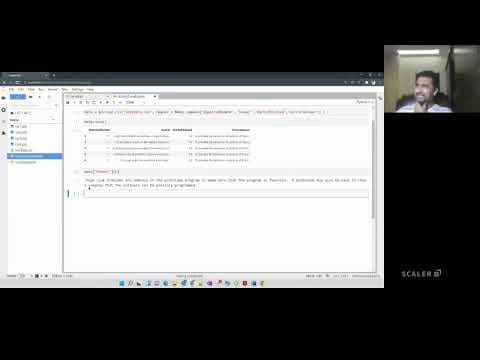
This analysis focuses on data cleaning, manual clustering, and unsupervised clustering using K-means. It provides insights on various data processing techniques and clustering strategies.
Transcript
hi all how are you are you hearing any background noise just let me know before we begin no okay cool hi hi nmit hi KARK okay before we begin um I would like to uh just check if most are joining or not so how you can help me over here is just drop a message on the group and let me know uh if there's anyone uh who is joining can you can you drop a m... Read More
Key Insights
- ❓ Data cleaning and preprocessing are critical for accurate clustering analysis.
- 👻 Manual clustering allows for better interpretability and decision-making based on job positions and salary percentiles.
- 👌 Unsupervised clustering using K-means can further group individuals based on similar characteristics.
- 😒 The use of dendrograms can help determine the optimal number of clusters in larger datasets.
Install to Summarize YouTube Videos and Get Transcripts
Explore YouTube Video Summarizer or Get YouTube Transcript Extractor
Questions & Answers
Q: Why is manual clustering preferred over unsupervised clustering in industry practice?
Manual clustering is often preferred in industry because it allows for better interpretability and understanding of the data. Unsupervised clustering results may be difficult to interpret, leading to challenges in making informed business decisions.
Q: How is the years of experience calculated?
The years of experience is calculated by subtracting the organization year from the current year. If the organization year is null, it is imputed using the median organization year of the corresponding company.
Q: Why is the email ID masked or dropped during clustering?
Email IDs are not relevant for clustering because they contain personal information that does not contribute to the grouping of individuals based on job positions and company data. Therefore, it is necessary to drop or mask this information to focus on important factors for clustering.
Q: What are the advantages of using label encoding instead of one-hot encoding in this analysis?
Label encoding is used instead of one-hot encoding in this analysis because there are numerous companies in the dataset. One-hot encoding would cause a significant increase in feature dimensions, making the analysis computationally expensive. Label encoding simplifies the process while preserving the essential information.
Key Insights:
- Data cleaning and preprocessing are critical for accurate clustering analysis.
- Manual clustering allows for better interpretability and decision-making based on job positions and salary percentiles.
- Unsupervised clustering using K-means can further group individuals based on similar characteristics.
- The use of dendrograms can help determine the optimal number of clusters in larger datasets.
- Label encoding is a practical alternative to one-hot encoding for categorical variables with numerous categories.
Summary & Key Takeaways
-
The content begins with a discussion on background noise and the start time of the session.
-
The speaker introduces the plan for a comprehensive review of the Scala case, including manual and unsupervised clustering techniques.
-
Data cleaning steps are outlined, including handling null values, removing duplicates, and standardizing data.
-
Manual clustering is explained, where tier classifications are assigned based on salary percentiles and job positions within companies.
-
The content concludes with a brief overview of unsupervised clustering using K-means and the potential use of dendrograms.
Read in Other Languages (beta)
Share This Summary 📚
Summarize YouTube Videos and Get Video Transcripts with 1-Click
Try YouTube Summary with ChatGPT & Claude or YouTube Transcript Generator
Explore More Summaries from ml008 📚



Summarize YouTube Videos and Get Video Transcripts with 1-Click
Try YouTube Summary with ChatGPT & Claude or YouTube Transcript Generator