How to Build Muscle Strength and Power Effectively
TL;DR
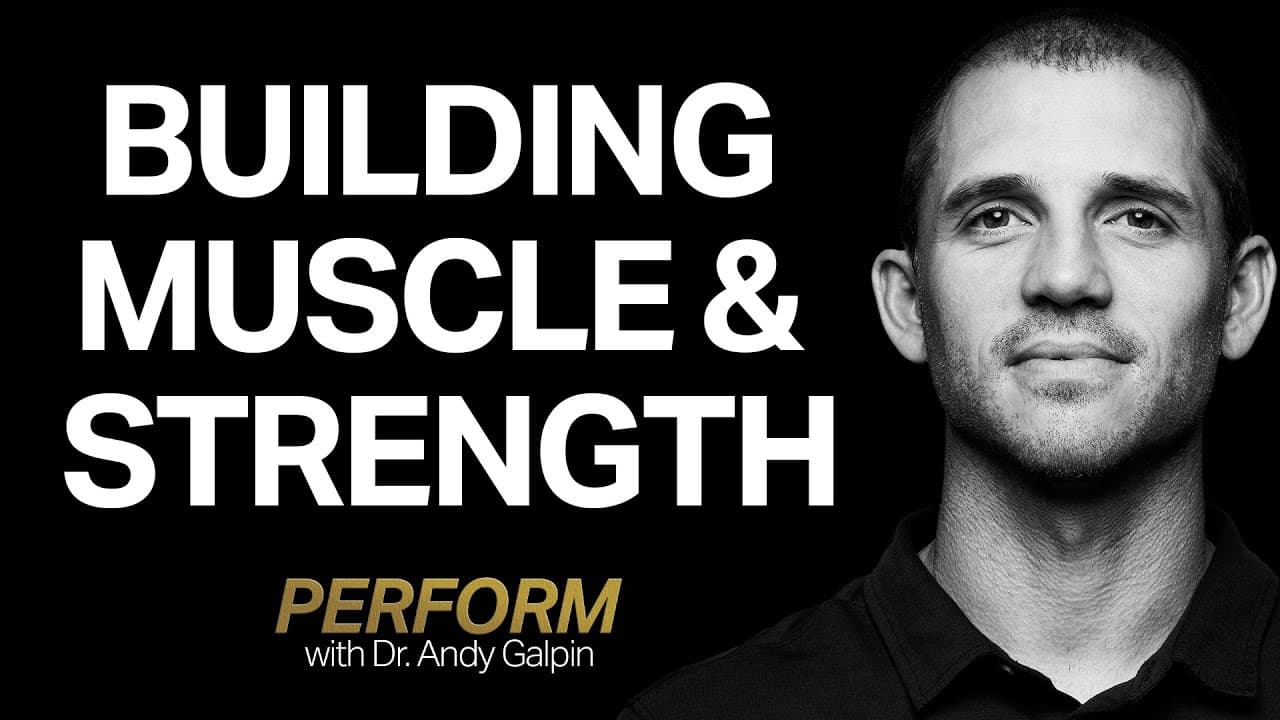
To build muscle strength and power effectively, focus on specific training programs designed for each goal. Use lower repetitions with higher weights for strength, while for hypertrophy, aim for moderate repetitions and higher volume. Implement progressive overload and ensure adequate recovery time tailored to your training type to maximize performance gains.
Transcript
the science and practice of enhancing human performance for sport play and life Welcome to perform Hello friends I'm Dr Andy Galpin I'm a professor of Kinesiology in the center for sport performance at Cal State Fullerton in today's show we're going to jump straight into the application of training for muscle hypertrophy and strength and power in o... Read More
Key Insights
- 💪 Muscle strength focuses on force production, while hypertrophy emphasizes muscle size increases, each requiring different training approaches.
- ✊ Training for muscle power involves velocity and is crucial for athletes in explosive sports, differentiating it from pure strength training.
- 🪡 Effective training programs can be tailored for various needs while maintaining principles like progressive overload for optimal results.
- 😣 Recovery time is essential; different training goals (strength vs. hypertrophy) necessitate varying rest periods to ensure effective adaptations.
- 🏃 Understanding the principles behind exercise selection, order, volume, and intensity helps develop balanced and effective training programs.
- 📶 The importance of integrating both hypertrophy and strength training into an athlete's regimen maximizes overall functional performance.
- 🏃 Variability in training methods, such as using velocity-based training and auto-regulation, can enhance response to exercise for competitive athletes.
- 🎙️ More videos with Andy Galpin:
Install to Summarize YouTube Videos and Get Transcripts
Explore YouTube Video Summarizer or Get YouTube Transcript Extractor
Questions & Answers
Q: What is the difference between muscle strength and muscle hypertrophy?
Muscle strength is defined as force production, typically measured by one repetition maximum (1RM), whereas muscle hypertrophy focuses on increasing muscle size. Although they are interrelated, one can increase in strength without significant hypertrophy and vice versa, which is crucial for athletes to understand when designing training programs.
Q: How can muscle power be defined in relation to strength?
Muscle power is defined as the product of force multiplied by velocity. While strength refers to how much weight you can lift, power indicates how quickly that weight can be moved. Therefore, athletes often favor training for power over strength for improved performance in sports, which typically require rapid movements.
Q: How often should one engage in training for hypertrophy versus strength?
It is generally recommended to train for hypertrophy with a focus on moderate repetition ranges (8-12 reps) and higher volume, while strength training usually involves lower repetitions (3-5 reps) with heavier loads. However, frequency of training per week can remain the same, as both can effectively be done across multiple days.
Q: What role does recovery play in strength and power training?
Recovery is critical in strength and power training as it allows the body to repair and adapt to the stresses of training. Adequate rest intervals of 2-5 minutes between sets are recommended for strength/power to maintain high quality in each repetition. Conversely, for hypertrophy, shorter rest intervals of 30 seconds to 2 minutes can deepen the training stimulus.
Q: What is progressive overload and why is it important?
Progressive overload is a training principle that involves gradually increasing the amount of stress placed on the body during exercise. This can involve adding weight, increasing repetitions, or enhancing workout intensity. It is vital for continuous improvement in strength and hypertrophy, preventing plateaus, and ensuring optimal adaptations.
Q: Can the presented training programs be adapted for non-athletes?
Yes, the training programs are designed with flexibility, making them appropriate for both athletes and non-athletes. Even if the specific protocols may vary in intensity and volume, the fundamental principles such as progressive overload and exercise selection can still be applied to general fitness goals.
Summary & Key Takeaways
-
Dr. Andy Galpin discusses the distinction between training for muscle hypertrophy, strength, and power, emphasizing their unique characteristics and applications.
-
Two detailed training programs for hypertrophy and strength/power are presented, highlighting their structures, methods, and scientific underpinnings to guide trainees effectively.
-
The importance of understanding the principles of progressive overload, exercise specificity, and structural balance across training modalities is underscored for achieving optimal fitness outcomes.
Read in Other Languages (beta)
Share This Summary 📚
Summarize YouTube Videos and Get Video Transcripts with 1-Click
Try YouTube Summary with ChatGPT & Claude or YouTube Transcript Generator
Explore More Summaries from Perform with Dr. Andy Galpin 📚
Summarize YouTube Videos and Get Video Transcripts with 1-Click
Try YouTube Summary with ChatGPT & Claude or YouTube Transcript Generator