Lecture 14: Hinged Dissections
TL;DR
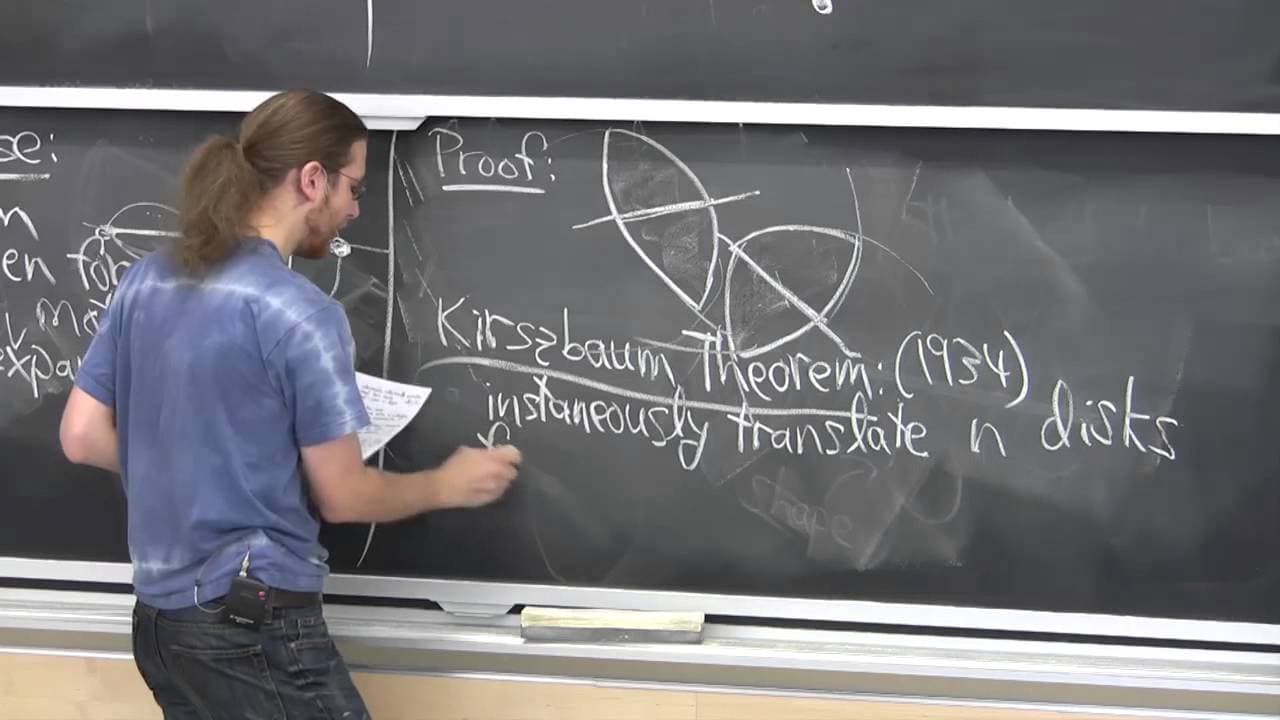
Hinge dissections allow for the transformation of one polygon into another by cutting and rearranging the pieces.
Transcript
PROFESSOR: Today we're going to continue our theme of linkage folding, but we're going to generalize our notion of linkage. And so we want to go beyond folding just one-dimensional structures in two dimensions, which is what we've been talking about the last two classes for the most part. We did a little bit in 3-D. But Carpenter's Rule theorem is ... Read More
Key Insights
- 💇 Hinge dissections involve cutting and rearranging polygons to transform one shape into another.
- 🪭 The Carpenter's Rule theorem enables the folding and unfolding of objects, which is important in hinge dissections.
- 👻 Slender adornments play a crucial role in hinge dissections, as they prevent locking and allow for continuous motion.
Install to Summarize YouTube Videos and Get Transcripts
Explore YouTube Video Summarizer or Get YouTube Transcript Extractor
Questions & Answers
Q: How does the Carpenter's Rule theorem relate to hinge dissections?
The Carpenter's Rule theorem allows for the folding and unfolding of objects, which is a key concept in hinge dissections. It enables the transformation of one shape into another by manipulating the polygon's connections.
Q: What is the significance of slender adornments in hinge dissections?
Slender adornments are important because they prevent locking of polygons. This allows for the continuous folding and unfolding of the polygons, which is necessary for hinge dissections to work effectively.
Q: Is there a limit to the number of polygons that can be used in a hinge dissection?
No, there is no limit to the number of polygons that can be used in a hinge dissection. The technique can be applied to any finite set of polygons as long as they have the same area.
Q: How does one create a hinge dissection from one polygon to another?
To create a hinge dissection from one polygon to another, you can use the concept of rooted subtrees. By cutting and rearranging the pieces, you can reattach them at different vertices to transform one polygon into another while maintaining connectivity.
Summary & Key Takeaways
-
Hinge dissections involve cutting and rearranging polygons to transform one shape into another shape.
-
The Carpenter's Rule theorem is an important concept in hinge dissections, which allows for the folding and unfolding of objects.
-
Slender adornments play a crucial role in hinge dissections, and they prevent locking of polygons.
Read in Other Languages (beta)
Share This Summary 📚
Summarize YouTube Videos and Get Video Transcripts with 1-Click
Try YouTube Summary with ChatGPT & Claude or YouTube Transcript Generator
Explore More Summaries from MIT OpenCourseWare 📚




Summarize YouTube Videos and Get Video Transcripts with 1-Click
Try YouTube Summary with ChatGPT & Claude or YouTube Transcript Generator