What Is Adiabatic Evolution in Quantum Mechanics?
TL;DR
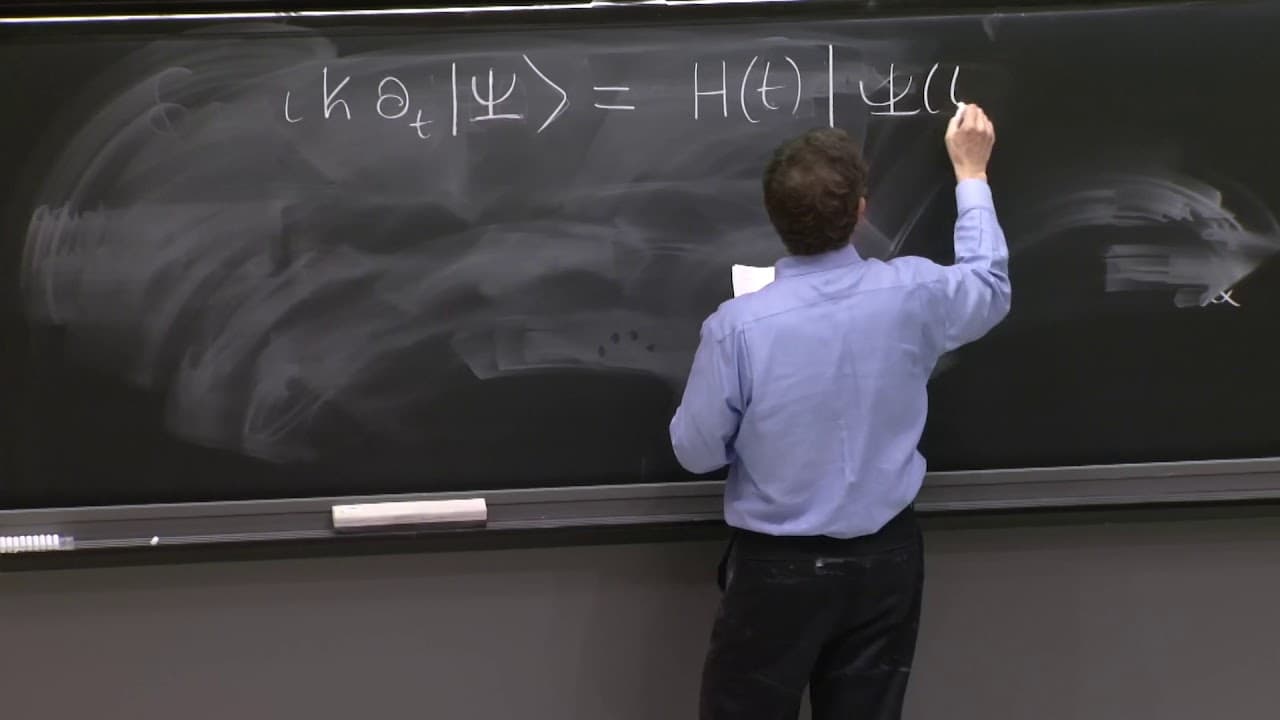
Adiabatic evolution in quantum mechanics allows a system to stay in the same quantum state as it evolves, with an additional Berry phase. Instantaneous eigenstates serve as approximations in this process, and the adiabatic theorem asserts that systems will trace these states closely unless conditions cause transitions. This principle is key in understanding quantum behavior and phenomena like Landau-Zener transitions.
Transcript
PROFESSOR: Let's do adiabatic evolution really now. Evolution. We're going to say lots of things, but the take away message is going to be the following. We're going to get maybe even confused as we do this, but the take away message is the following. You sort of begin in some quantum state, and you're going to remain in that quantum state as it ch... Read More
Key Insights
- 👻 Adiabatic evolution allows a system to stay in the same quantum state as it changes over time, except for additional phases called the Berry phase.
- ❓ Instantaneous eigenstates are used to approximate the behavior of the system in the adiabatic approximation.
- ❓ The adiabatic theorem states that, under certain conditions, the system will closely follow the instantaneous eigenstate, up to a dynamical phase and the Berry phase.
- ❓ The adiabatic approximation is an approximation method used to solve the Schrodinger equation in the context of adiabatic evolution.
- ❓ The concept of adiabatic evolution is significant in understanding the behavior of quantum systems in various conditions.
- ❓ Adiabatic evolution can be used to calculate the likelihood of transitions between different eigenstates, known as Landau-Zener transitions.
Install to Summarize YouTube Videos and Get Transcripts
Explore YouTube Video Summarizer or Get YouTube Transcript Extractor
Questions & Answers
Q: What is the significance of adiabatic evolution in quantum mechanics?
Adiabatic evolution allows a system to remain in the same quantum state as it changes over time. This is important in understanding the behavior of quantum systems under varying conditions.
Q: What are instantaneous eigenstates?
Instantaneous eigenstates are eigenstates at every instant of time. They are used to approximate the behavior of the system in the adiabatic approximation.
Q: What is the adiabatic theorem?
The adiabatic theorem states that, under certain conditions, a quantum system will closely follow the instantaneous eigenstate as it changes over time, up to a dynamical phase and the Berry phase.
Q: How does the adiabatic approximation relate to the adiabatic theorem?
The adiabatic approximation is a method used to solve the Schrodinger equation by using the instantaneous eigenstates. It is a way of approximating the behavior described by the adiabatic theorem.
Summary & Key Takeaways
-
Adiabatic evolution in quantum mechanics involves a system remaining in the same quantum state as it changes over time, with the addition of a phase called the Berry phase.
-
Instantaneous eigenstates, which are eigenstates at every instant of time, are used to approximate the behavior of the system in the adiabatic approximation.
-
The adiabatic theorem states that, under certain conditions, the system will closely follow the instantaneous eigenstate, up to a dynamical phase and the Berry phase.
Read in Other Languages (beta)
Share This Summary 📚
Summarize YouTube Videos and Get Video Transcripts with 1-Click
Try YouTube Summary with ChatGPT & Claude or YouTube Transcript Generator
Explore More Summaries from MIT OpenCourseWare 📚


Summarize YouTube Videos and Get Video Transcripts with 1-Click
Try YouTube Summary with ChatGPT & Claude or YouTube Transcript Generator